
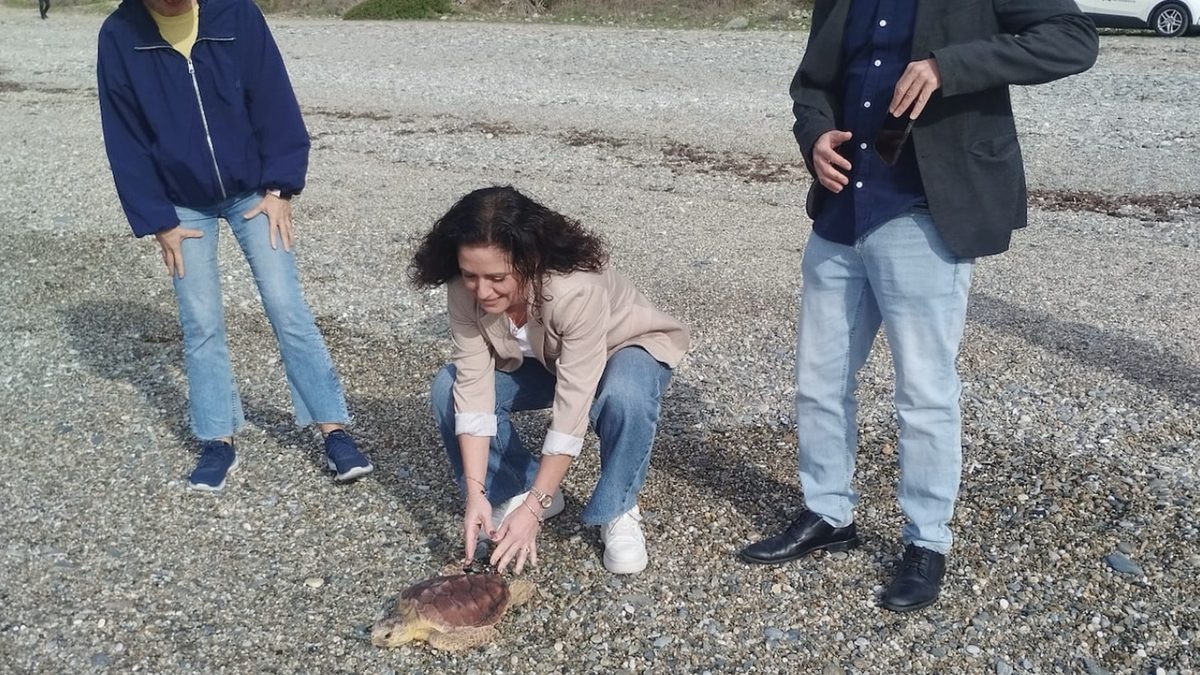
A loggerhead turtle that appeared in September off Nerja struggling to dive has returned to the sea. It was released on November 20 in Cala del Cañuelo, within the Maro-Cerro Gordo Cliffs Natural Area, in Málaga. Before that, it had passed through the Andalusian Sea Management Center (CEGMA) in Algeciras, of the Junta of Andalusia.
The specimen, of the species Caretta caretta, is known as “Rogelio.” This was stated by the Nerja Town Hall, which participated in the release with its councilors for the Environment and for Beaches.
Found from a boat
It was located on September 23 by the occupants of a recreational boat, in waters near Nerja.
According to the City Council, it was in a delicate health condition. It had difficulty diving and showed signs of weakness. It also carried abundant algae and organisms attached to the shell.
Then the rescue protocol was activated. The Seashore team provided initial veterinary care in Málaga, and later personnel from the Andalusian Agency for Environment and Water (AMAYA) took it to Algeciras.
What it had on arrival
When admitted to the CEGMA, “Rogelio” weighed 2.5 kilograms and its carapace measured 22 centimeters. Veterinary examinations detected moderate anemia and dehydration.
It also had buoyancy alterations and a possible mild pulmonary involvement. There was also a superficial lesion on the shell.
Hydration and warm baths
In the following weeks, it received hydration treatment and warm-water baths. It also received care for the superficial shell lesion.
Its evolution was favorable, according to the municipal note, until the turtle regained good health. This made it possible to authorize its return to the natural environment.
The Junta explains, in another note about its 2026 releases, what is checked before discharge. Teams review the health status of each turtle, its physical condition, its behavior, its ability to swim, and the progression of its weight.
It is not an isolated case
The CEGMA in Algeciras is managed by AMAYA, which depends on the Ministry of Sustainability and Environment. There, veterinary evaluation, treatment, and follow-up are carried out on the animals until they can return to the sea.
By August, according to a note dated August 26 from the Junta of Andalusia, the Junta had released 35 loggerhead turtles in 2026. Four came through the strandings program and two were accidentally caught in fishing nets. The other 29 hatched from two nests on the Almería beaches of Mojácar and Roquetas de Mar in 2025.
One of the turtles in that tally, Manuelita, also arrived with a lot of algae and limited mobility. It was found by a private individual on Getares Beach, in Algeciras, with very reduced mobility and algae on the shell, head, and flippers. It returned to the sea on June 5.
Two others, Boychi and Charlie, weighing seven and two kilograms, were found floating in waters near Almuñécar with limited mobility. They were located by two biologists. At the CEGMA, the first step was hydration, and after a month of care they returned to the sea on March 24 from La Herradura beach.
The role of the notifier
This turtle was located by the occupants of a boat. The Nerja councilors emphasized, at the release, the importance of citizen collaboration.
They also highlighted the work of the specialized services in recovering threatened marine fauna, and the environmental value of the Nerja and Maro coastline, where “Rogelio” now swims freely.
What the note does not say
The municipal note does not indicate whether the turtle carries any tagging or transmitter to monitor it at sea. It also does not explain what caused the anemia and weakness with which it arrived.
In another case from that tally, yes. El Guapo, an adult male weighing 43 kilograms caught accidentally in a net and released on April 21, had a satellite transmitter installed to monitor its movements, according to the Junta. Its return coincided with the start of the breeding season.
Image: Nerja Town Hall