
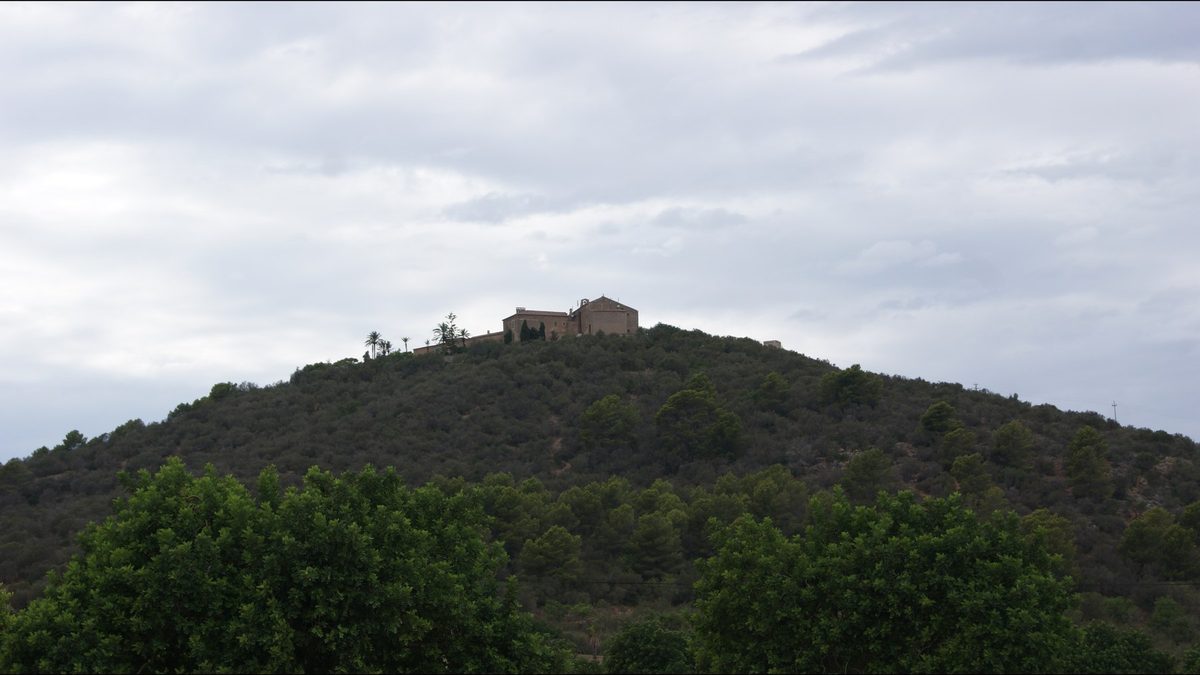
A team from the Mediterranean Institute of Advanced Studies (IMEDEA, CSIC-UIB) has described a new beetle species. For now, it is known only from Mallorca. It is named Attagenus montisionensis, measures about 3.5 millimeters, and owes its name to Monti-sion, a locality in the municipality of Porreres.
The striking thing is where it appeared and where it did not. It showed up in Monti-sion in every sampling campaign (2018, 2023, 2025 and 2026), which suggests a stable population. In the other 19 localities studied, not a single specimen was found, according to the IMEDEA note dated November 25.
It emerged from a pollinators study
The specimens were collected within the WILDFUN, MULTIFUN and FUNLAND projects. Their aim was to study the interactions between plants and pollinating insects at different points across Mallorca.
That work focuses on the communities of wild olive trees (Olea europaea) and is led by IMEDEA researcher Amparo Lázaro. The projects are funded by the Ministry of Science, Innovation and Universities and the State Research Agency.
The study covered 20 locations, with samplings in 2018, 2023, 2025 and 2026. The reference male of the species (the holotype) was collected by Dimitra Kafetsi on May 11, 2023. The other five described specimens, one female and four males, are from 2025 and 2026.
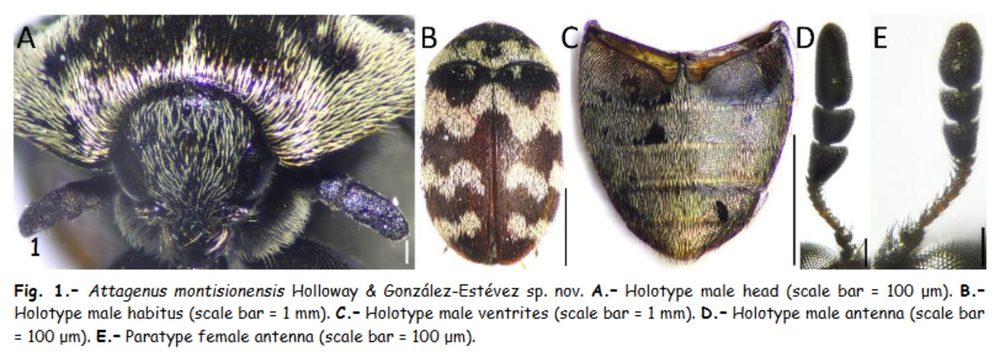
What the new beetle looks like
The described male measures 3.5 millimeters in length and 2 millimeters in width. It would fit loosely on the nail of a pinky finger.
Brown in tone, it features bands of cream- and yellow-colored hairs on the elytra (the hard covers of the wings). The head and the pronotum are dark brown, with yellow and brown hairs.
On the underside, the body is covered with golden-yellow hairs. Its antennae have 11 segments, and the last segment is more developed in males than in females.
Why it is a distinct species
Describing a new species requires more than a casual look. The authors compared external and internal characters, including the genitalia, with other species in the same group to confirm that this one has distinct traits.
They compared it with Attagenus trifasciatus and with two species described this year, A. balearicus (Ibiza) and A. vitalii (south of France). The work is by entomologist Graham Holloway (University of Reading) and Miguel Ángel González-Estévez (IMEDEA) in the journal Arquivos Entomolóxicos.
González-Estévez was the one who detected the species. For him, the finding represents “a recognition of the great effort carried out during all these years of study by the entire team.”
How to study something so small
The article details the laboratory work. The specimens were left for a day in 5% acetic acid to soften them before dissection with two entomological pins under a stereo microscope.
Whole-body photos were taken at 20x, the photos of the antennae and the male genital parts at 100x, and the female’s at 200x. All were processed with a focus-stacking program, which combines images taken at different depths to produce a sharp result.
A brown beetle that was getting misidentified
The article points to something broader than Mallorca. On iNaturalist, many beetles of this group photographed in Spain carry the name Attagenus trifasciatus, and they look brown. But that species is actually dark-colored, according to a recent description cited by the article.
Some of those brown specimens proved to be other species, such as the Ibiza or the French one, and now Monti-sion’s is added to the list. Will there be more waiting for a name? The study does not say.
What remains unknown
It is a dermestid, a family of beetles typically associated with the consumption of dry organic remains, whether animal or vegetal. It is a common trait of the family, and it is not known whether this species shares it, since its ecology has not yet been studied.
The authors note that very little is known about the ecology of most dermestids. They add an intriguing point: Monti-sion was one of the most disturbed sites among those studied.
Therefore, there is still much to learn about this small beetle. For now, we know what it looks like, where it appears, and that it has been found there since, at least, 2018.
Photo: Asurnipal / Wikimedia Commons, CC BY-SA 4.0
