
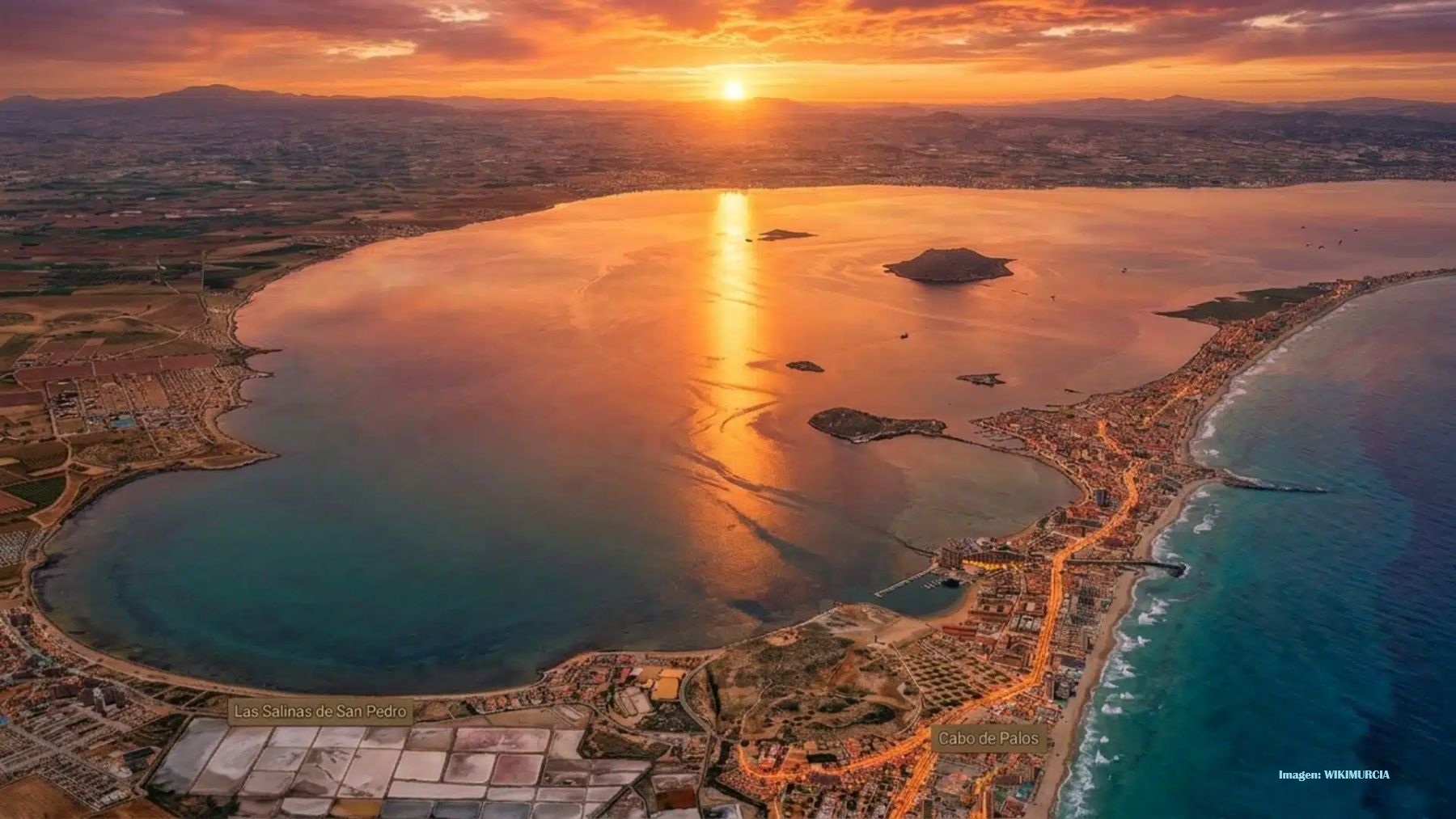
The assessment of the state of the Mar Menor, recently presented by Juan María Vázquez, points to values that are within reference ranges.
After the summer, the government of the Region of Murcia analyzes the state of the Mar Menor and concludes that, although its condition remains fragile, the observed values indicate stability, even though the summer season brought very high temperatures and there was an influx of freshwater from the ravines.
What is the reality of the Mar Menor according to the results obtained? In the article the data on transparency, salinity, oxygen, etc. are provided and it explains how these parameters should be interpreted to monitor the Mar Menor’s state and what pressures continue to affect this ecosystem.
The data provided come from the Canal Mar Menor and pertain to September 22. The measurements (transparency: 3.76 metres, oxygen near 7 mg/l and salinity close to 44 g/l) offer a guide that should be considered over time.
The freshwater input was significant, as it greatly surpassed the figure from one hydrological year to the next (11 cubic hectometers versus 4.9), and does not include contributions from the Quaternary aquifer. The representative of the Murcian government acknowledged that, while the state of the Mar Menor shows signs of ‘relative stability’, its fragility is undeniable.
What is the state of the Mar Menor?
The Mar Menor has this summer managed to maintain a balance in its values despite temperatures, especially at night, being higher than usual and despite the freshwater input having multiplied and, in this hydrological year, being more than double the previous one.
This is the balance of the state of the Mar Menor that was presented in a press conference this Wednesday by the Minister of Environment, Industry, Universities, Research and the Mar Menor, Juan María Vázquez, who noted that all the parameters monitored in the salty lagoon (transparency, turbidity, oxygen, temperature, chlorophyll and salinity) have surpassed the summer “within their ranges, with no spikes of misalignment.”
Thus, according to the data collected in the Canal Mar Menor as of September 22, salinity was around 44 grams per liter (normal values range from 42 to 47), while oxygen stayed near 7 milligrams per liter (5 mg/L is considered a proper value).
Data within the reference parameters
Transparency stood at 3.76 meters (the expected minimum is not to fall below 3 meters), turbidity was 1.33 FTU (the normal value is below 2), chlorophyll was 0.49 milligrams per cubic meter (slightly below what was expected) and the average temperature was 25.78 degrees (typical for the season).
In summary, the minister highlighted, the Mar Menor has exceeded the months of June to September “with values within normality”, despite this summer in the area registering higher-than-usual temperatures, especially on August nights, which prevented the water from cooling at night.
Moreover, the freshwater input has doubled this hydrological year compared to the previous one, rising from 4.9 to 11 cubic hectometers, taking into account only the ramblas contributions, since the inputs from the Quaternary aquifer are not quantified, with a very high groundwater table, according to Vázquez.
The balance of the state of the Mar Menor after the summer, therefore, has been one of “relative stability within the fragility” of this ecosystem, he stated.