
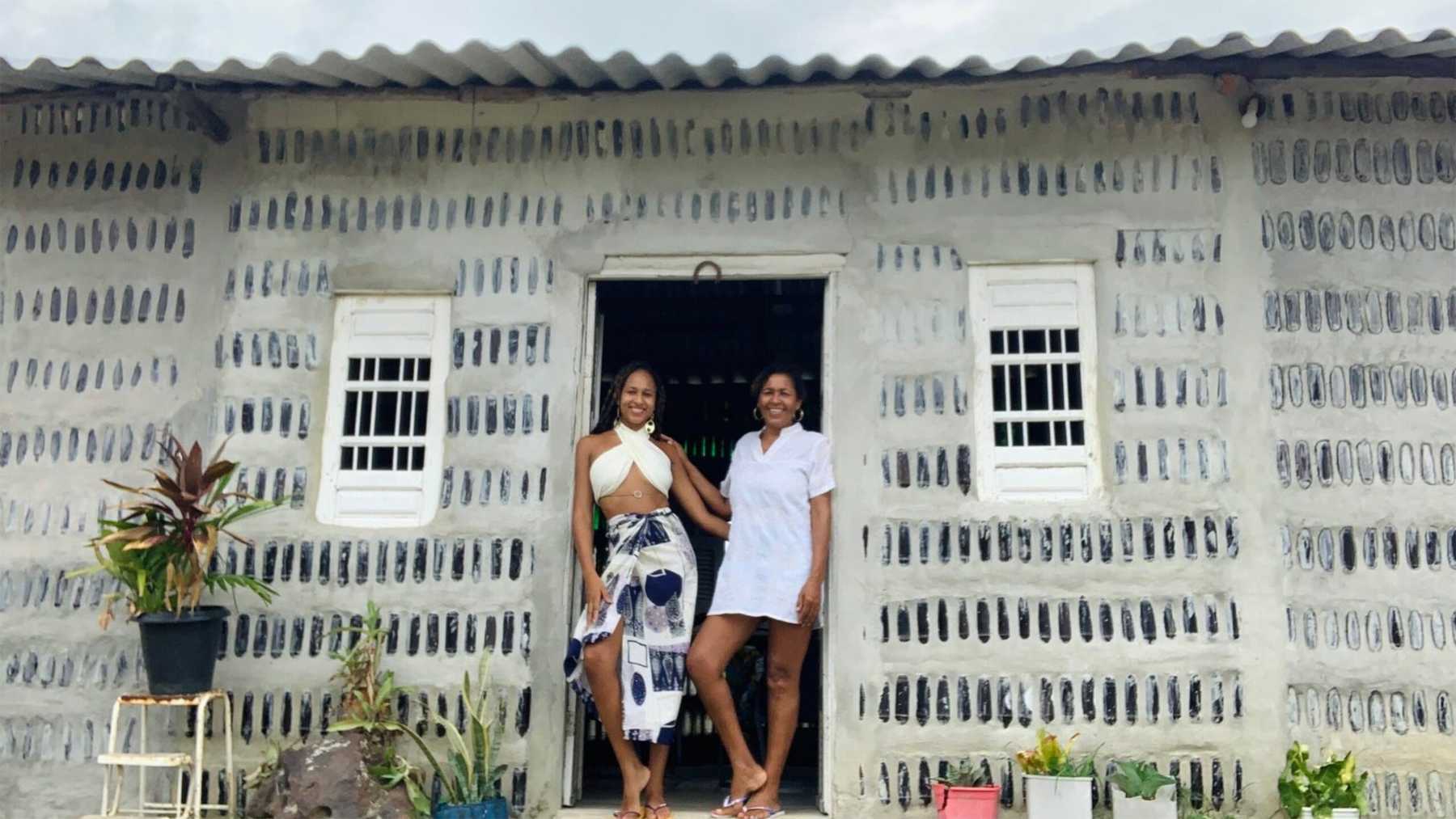
The bottles that had piled up like trash on a Brazilian island ended up forming the walls of a dwelling. Edna Dantas and her daughter, Maria Gabrielly Dantas, built the House of Salt with about 8000 bottles recovered in Itamaracá, in the state of Pernambuco. The result was a seven-room home that has also become a space for sharing environmental knowledge.
The story brings together two very concrete needs, having one’s own house and finding a way to address abandoned waste. The project, located at Praia do Sossego, has grown to include activities with the community. Its website reports more than 13,000 bottles collected between construction and other initiatives.
An idea born from necessity
During the pandemic, the owner of the dwelling where they lived asked them to return it, as Edna told Metrópoles. They already had a plot of land and decided to make use of the materials they found nearby to build their own home.
They were not starting from scratch in dealing with waste. Edna had participated in recycling cooperatives and her daughter contributed her training in fashion design. That blend of hands-on experience and creativity helped turn an urgent need into a project of their own.
How long the construction took
Work began on May 1, 2020, according to an interview with Gabrielly published by Correio Braziliense in April 2025. The same report notes that the seven spaces were completed in two years. That timeframe differs from the five years that appear in some versions of the story.
It is also worth clarifying what the announced size means. The original information uses the Portuguese word “cômodos,” which refers to the different rooms or areas of a house. Therefore, talking about seven bedrooms would give a misleading image of the house.
From trash to walls
The collection led mother and daughter through beaches, mangroves, and plots where waste had accumulated. They then cleaned the bottles before incorporating them into the construction. As they explained to UOL in 2021, the bottles used up to that point came from within a 500-meter radius around the house.
And how were they integrated into the walls? They placed them vertically, a decision Gabrielly links to the entry of light and the look of the interior spaces. The bottles kept their shape and assumed a function different from the one for which they had been manufactured.
Much more than glass
The recovery of materials also extended to wood. In an interview with Marie Claire, reproduced by the university project RE-HABITARE, it explains that the structure was built with reused wood. To select it they drew on knowledge inherited from Gabrielly’s grandfather, who was a carpenter.
The interior partitions incorporated pallet wood, and the project used tiles made from toothpaste tubes, according to the UOL report. There was also help from friends to raise the roof. Behind the glass walls there were many hours of work and collaboration.
A house that is shared
“It is the greatest achievement of my life,” Edna expressed in her interview with Metrópoles. In that same account she explained that the house welcomed visitors and served as a space to discuss sustainability and the environmental issues of the territory. The dwelling had also acquired an educational function.
That evolution appears in the official presentation of Cabrochas, the sustainable fashion initiative of both women. There, they describe how the private residence gave way to a collective that organizes cultural activities and environmental actions with the local community.
The figure of more than 13,000 bottles collected corresponds to that broader work. It should not be confused with the approximately 8000 used in the residence. Distinguishing these two data points helps understand how the project continued to grow beyond its walls.
Also of interest to the university
The House of Salt has reached the academic sphere. The portal of the Federal University of Pernambuco hosts a master’s research by Andi Pinheiro de Almeida on the relationships between the house, its territory, and its presence on digital platforms.
The abstract describes 13 months of fieldwork, two in-depth interviews, and the analysis of 138 images published on Instagram. Its approach allows observing how a domestic experience communicates and connects with other people. The focus centers on that social and cultural dimension.
The university announced the defense for August 21, 2026. The fiche and the abstract of the research were published on August 3 on the official portal of the Federal University of Pernambuco.
Imagen: Cabrochas