
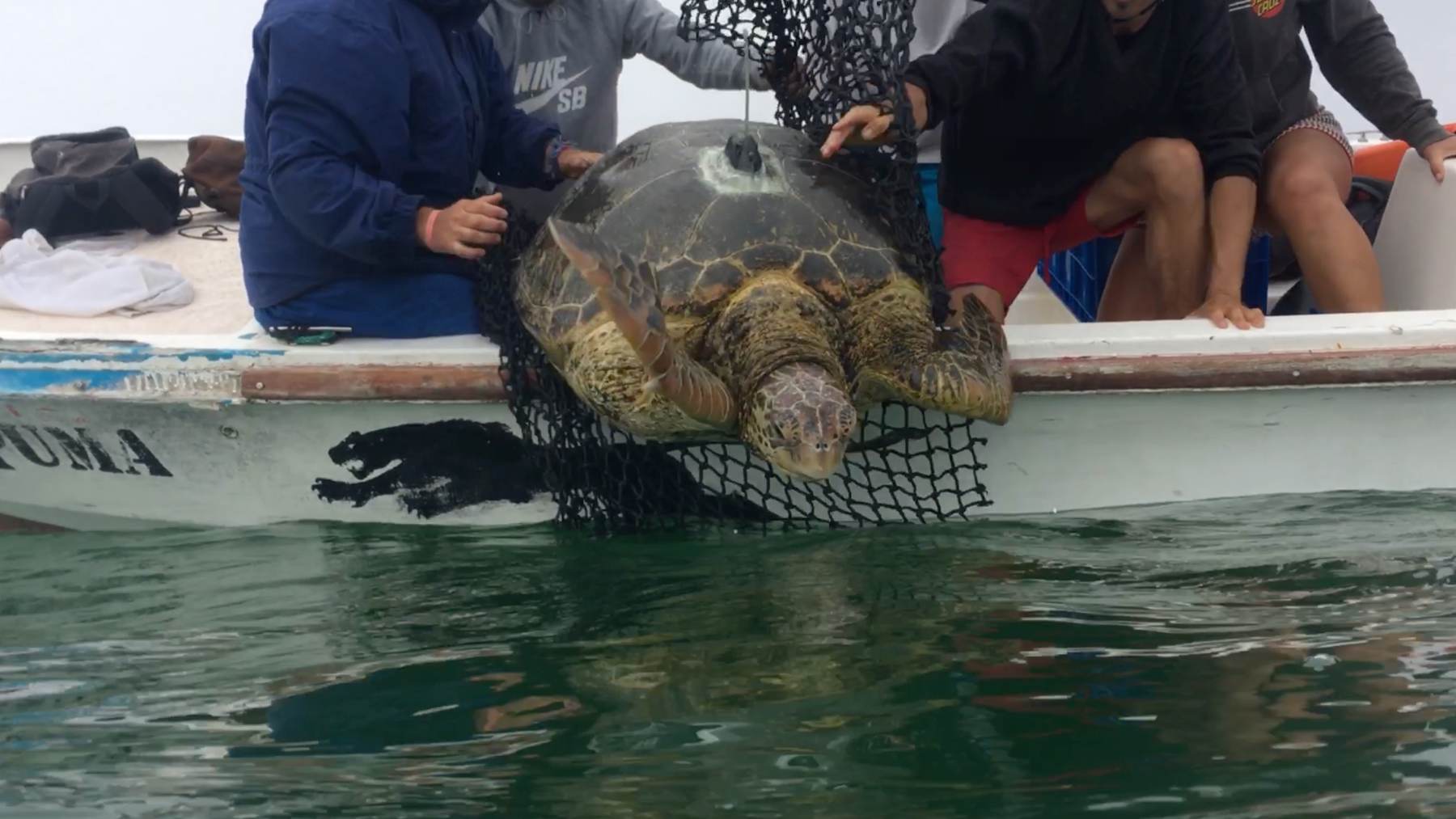
Between August 2015 and November 2018, a team of biologists waded into the shallow waters of four Galápagos Islands to manually retrieve nine yellow-green sea turtles, fitted a transmitter to their shells, and released them back into the sea. One of them transmitted signals for 418 days, and none wandered beyond the archipelago.
The result took even the researchers by surprise, who had expected to see some of these animals crossing the Pacific. What the satellites recorded was a fairly sedentary life, hugging the coastline and, at most, distributed among two or three islands.
Two distinct green turtles share the same waters
The green sea turtle (Chelonia mydas) exhibits two forms in the Pacific, differing in color and genetics. The black form is native to the eastern Pacific, while the yellow form has been linked to populations in the western Indo-Pacific.
Galápagos is the only known place where the two coexist and feed on the same algae. Yet the young yellow individuals grow faster than the black ones, and no one yet knows why.
Much was known about the blacks because prior studies had tracked females after laying eggs and some wandered to Central America or out to sea. Little was known about the yellows, and even less about the males, which are far harder to capture than nesting females.
Seven males and two females with transmitters
The study is authored by Juan Pablo Muñoz-Pérez, from the Universidad San Francisco de Quito and the University of the Sunshine Coast, and John W. Rowe, professor at Alma College (United States) and corresponding author, together with researchers from the Galápagos Science Center, Costa Rica, Mexico, Singapore, and the Turtle Island Restoration Network.
They captured seven adult males and two adult females from Española, Floreana, Isabela and San Cristóbal. Each transmitter sent its position to the Argos satellite system, which estimates location with an error margin ranging from roughly 250 meters to more than 1,500 meters.
The turtles were given names such as Leandro, Cristian, Roberto, Ainoa, Bernardo, or Sara. The tracking lasted between 45 and 418 days, with an average of 280.8 days.
No yellow-green sea turtle strayed from Galápagos
“We expected them to migrate to distant beaches in the western Pacific to reproduce, but, curiously, none of our satellite-tagged turtles even left the Galápagos Marine Reserve during the three years of our study,” Rowe explained in statements collected by SciTechDaily in 2026.
Five of the nine stayed for most of the time near a single island, close to where they were captured. Cristian, Roberto, Mike, John, and Jason2 sent 100% of their signals from their island of capture.
The other four did travel between islands. Bernardo and Sara moved between Isabela and San Cristóbal, and Leandro shifted between Isabela and Española. Ainoa, tagged on the southeast coast of San Cristóbal, later moved to the west of Santa Cruz and ended up in the west of Isabela—the longest distance traveled in the entire study.
According to the study, the inter-island movements occurred from April to October, a period that in Galápagos coincides mainly with the cool season. The authors suggest temperature changes in the sea and shifts in prey availability could be behind these movements, though they call for longer monitoring to verify it.
Home ranges vary widely between individuals
The home range is the area where 95% of an animal’s locations are found. For these turtles it varied greatly, from 23.9 km² for Mike to 27,316 km² for Ainoa.
The study reports an average group value of 1,497.9 km², a figure that matches Cristian’s, placing four turtles below and four above. Ainoa’s enormous range makes the arithmetic mean in the study’s table almost threefold. These are large areas when compared with most green turtle populations worldwide, which typically stay under 85 km².
Females will probably leave someday
This finding does not mean that yellow-green turtles never cross the ocean. It is not known whether males or females of this form reproduce in Galápagos, and their natal beaches remain unidentified.
“Since it’s not known that yellow-green female green turtles nest on Galápagos beaches, we believe they will end up leaving the area to return to their natal beaches in the western Pacific,” Muñoz-Pérez said, as quoted by Discover Wildlife.
The researcher compared them with the black turtles. “Some female black-green turtles do nest in Galápagos: depending on the individual, they may spend the whole year in the archipelago, travel to nearby oceanic islands, or even to foraging areas off Central America and South America,” he added.
What the tracking cannot prove
The authors themselves urge caution. The sample is small—nine animals—and some of the males, between 82.5 and 92.5 centimeters in carapace length, may not yet have reached reproductive maturity, as this species typically matures above 90 centimeters.
The tracking also was not long enough to cover a full reproductive cycle if these turtles breed every several years. “Our results should not be taken as proof that these turtles do not undertake transoceanic reproductive migrations,” they write.
The Argos precision also weighs in. The authors acknowledge that low-quality positions can inflate home-range estimates, and in John’s case they had to discard his central area because the calculation placed it entirely on land.
Protecting the coasts of all the islands
The practical takeaway affects reserve management, created in 1998 and which, together with the Hermandad Marine Reserve, covers nearly 200,000 km² of protected area. A turtle that seems tied to one island might later rely on the coast of another and the open sea that links them.
“Because each turtle may depend on the waters of several islands, the quality of feeding habitat must be maintained intact across all of them and not allowed to degrade anywhere,” Rowe summed up.
The study also provides one of the first descriptions of the movements of adult-sized males of this form, a group poorly represented in satellite-tracking studies, though there are already projects using satellite transmitters on male sea turtles in other seas. And it underscores the role of these herbivores along the coast, akin to the role sea turtles play against invasive algae in Hawaii.
The full study has been published in Frontiers in Amphibian and Reptile Science.
The next questions involve using higher-resolution GPS tags and tracking the animals for several years, including El Niño and La Niña episodes, to understand when and where the yellows migrate.
Photo: Juan Pablo Muñoz-Pérez
