On a slope of La Quebrada El Lápiz, on Chile’s Robinson Crusoe Island, a tree about 150 years old is tied with ropes to prevent it from plunging off the cliff. It is the last known wild specimen of Dendroseris neriifolia, a species that exists only on that Pacific island.
From its seeds eight seedlings have germinated at the Millennium Seed Bank of the Royal Botanic Gardens, Kew, at Wakehurst (England), and two of them arrived in September at Logan Botanic Garden in southwestern Scotland.
“It’s a race against time,” summarizes Diego Penneckamp, a scientist at VerdeNativo Botanical Garden and author of Flora Vascular Silvestre del Archipiélago Juan Fernández. “This international collaboration to support the last remaining individual could prevent the extinction of a species that represents a unique lineage with its own natural history,” he adds in Kew’s press release.
A Relative of Daisies Hanging from a Cliff
In Chile it is called colecillo or Juan Fernández col. According to the classification sheet from the Chilean Ministry of Environment, it is a shrub or small tree with extensive branching, up to 4 meters tall, with a trunk that can reach 30 centimeters in diameter and a corky bark.
It belongs to the daisy family, the same as the daisies, which is why it is described as a “tree daisy.” Its leathery leaves, about 15 centimeters long, cluster at the tips of the branches, and its flowers are white. The name neriifolia alludes to the resemblance of those leaves to those of the oleander.
Getting to the tree is already a challenge. The cliff “is extremely difficult to access and requires specialized fieldwork and careful planning to avoid causing any damage,” Paulina Hechenleitner, associate researcher at the Royal Botanic Garden Edinburgh and scientific lead of VerdeNativo, explained to Mongabay via email.
Harvesting is done every March, when the fruits mature, each containing a single seed. The collectors climb along the trunk to the flowering branches and catch the seeds in nets. This year they collected about 400 seeds on the Robinson Crusoe cliff, according to Kew.
From Eight Wild Trees in 1980 to a Single One
The species used to grow in the island’s ravines and lower-lying areas, but by 1980 only eight wild specimens remained. In the 1990s it was identified as a conservation priority, and park rangers from CONAF (National Forestry Corporation) stepped up recovery work.
There were reintroductions in the early 2000s, but in 2017 protection measures failed and invasive species moved into the area, according to Kew. Today there is only one tree in the wild, representing an 87.5% loss of the wild specimens that existed in 1980.
Conservation efforts off the island also failed. A collection established at Chile’s National Botanical Garden collapsed due to climatic conditions, and plants grown in gardens suffer from hybridization, so their seeds are not usable. Additionally, 90% of the seeds are not viable due to geographic isolation, according to the statement. VerdeNativo preserves a young plant.
The Chilean entry lists the threats on the island: rats, rabbits, goats, and cows that eat the plant, erosion affecting 75% of Robinson Crusoe’s surface, and invasive plants that compete with native species, such as maqui and murtilla. Rabbits introduced to remote islands are a problem that recurs across many archipelagos.
Twenty-Nine Seeds at Wakehurst and Eight Seedlings
From those 400 seeds, 29 arrived this spring at the Millennium Seed Bank in Wakehurst, Sussex. X-ray analysis indicated that 25 were potentially viable, though Mongabay reported that 24 showed a developing embryo.
Those 24 seeds were divided into three groups of eight, as Alice Hudson, Millennium Seed Bank’s partnerships technician, told Mongabay. “We tested the first group of eight to germinate, to see if we had the conditions right,” Hudson explained. “Now that we know the method works, we plan to germinate another eight seeds. The last eight will be stored at the Millennium Seed Bank for long-term conservation.”
Sarah Gattiker, head of seed processing at Kew, and horticultural botanist Alice Livingstone detailed the method. “We decided to sow the seeds directly into substrate in Wakehurst’s greenhouses,” they explained, after receiving horticultural guidance from Felipe Sáez Quintana and Gonzalo Rojas Sea of CONAF.
According to the two specialists, this reduced the risk of the seedlings being exposed to “too much humidity on the laboratory agar plates,” and they handled them as little as possible. “Thanks to this collaborative effort, the eight seedlings have germinated,” they added.
Seeds not used for propagation will go into long-term storage, as a backup in case the species disappears in the wild or during cultivation, the same logic followed by other seed banks that preserve threatened flora at -20 ºC.
Two Seedlings Travel to Logan’s Mild Climate
Kew had planned to send three seedlings to Logan, which depends on the Royal Botanic Garden Edinburgh. In the end, two of them traveled more than 480 kilometers north and arrived in mid-September at this garden in Dumfries and Galloway, while the remaining seedlings remain at Kew Gardens and Wakehurst, PA reported.
Logan’s mild climate allows outdoor cultivation of Southern Hemisphere plants, especially from Australia, South America, and southern Africa. The garden already houses Chilean species and other Juan Fernández plants, such as the palm Juania australis, which is very difficult to grow outside its native habitat.
“The experience has shown that Juan Fernández island species feel especially at home here in Logan, in Scotland’s far southwest, bathed by the mild air of the Gulf Stream,” said its curator, Richard Baines, noting that they have “more than 40 years” of strengthening partnerships with scientists and horticulturists from Chile.
After the seedlings arrived, Baines spoke of “a significant moment for everyone involved.” “This is the beginning of an exciting new period,” he told PA. “Creating a safe place for these seedlings, getting to know them, and learning more about their adaptation to different environments gives us the opportunity to contribute much more.”
An Archipelago with the Highest Density of Endemic Plants
The 11 species of the genus Dendroseris exist only on the Juan Fernández archipelago, and Kew describes them as the only known plants shaped like a “tree daisy,” with daisy-like flowers atop a woody, branched trunk.
“The Juan Fernández archipelago has the highest density of endemic plant species per square kilometer in the world, but it is also among the most vulnerable,” said Felipe Sáez, a plant biotechnologist and administrator of the Juan Fernández Archipelago National Park. According to Sáez, the proportion of threatened species listed by the IUCN “has risen from 45% to 88% in the last 30 years.”
“Within the genus Dendroseris, six species are currently classified as Endangered, four as Critically Endangered, and one Extinct in the Wild,” he added. Alongside D. neriifolia, teams have sent seeds of two other island species, D. litoralis and D. pruinata, which will undergo trials at Logan and Wakehurst.
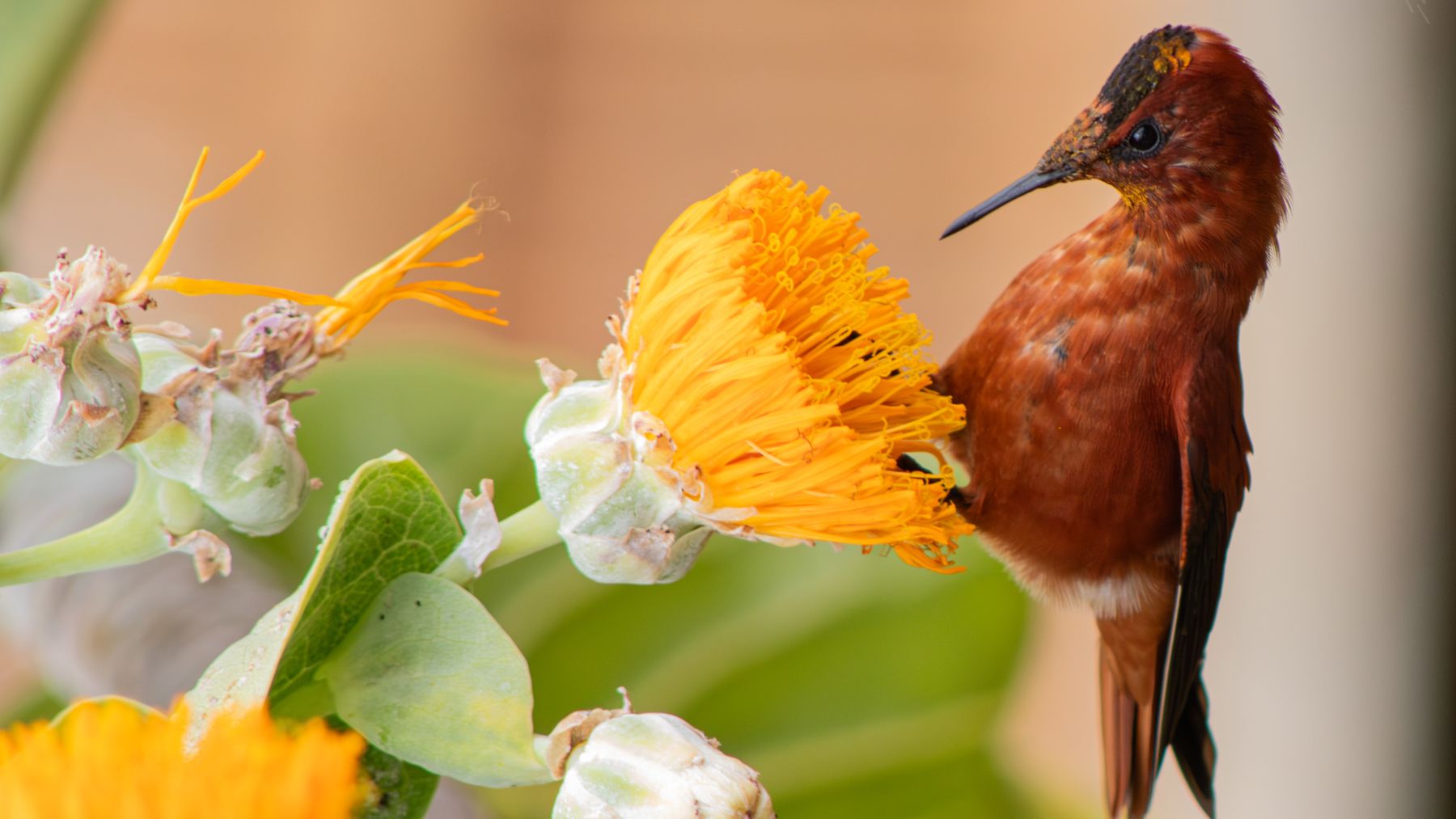
Losing this genus would also affect other species. The Juan Fernández hummingbird, a critically endangered hummingbird, feeds on the nectar of Dendroseris flowers. “This genus exists only on the Juan Fernández Islands; if it disappears, an entire group of species with unique diversity would vanish,” warned Hudson.
Eight Seedlings Are Still Not Enough to Save the Species
Germinating the seeds is only the first step. The seedlings must survive, reach adulthood, and produce their own seeds, and none of that is guaranteed with so few specimens, all born from seeds from a single tree.
“Increasing seed production is key to strengthening seed bank collections and generating material that can, over time, be repatriated to Chile to restore habitat,” Hechenleitner told Mongabay. The ultimate goal is to recover wild populations, but that “will require long-term investment in habitat restoration, invasive species control, monitoring, and carefully planned reintroductions,” she noted.
Restoring a habitat takes years, as the case of a Brazilian family planting a million native Atlantic Forest trees in two decades demonstrates. CONAF’s harvesters aim to send another batch of seeds to the United Kingdom next year, and the project is funded by the Mohamed bin Zayed Species Conservation Fund.
Kew’s full press release was published on May 29, 2026, and the arrival of the seedlings in Logan was reported by PA on September 17, 2026.
Image: Rolando Recabarren / RBG Kew