
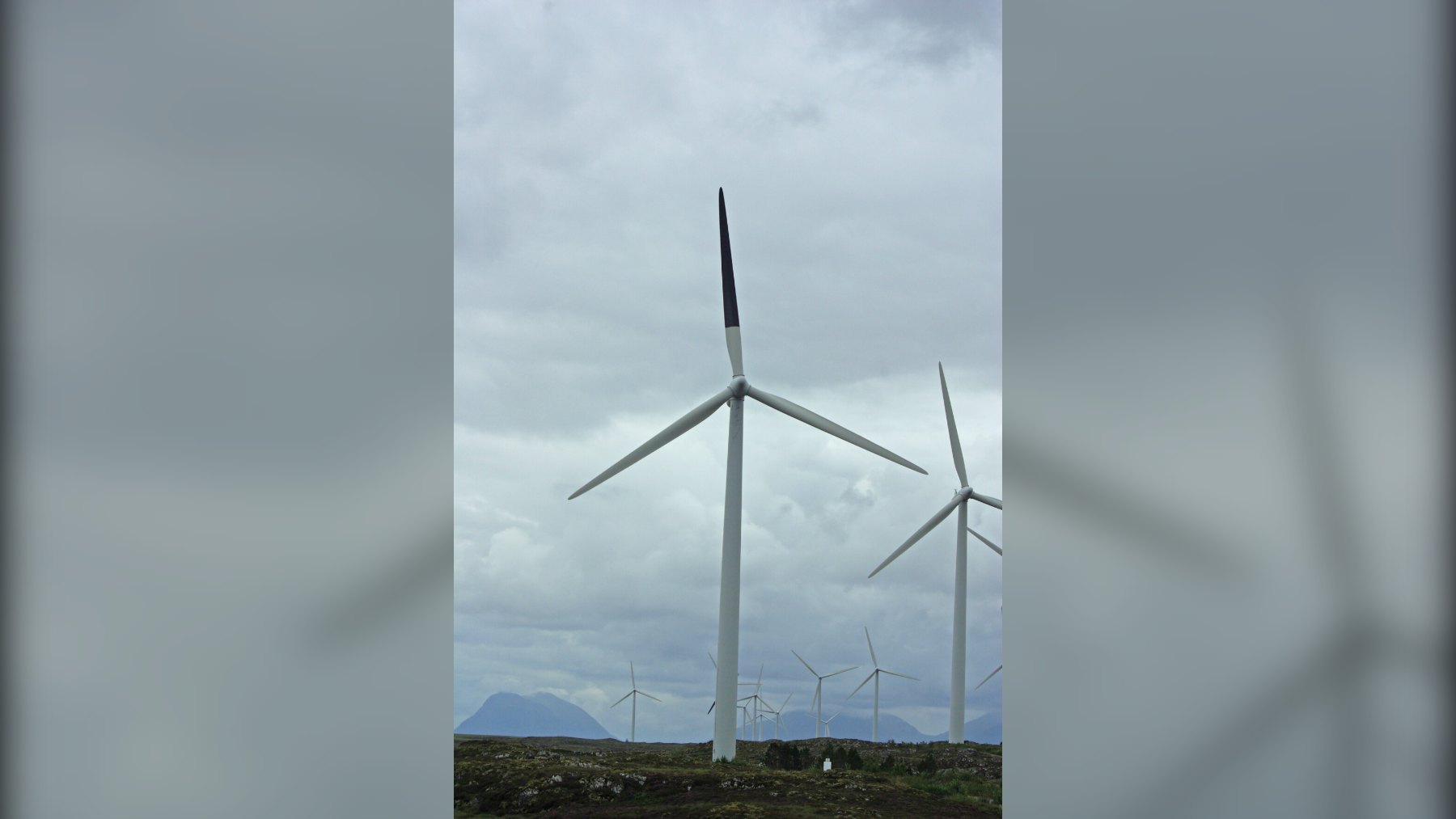
Painting a single blade of a wind turbine black may seem like a small change. Yet, an experiment on the Norwegian island of Smøla recorded a 71.9% reduction in the annual bird-mortality rate compared with the control turbines. The result opened a path toward reconciling wind energy with wildlife protection.
But there is a nuance that changes the story. The study was published in 2020, and subsequent tests have not always yielded the same result, as shown by a trial in the Netherlands. Painting remains a promising option, although its effectiveness depends on questions that are still being investigated.
Four Turbines Under Scrutiny
In August 2013, the researchers painted one of the three blades of four turbines at the Smøla wind park, operated by Statkraft. Four nearby turbines retained their usual appearance and served as controls.
The team, led by Roel May of the Norwegian Institute for Nature Research (NINA), gathered seven and a half years of data before the intervention and three and a half years after. The searches included dogs trained to locate bird remains, a task less glamorous than painting a blade but essential to determine what happened.
What Happened to the Eagles
In the modified turbines, the counted bird carcasses fell from 11 before painting to six after. In the controls, they rose from seven to 18, excluding the common rock ptarmigan, associated with collisions with the towers. The 71.9% comes from the comparative analysis, which accounted for search effort.
European buzzards, also known as white-tailed eagles, deserve a clarification. In the four painted turbines six individuals were found dead before and none after, but there were no dead eagles found in the control turbines during the post-period either. The figures of seven and 18 refer to the total birds analyzed.
The monitoring later offered another favorable signal. A NINA report published in January 2024 did not record dead eagles in the four painted turbines during 2020–2023, while 23 were found across the entire park. It is encouraging, though it does not prove that the risk has disappeared.
A Blade More Visible
The proposed explanation relates to the way birds perceive motion. It is similar to what happens when we look at a running fan and have trouble distinguishing its blades. A black blade breaks the rotor’s uniformity and could help the animal detect the obstacle.
That was the Norwegian trial’s hypothesis, which measured mortality and did not directly show how birds perceive the blades. The authors themselves urged caution because they worked with only four turbine pairs. “We must be careful about what we infer from the experiment,” they wrote.
The Netherlands Did Not Repeat the Result
In Eemshaven, another team studied 14 turbines, seven of which had a black blade. The April 2025 report covered three years of monitoring and 436 birds considered collision victims. It found no statistically significant reduction, neither for the overall species nor for the groups analyzed separately.
Why did the result change? Researchers suggest that the background visual of the surroundings could reduce contrast and that blur matters less for large rotors that spin more slowly. These are plausible explanations, not proven causes, and they reinforce the need to test each design under different conditions.
Implementation Also Carries Costs
The idea may seem simple from the ground, but carrying it out on an already installed turbine requires resources. The Norwegian study warned about the difficulties of painting blades in their installed position and noted that doing so before building the park would reduce costs.
Moreover, RWE explains that the Dutch trial monitored potential temperature increases on black blades and evaluated technical, landscape, and aerial-safety aspects. Therefore, presenting the measure as a simple paint job leaves out part of the work. Making a turbine more visible also requires checking how the machine responds.
Now Red Stripes Are Being Tested
The most recent research adds another variant. A study released in May 2026 examined four Hopefield turbines in South Africa, with two red stripes on a single blade. Its authors estimated an 83% reduction in mortality relative to controls, though with wide margins of uncertainty.
The result is preliminary and was published without peer review. Moreover, it concerns red stripes and a different environment, so it does not confirm that a completely black blade works at any park. What it does provide is a reason to keep comparing colors, patterns, and species.
Taken together, these works suggest that improving visibility could help, but we still need to know which design works best in each place. The most recent study cited, on red stripes in South Africa, was published on May 7, 2026 as a preprint in bioRxiv.
Imagen: May et al. / Ecology and Evolution