
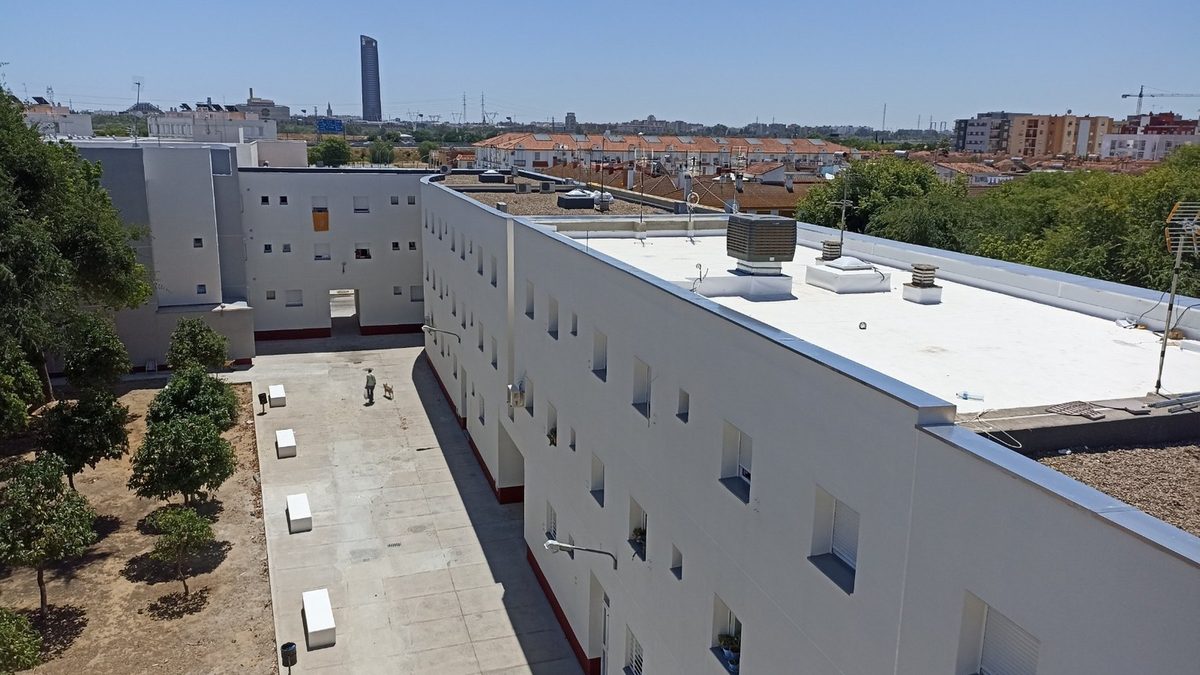
A roof that keeps the cool of the night has kept Andalusian social housing under 29 degrees during the 2025 heat waves, without air conditioning. Without the work, according to the university, the interior would have reached between 33 and almost 35 degrees. The system is from the Termotecnia Group of the University of Seville, its operation costs less than 1.20 euros a day, and it has just received the Innovation Award from the National Association of Energy Efficiency Companies (A3E).
Rafael Monge Palma, a researcher with the group at the Escuela Técnica Superior de Ingeniería, collected the award in Santiago de Compostela. In his acceptance speech, he argued that research should have a practical, concrete, and measurable application. “The university is only a true university when its solutions reach the citizenry,” he stated, according to the university’s note of November 26.
A roof that stores cold
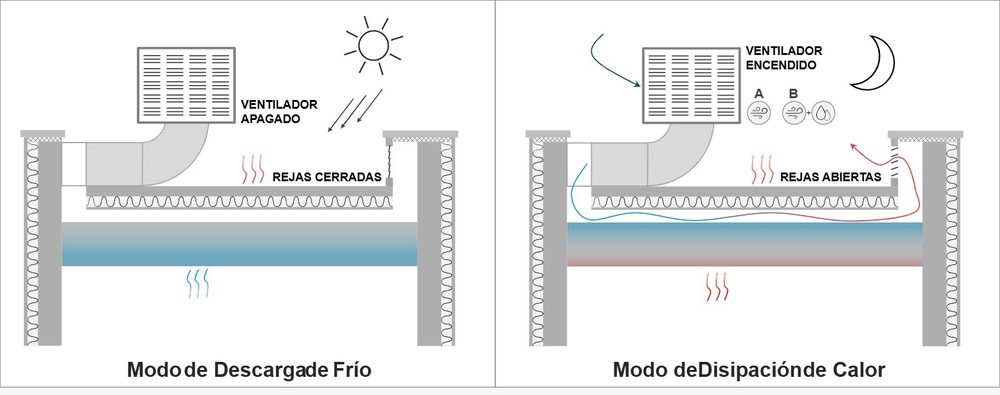
The solution is a double-skin roof installed on top of the existing rooftop. According to the group’s scheme, a chamber is left between the slab and the new layer through which street air circulates. In this way the slab acts as a thermal battery that stores cold.
At night, the ventilation removes the heat accumulated during the day using the outside air. The cold remaining in the slab then helps keep the dwelling cool during the day. A predictive algorithm anticipates environmental conditions and controls ventilation and cooling.
During heat waves, a fan with an evaporative cooling system comes into play, cooling the air that enters the roof. It works on the same principle as a botijo cooling water. As the water evaporates, it absorbs heat from the passing air.
What the data show
The system has been installed in more than 20 social housing units run by the Andalucía Housing and Rehabilitation Agency (AVRA) in Camas (Seville) and in Mengíbar (Jaén). In Mengíbar, the roofs of an entire district were treated, involving more than 150 houses, according to the university.
During the 2025 summer heat waves, interior temperatures stayed below 29 degrees. The note compares this with the 33 to almost 35 degrees that would have been reached without the intervention. Thermal comfort remained at 96.6% of the summer time without air conditioning, according to the university.
The field trial was published in the Energy and Buildings journal in October 2026. It is signed by Monge Palma and seven other researchers. The work is framed within the European COSMIC project.
Less than the price of a coffee with milk
The team emphasizes operating costs, which are under 1.20 euros per day. It is “less than what a coffee with milk costs,” the researchers note in the press release. That is why they present it as a straightforward weapon against energy poverty.
The note recalls that most Spanish buildings built before the first European directive on building energy efficiency suffer from the same problem. They heat up in summer and cool down in winter. The system, it adds, also promotes thermal well-being in the cold months.
Heat inside the home is a problem that is becoming more common with climate change, the university notes.
What residents said
For Monge Palma, the best indicator of success was not the figures. It was the residents’ testimony, as he related in his speech. They thanked the team for being able to rest normally during the summer.
The researcher also highlighted the social dimension of the project. He described it as an innovation designed to give dignity to those living in these homes and to ensure them an affordable and comfortable dwelling.
Easy installation, open questions
The university describes the system as plug and play, installed on the existing surface without complex construction work. It is suitable for any flat-roofed building, including commercial premises, and allows the design to be replicated on façades.
Open questions remain. The note does not say how much installation costs, how long it takes to amortize, or whether it works for pitched roofs. It also does not specify which homes, in Camas or Mengíbar, were measured.
It also does not specify whether 29 degrees represents the maximum for all houses or a representative value, something that would be in the study. The statements have been published on the University of Seville’s website.
Image: University of Seville
