
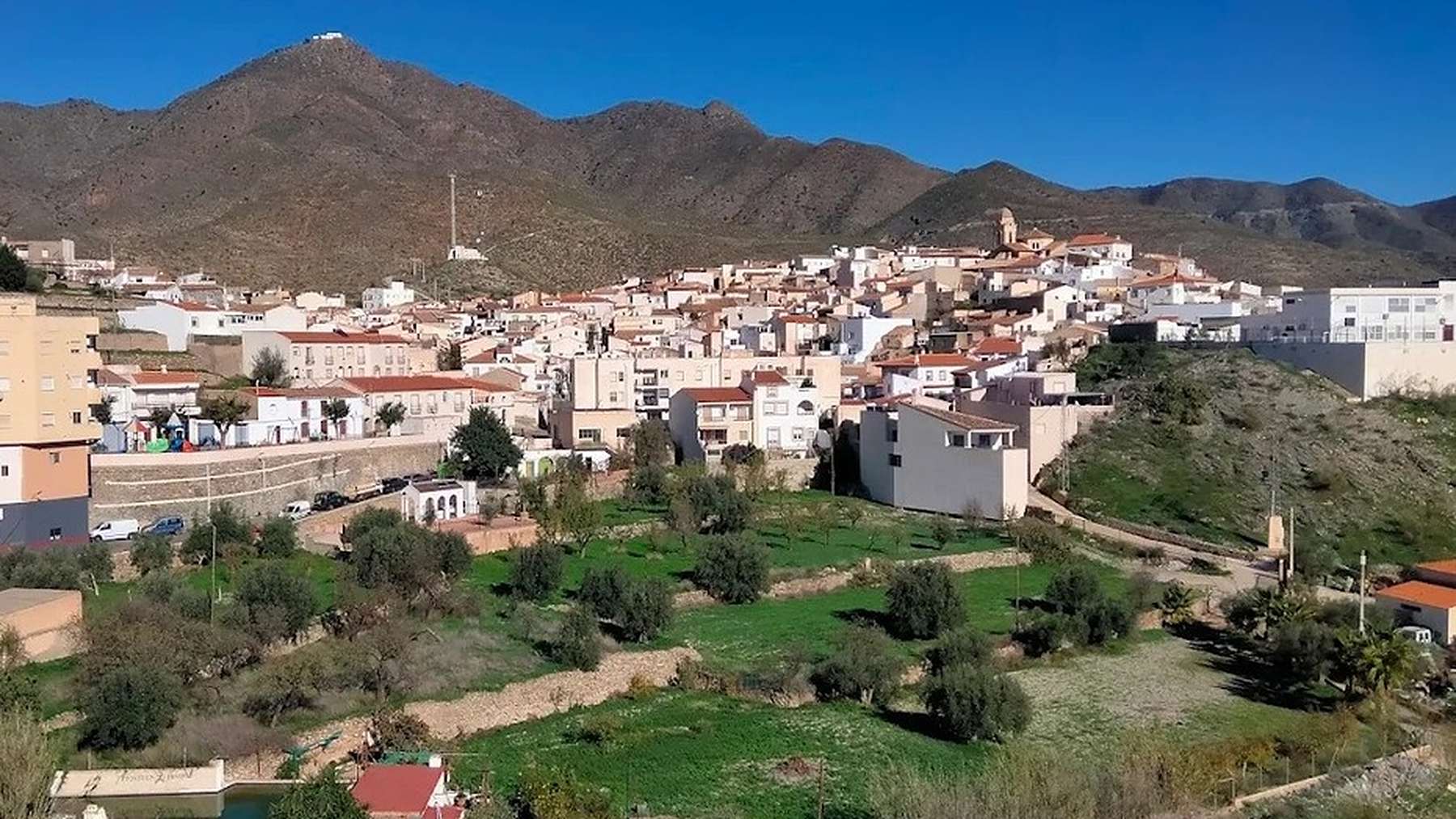
About four kilometers south of the town of Uleila del Campo (Almería) lies an old inert-waste landfill. The Andalusian regional government intends to close it in accordance with the regulations and return it to the landscape.
The Department of Sustainability and Environment has tendered the sealing and environmental restoration works, according to a notice dated November 20. The base budget is 991,417.62 euros, funded by the FEDER 2021-2027 program, and the planned deadline is ten months. Approximately 5,000 square meters will be recovered.
A landfill on two slopes
The site covers about half a hectare, access is restricted, and it is reached via the AL-1100 road. Inside there are two clearly distinct zones.
The first, on the western side, is where the initial waste disposal took place. It is a hillside terrain where a slope of around nine meters in height eventually formed.
The second, on the eastern side, holds the largest volume of waste and sits in a hollow. Its upper platform measures about 1,381 square meters, and the slope about 1,970 square meters, with a height difference of up to 18 meters. The access path adds another 980 square meters, also quite inclined.
What is inert waste
An inert-waste landfill is not a dump for household trash. According to Royal Decree 646/2020 on landfills, inert wastes are non-hazardous residues that do not undergo significant transformations. They do not dissolve, do not burn, and are not biodegradable, and they should not contaminate their surroundings.
So why seal it then? The Junta’s note mentions reducing environmental and health risks and reinforcing the stability of the ground. Among the impacts it aims to prevent is erosion caused by rainwater flowing over the surface.
Monitoring how a landfill’s ground moves can already be done from space. In general, satellites detect illegal dumps by ground movements, although Uleila is not an illegal landfill.
The planned works
Among the actions outlined in the project are sealing the perimeter, improving the access road, and cleaning the disposal basin. The waste will also be prepared and stabilized so that the ground becomes firmer.
Over the waste will lie the sealing layers. At the top of the slopes there will be ditches for water and a rock-filled retaining wall will be constructed (made of large stone blocks). The note also mentions additional complementary actions to reinforce the area, without detailing them.
Restoration will be completed by planting native species to integrate the site into the landscape. The note does not specify which species. Another example of degraded space recovered is the environmental restoration of the Cauneu mines in Somiedo.
Thirty years of monitoring
The works are scheduled to last ten months, but the job will not end there. A Surveillance and Environmental Control Plan of at least 30 years will then begin. It will be carried out by the City Council.
That plan will serve to monitor the landfill’s long-term behavior and verify whether the measures work. It will focus mainly on the stability of the surfaces and on ensuring there is no damage to waters or to natural and cultural assets.
The timeframe aligns with the minimum set by the national royal decree. The competent authority determines how long the monitoring lasts based on how long the landfill could pose a risk. But “in no case” can it be shorter than thirty years.
Gases, leachate, and water
The same decree details what is monitored in a closed landfill while it continues to pose a risk. These are the gases when they are generated, the leachate—the liquid that percolates through the waste—and the quality of nearby groundwater and the stability of the deposit itself.
In landfills that receive biodegradable waste, the regulation also obliges capturing, treating, and utilizing the gas. A inert-waste deposit like Uleila does not fall into that group. The Junta’s note focuses on the land and on the waters.
The rule also establishes that by 2035 municipal waste dumped should drop to 10% or less of the total municipal waste generated. And the debate remains open. This week, waste incinerators asked to be exempt from the CO2 market, arguing that making them more expensive could divert waste to the landfill.
What remains to be seen
For now the Department has only put the project out to tender. The notice provides no date for award or start. The expediente data are in the Junta’s bidding profile.
The Andalucía FEDER 2021-2027 program supports, according to the Junta, the recovery of degraded spaces and the prevention of risks from poorly managed waste. In the case of Uleila, the project aims for those 5,000 square meters to be integrated into the landscape.
Image: Junta de Andalucía
