
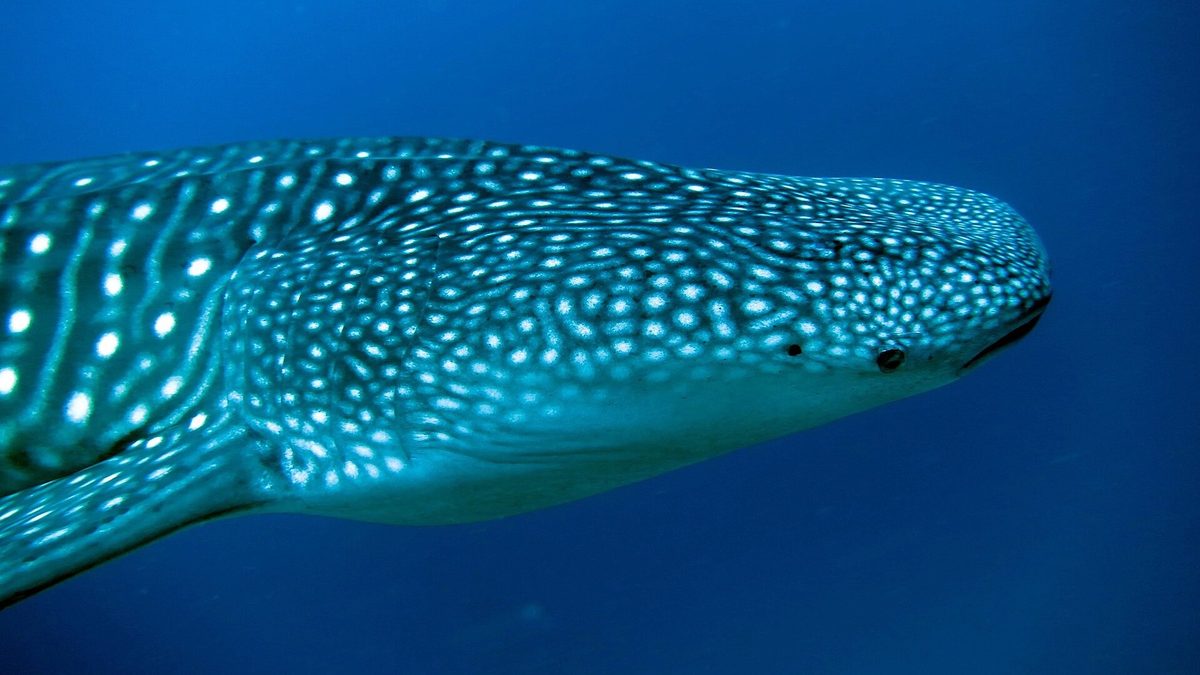
The whale shark spends almost half of its time near the surface, at the level of ships’ hulls. A study from the University of Southampton estimates that diverting oil tankers and container ships to avoid crossing their aggregation zones costs at most 1% more fuel on long trips.
It’s a simulation, not a change that has been implemented at sea. It was done with the same routing software used by shipping lines. The work is led by Ryan Reisinger, from Southampton, in collaboration with the Marine Biological Association, and it has been published in Royal Society Open Science.
Unseen collisions
There are collisions with ships recorded in at least 75 marine species, according to the university’s note dated November 11. The actual figure is unknown. Many collisions go undetected or unreported.
With the whale shark the problem is greater. When it dies, it sinks, so a collision can pass unnoticed. Its population has fallen to less than half in 75 years.
Coauthor Freya Womersley, of the Marine Biological Association, believes it could get worse. Climate change could drive these sharks into new areas intersected by heavily traveled routes. And maritime trade is expected to keep growing.
What exactly did they simulate
The team loaded maps of whale shark aggregation zones into a route-optimization program. It is software already used in commercial transport. The idea was to measure what happens to fuel consumption if a ship reroutes or slows down.
They then simulated eight voyages starting from the Persian Gulf and the Gulf of Mexico. Both are among the riskiest routes for this species. They tested two approaches: completely circumventing the zones, or passing through them at a slower pace.
How costly is the detour
Avoiding the aggregation zones cost up to 1% more fuel on journeys longer than six days. On journeys longer than twelve days, the increase was capped at 0.5%.
On shorter routes the math changes, because any detour weighs more on the total distance. There, it was better to slow down within those zones. The extra cost stayed below 1% for slower ships.
“Our research shows how incorporating habitat data for each species into voyage planning could reduce collision risk with only a negligible disruption to global trade,” explains Reisinger in the university note.
Coauthor David Sims looks at it from the shipping lines’ side. If protecting these animals proves costly, it is unlikely the sector will do it on its own. And that could also slow down regulations to protect large marine fauna.
What it does not prove
They are calculations based on simulated routes. They do not prove that a particular detour has already saved any shark, nor do they say what shipping lines or regulators will do with these data.
“By incorporating biodiversity into voyage optimization, the shipping sector can make a meaningful contribution to global efforts to reduce collisions,” concludes Reisinger. According to him, this protects endangered species and ocean ecosystems, all while maintaining efficient transport of goods.
According to the authors, the idea could be extended with better data, dynamic forecasts, and rules or incentives. Reisinger believes it could also apply to other large animals. “We have demonstrated it with whale sharks, but it could be applied to other large marine creatures at risk of ship collisions, such as whales and dolphins,” he notes.
Image: Jérôme Paillet, IFREMER / Wikimedia Commons, CC BY 4.0