
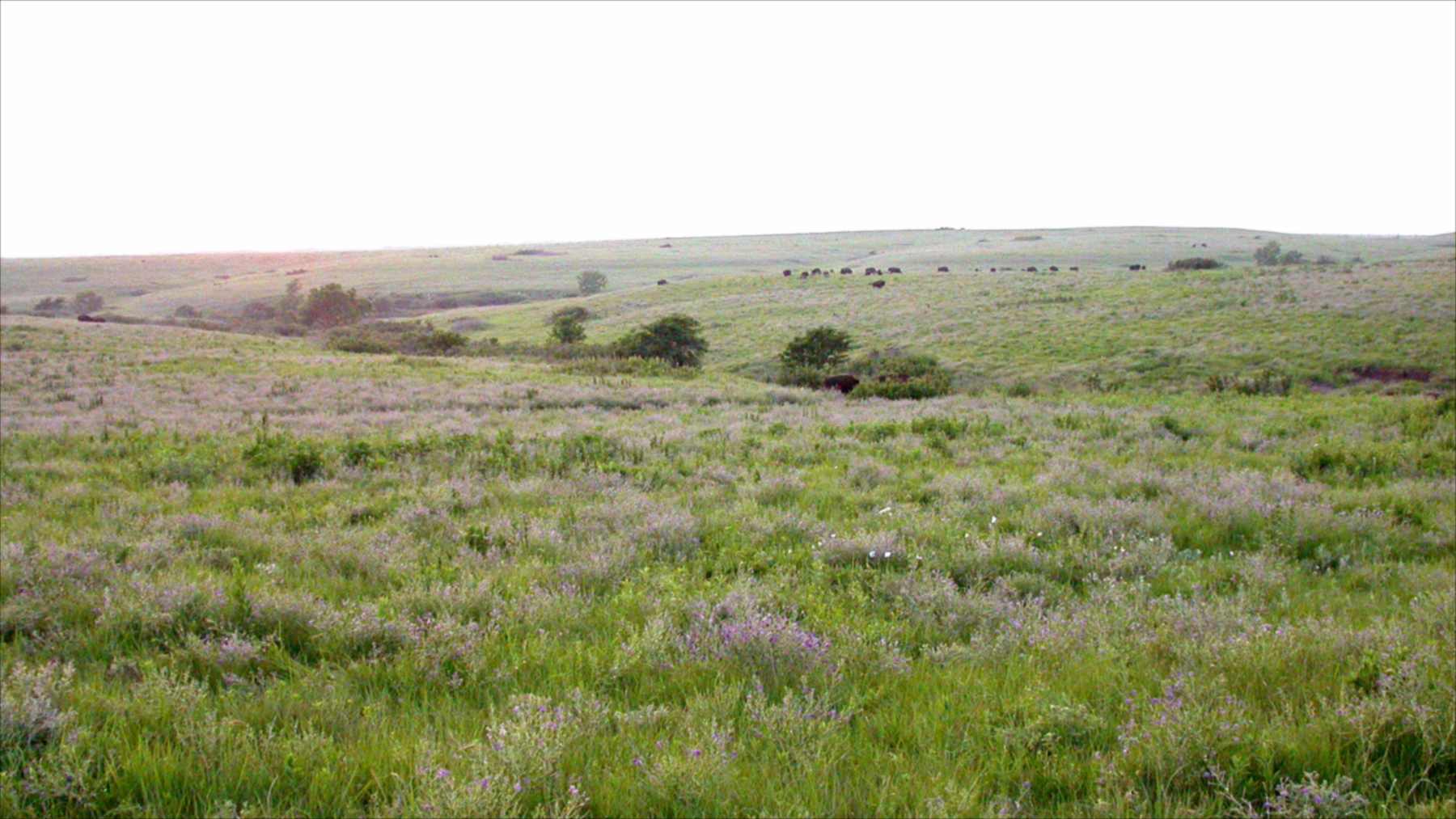
Back in 1987, a herd of 30 bison returned to Konza Prairie, a Kansas tallgrass prairie, and set in motion a transformation that scientists have tracked for decades. By 2020, plots grazed by these animals supported 103% more native plant species than areas without large herbivores, a difference that reached 86% when evaluated across larger landscapes.
The finding stems from a study published in 2022 in the Proceedings of the National Academy of Sciences (PNAS), with an experimental 29-year follow-up. Moreover, the gains in diversity rebounded after an extreme drought, offering a hint about the potential role these animals may play in prairie restoration.
What That Increase Means
The 103% figure refers to the count of native species found in 10-square-meter plots. It measures how many plant types coexist, which is different from the amount of grass you might see when walking across a field.
The 86% pertains to the watershed-scale, which aggregates observations over a larger area. Both percentages compare areas with bison to those without grazing in 2020, so they don’t represent a rise calculated directly from the vegetation present in 1987.
The story began with animals donated by the Fort Riley military reservation. The herd grew through natural reproduction and new additions, and in 1992 the space available for the bison was expanded within a program that studies how grazing, fire, and climate interact.
Grazing Opens Up Space
How can a plant-eating animal help increase the number of species? Researchers link the outcome to a reduction in the dominance of a few grass species, the group to which many of the grasses in these prairies belong.
Bison predominantly feed on those grasses and repeatedly return to spots where fresh grass sprouts. By keeping them in check, they free up opportunities for other plants that previously faced stiffer competition for resources.
They also physically alter the terrain by rolling, creating small depressions and different microhabitats within the landscape. In areas with bison, native prairie plants increased, while exotic species remained relatively scarce.
Cattle Also Helped
The team compared three land-management approaches: year-round bison presence, cattle grazing during the growing season, and no large herbivores. The comparison aimed to reflect common regional practices, as explained by Kansas State University.
Cattle also enhanced plant diversity compared with ungrazed areas. The difference was 41% at the plot level and 30% at the watershed scale, less than half of the increase observed with bison.
But there is a nuance that changes how we should interpret the result. Because the two species grazed in different seasons, the experiment cannot fully disentangle the effect of the animal from that of its management.
The Drought Test
Droughts in 2011 and 2012 offered a test of what happens when water is exceptionally scarce. Initially, the number of native species declined in the bison areas, causing the plant community to suffer a hit as well.
Recovery followed, taking about four years at the plot scale and two at the watershed scale. Species richness returned to the pre-drought trajectory, a result the authors describe as resilience.
One possible explanation lies beneath our feet. While the local grasses mostly draw water from the upper soil layers, many other herbaceous plants tap deeper reserves, which can reduce competition when the soil dries.
Restoring Natural Processes
“Reintroducing native megafauna could help restore the biodiversity of grasslands,” explained lead author Zak Ratajczak in the university’s press release. The idea envisions bringing back animals capable of influencing ecosystem functioning, in addition to preserving the plants as separate components.
The results come from a Kansas tallgrass prairie under specific management conditions. Therefore, applying them to other places requires examining the terrain, climate, and native fauna of each ecosystem, without assuming that any introduction will yield the same benefit.
Konza also demonstrates why it is worthwhile to observe nature for decades to understand its changes.
The original study was published on August 29, 2022, in the Proceedings of the National Academy of Sciences (PNAS).
Image: Kgwo1972 / Wikimedia Commons (public domain)