
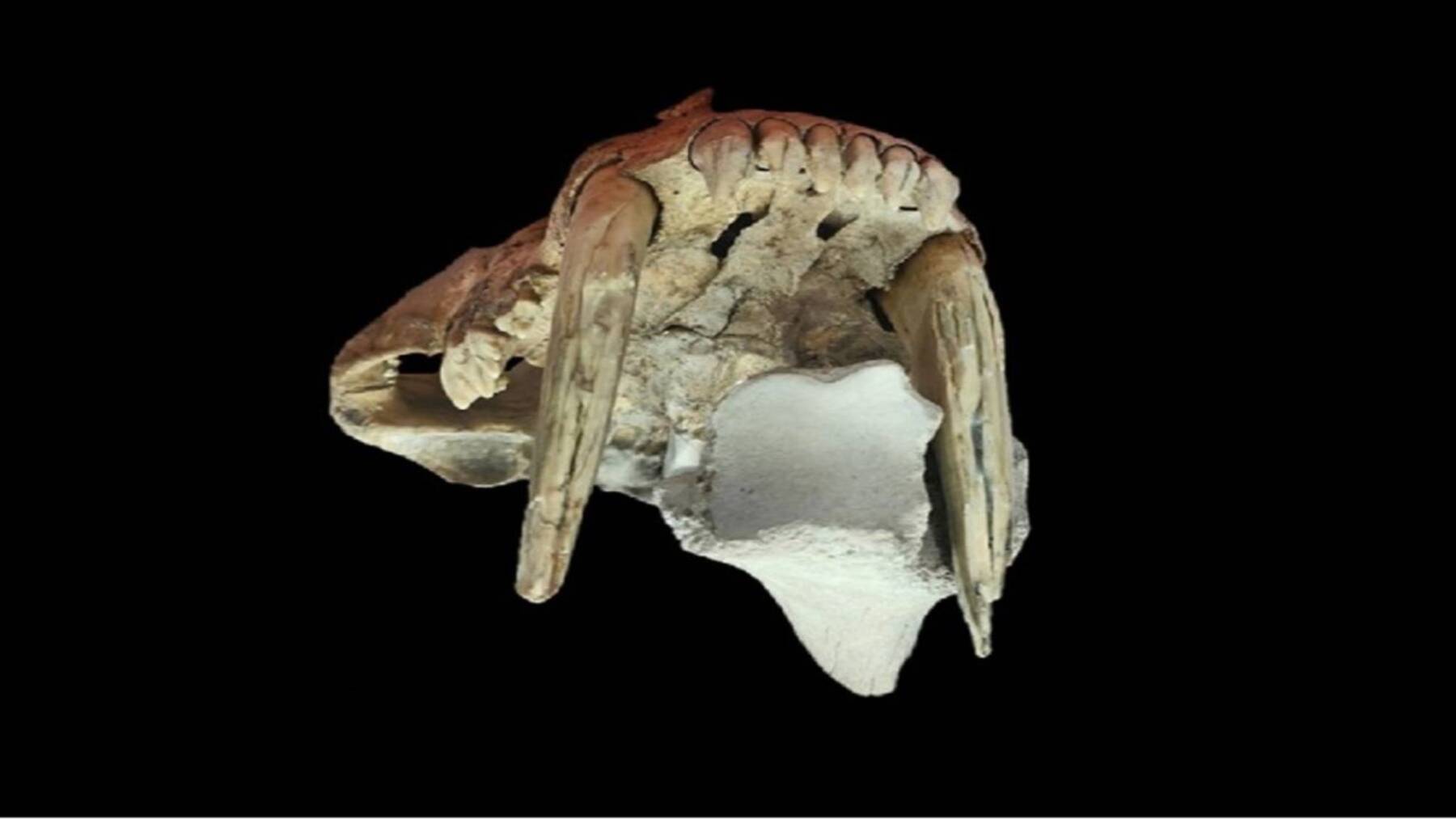
The saber-toothed canines left perforations in large herbivores in Argentina: evidence that compels a reevaluation of how this superpredator hunted and fed.
Saber-toothed cat fangs
The saber-toothed cat fangs possessed a resilience that prior hypotheses had undervalued. A scientific study from the MNCN-CSIC identifies bite marks on Argentine fossils that demonstrate Smilodon populator could penetrate the bone cortex of its prey.
The image of a giant armed with teeth fragile enough to touch bone loses its main argument. The perforations and the grooves preserved in large herbivores provide evidence against an interpretation that had seemed solid.
The study also reconstructs its diet and coexistence with humans. And it delivers a forceful ecological warning: surpassing 300 kilos and wielding extraordinary weapons does not guarantee survival if the prey on which it depends disappears.
The saber-toothed cat fangs cast doubt on the fragility traditionally assumed
The remains originate from Salto de Piedra, in the Argentine Pampa, spanning a range between 22,200 and 13,300 years ago. The team found marks compatible with the canines and carnivorous teeth of this iconic feline, whose fangs could exceed 20 centimeters.
The signs appear on bones of animals such as the giant sloth Lestodon, the bulky Toxodon, and Notiomastodon, an extinct relative of elephants. Its morphology allows identifying a bite-mark signature attributable to Smilodon.
The study has a concrete utility: recognize those same signals in other sites and reconstruct their feeding relationships. The saber-toothed cat fangs stop being interpreted solely by their appearance; they are now studied also through the marks of their use.
A formidable predator trapped by the loss of its prey
The research documents sustained predatory pressure on large herbivores. Its survival depended on a megafauna that eventually declined: the individual prowess of the hunter could not indefinitely compensate for the deterioration of its food base.
The results support a multi-causal explanation of extinction: environmental and climatic changes, progressive loss of prey, and human presence acted together. Reducing that disappearance to a single cause impoverishes what the fossils reveal.
The conservation lesson is uncomfortable but necessary. Protecting a large carnivore requires preserving its prey and its habitat. A policy that brands the predator as an emblem while allowing its sustenance to degrade leaves unresolved the basic condition of its survival.
Humans and big cats: the bones debunk the tale of confrontations
The researchers compared Salto de Piedra with nearby human settlements, some located as close as seven kilometers. During roughly 700 years of regional overlap, the analyzed record shows no evidence of direct confrontations or human pursuit of the feline.
The team interprets that both populations tended to avoid each other and pursued different species. In this local comparison, Smilodon exploited a broader array of large herbivores than what is documented at the human settlements.
The fossils and bite marks were digitized with high-resolution 3D scanners, and the models are available in open repositories. That transparency allows results to be cross-checked and analyses expanded: scientific evidence gains strength when it can be reviewed.
The ecological role of large carnivores even reaches vegetation: by altering the abundance or behavior of herbivores, they can trigger trophic cascades.
Administrations that treat them as mere obstacles neglect these connections. Conserving predators means protecting the relationships that sustain entire ecosystems.
