
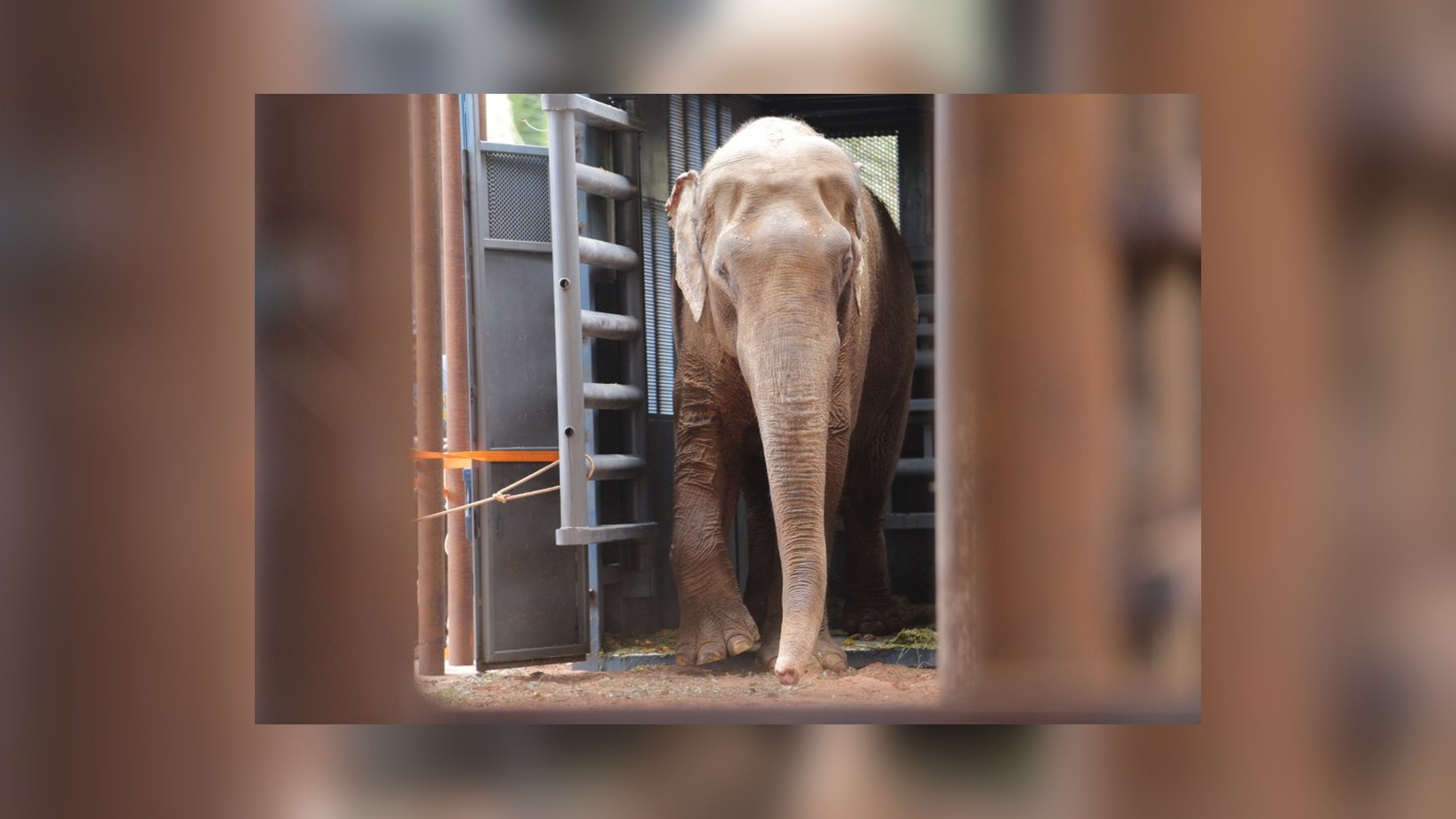
Sandro, a 54-year-old Asian elephant, arrived on September 18, 2026 at the Brazil Elephant Sanctuary in Mato Grosso. He came from Sorocaba Zoo in São Paulo, where he had lived since 1982, after covering roughly 1615 kilometers.
A month later, his caretakers were focusing on something less visible than the journey. Sandro needs to gain weight and muscle, and he already shows signs of arthritis in his knees.
The transfer was organized by the sanctuary in collaboration with Global Sanctuary for Elephants (GSE), the American NGO that founded it. He arrived after years of legal battles with the Sorocaba City Hall, which had wanted to keep him.
From a traveling circus to a solitary enclosure
According to records kept by the sanctuary, Sandro was captured in Asia in 1971, when he was still a calf. He passed through Cauberg Zoo in the Netherlands, where he was trained by a well-known animal trainer.
That same year, the Orlando Orfei circus hired the trainer, who traveled to Brazil with three elephants. Sandro was one of them, and he spent about ten years moving from circus to circus.
In August 1982 he entered the Quinzinho de Barros Municipal Zoo, according to the City Hall. There he lived alone until 1995, when the elephant Haisa arrived.
They shared the enclosure for 25 years. Haisa died in November 2020, and the necropsy listed osteoarthritis among the causes, according to the sanctuary.
Loneliness weighs on this species. In the wild, the oldest female keeps the map of the herd’s water points.
A protracted dispute with the City Hall
The City Hall opposed the transfer in court. In July 2025 it challenged a transfer order, and a magistrate of the São Paulo Court of Justice suspended it for a time.
In June 2026, the court again ruled on the case and the municipality announced another appeal. It argued that “Sandro is well cared for” and that the journey posed a “high risk” for him.
GSE sees it differently. On its rescue page, it calls the Sorocaba facility “deficient and unsuitable for any elephant.”
The NGO adds that Sandro had not undergone full veterinary examinations or blood tests. It also cites weight loss, feet in poor condition, and stereotyped behaviors, which are repetitive movements typical of captivity.
Two and a half days without sedatives
The transport crate arrived at the zoo on September 11. The sanctuary team used food rewards so that Sandro would enter it by his own accord.
On September 16, a crane loaded the crate onto a truck. The City Hall says the mayor, Rodrigo Manga, was there from the early hours of the morning. Visitors and protesters opposed to the transfer also attended.
The sanctuary does not press elephants to travel. Its cofounder, Scott Blais, has moved more than 50 in this manner, and the team monitored Sandro with cameras inside the crate.
There were stops so he could rest, eat, and drink. As the Brazil Elephant Sanctuary puts it, “it is the elephant who sets the pace.”
Sandro arrived on September 18 and stepped out of the crate within seconds, according to GSE. He had eaten and drunk throughout the journey.
A private enclosure on 1,200 hectares
The sanctuary opened in 2016 in Chapada dos Guimarães and presents itself as the only elephant sanctuary in Latin America. It covers about 1,200 hectares of cerrado, the central Brazilian savanna.
There live the female elephants Maia, Rana, Mara, Bambi, Guillermina, and Baby. Sandro, the sole male, has his own habitat with three courtyards, and from one of them he can view the females.
Their fences stand about 2.75 meters tall. GSE estimates that Sandro is nearing 3 meters in height.
Soaked hay to gain weight
At the zoo he consumed around 250 kilograms of food daily, according to the City Hall. Even so, GSE calculates that he needs to gain several hundred pounds, more than 100 kilograms.
Initially, he showed little interest in the hay prepared for the females. On October 12, the team reported that they give him precooked hay. It comes in blocks that are soaked for several hours, and he seems to prefer it that way.
His diet includes fruits and vegetables, some cooked and some raw. The medicines are taken hidden inside bran pellets and in apples with peanut butter.
On October 15, a caretaker saw him eat the vegetables first. Then he blew handfuls of hay into his mouth with the trunk. The team monitors how much he eats to ensure weight gain without aggravating old problems.
A tree, a rumble and a knee
On October 9, Scott Blais filmed Sandro felling his first small tree. Around that period, during the night meals, he let out for the first time a low, soft but deep rumble.
The team took it as a sign that he is at ease. Elephants use these deep sounds to communicate, as explained by a study on the choruses of elephants.
A similar pattern has been observed in elephants reintroduced after years in captivity, who relearn behaviors characteristic of their species.
On October 20, GSE reported a problem with his rear knees. When he walks slowly, there is a small wobble, a wear sign, “almost certainly in the form of severe arthritis.”
The team has also noted stiffness in the hips and some muscle atrophy. Walking more and the new supplements are helping him, and for now he shows no additional pain.
What remains unknown
The City Hall still had pending resources when Sandro left the zoo. Its statements do not clarify how they were resolved.
The full extent of his injuries is also not known. According to the team, Sandro is still learning the poses required for a full examination.
Distances vary: the sanctuary cites 1,615 kilometers, GSE 1,650, and the City Hall a little over 1,600. Almost all knowledge about his health comes from those who care for him.
The rescue story is on the official page of the Brazil Elephant Sanctuary. The latest health update is from October 20, 2026, on the GSE blog.
GSE and the sanctuary continue posting videos and notes about Sandro almost daily on that blog and on their social networks.
Photo: Global Sanctuary for Elephants
