
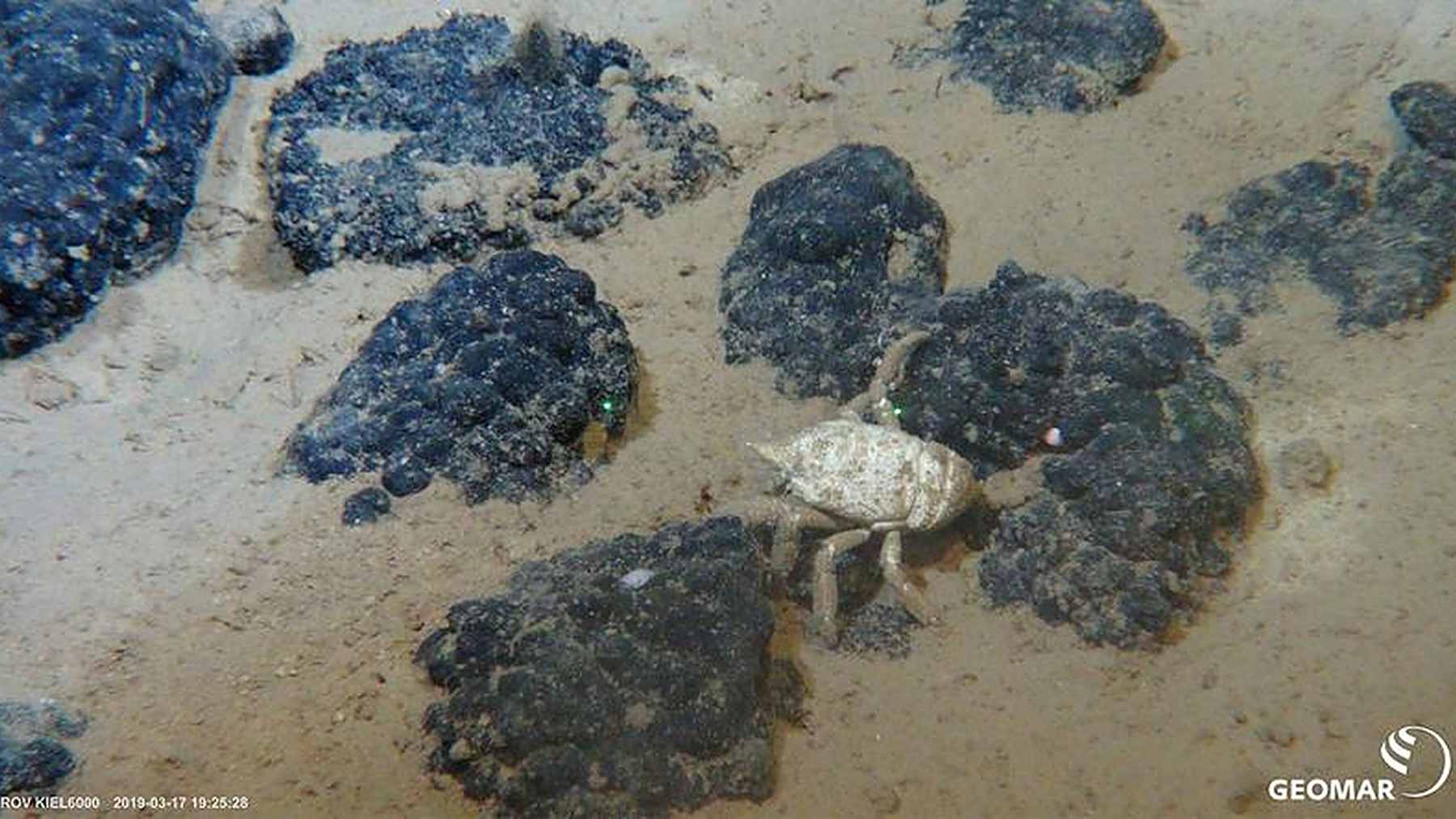
More than 4,000 meters below the surface, in the heart of the Pacific Ocean, dark polymetallic nodules the size of a fist lie. They take millions of years to form. An international team has opened 244 of them and counted 4,139 tiny animals in their crevices, and in a single rock there were 245.
The study, led by researchers from MARUM at the University of Bremen and the Dutch institute NIOZ, shows that these nodules are not mere stones. They are shelters with their own inhabitants, distinct from those living in the surrounding mud. And that matters in the debate over deep-sea mining.
Rocks that grow by millimeters
Polymetallic nodules are black mounds of iron and manganese oxides that grow incredibly slowly. Often they add just a few millimeters every million years. At depths between 4,000 and 6,000 meters, they form one of the few hard surfaces atop a soft, muddy seabed.
Samples came from the Clarion-Clipperton Zone in the central Pacific. There the team used box corers and remotely operated vehicles to collect the nodules. They then carefully dissected them in the laboratory to remove the animals from each fissure.
A Home of One Millimeter
The researchers started by measuring the size of the cracks inside these stones. «In our study we show that the interior cracks of the nodules are large enough to shelter animals smaller than one millimeter,» explains Tanja Stratmann. She is a deep-sea ecologist at MARUM and one of the three lead authors.
Those organisms form what biologists call meiofauna, including nematodes and copepods among their groups. The nodules do not merely provide a surface to cling to; their internal structure creates a three-dimensional habitat, full of protected cavities.
245 animals in a rock
When analyzing the 244 nodules, the team counted 4,139 animals in total. The average came out to about 17 per stone. Yet, in one particular instance, 245 were found inside a single nodule, about 14 times the average.
Inside the rocks there is less life than in the surrounding sediment. Among the nematodes, the life inside the nodules accounts for roughly 10% of what is found in the mud. For copepods, the figure is around 25%.
The MARUM note emphasizes that this fraction matters for the entire ecosystem. What matters most, according to the note, is that the species inside and outside are not the same.
Neighbors that stay in
«The cracks in the nodules act as tiny refuges and host animals that we do not find in the soft sediment of the seafloor,» summarizes Coral Díaz-Recio Lorenzo. She is another lead author, who worked at NIOZ and is now at the Roscoff Biological Station in France.
Genetic analyses added an intriguing detail to the story. The communities within nodules looked very similar to each other even when separated by up to 1,000 kilometers. By contrast, they differed clearly from the animals in the mud.
One of these inhabitants is Thurammina sp. 1, a single-celled organism that appears with particular frequency inside nodules. It seems perfectly adapted to those sheltered spaces.
What would be lost
All of this matters because nodules are considered a target for industrial submarine mining. What is sought from them are nickel, cobalt, and copper. On ecoticias.com we have already explained how the International Seabed Authority is studying the legal framework for that activity.
If nodules are mined, the habitat disappears along with everything living there. The note recalls that the loss would be permanent on geological timescales. These stones do not regrow within a human lifetime.
«Our results indicate that commercial mining could trigger an irreversible loss of unique biodiversity, some of which remains undescribed, associated with nodules,» warns Sabine Gollner of NIOZ. «This must be considered in the environmental management of deep-sea mining,» she adds.
The small things also matter
Protecting the deep ocean requires looking at its microscopic inhabitants as well, not just the larger animals, the note insists. Other voices have already warned that submarine mining could have unpredictable consequences. The debate about when to begin exploiting the ocean depths remains open.
We still need to know whether losing these local communities would drive any species to global extinction. Perhaps the creatures could survive in other areas. To find out, Stratmann is now taking part in an international expedition to the Clarion-Clipperton Zone, as part of the MiningImpact 2 and 3 projects of JPI Oceans.
The results will also help plan protected areas in the deep ocean and assess the impact of future mining projects. It is another piece in the debate over protecting the high seas. The study has been published in Scientific Reports.
Foto: ROV Kiel 6000 / GEOMAR
