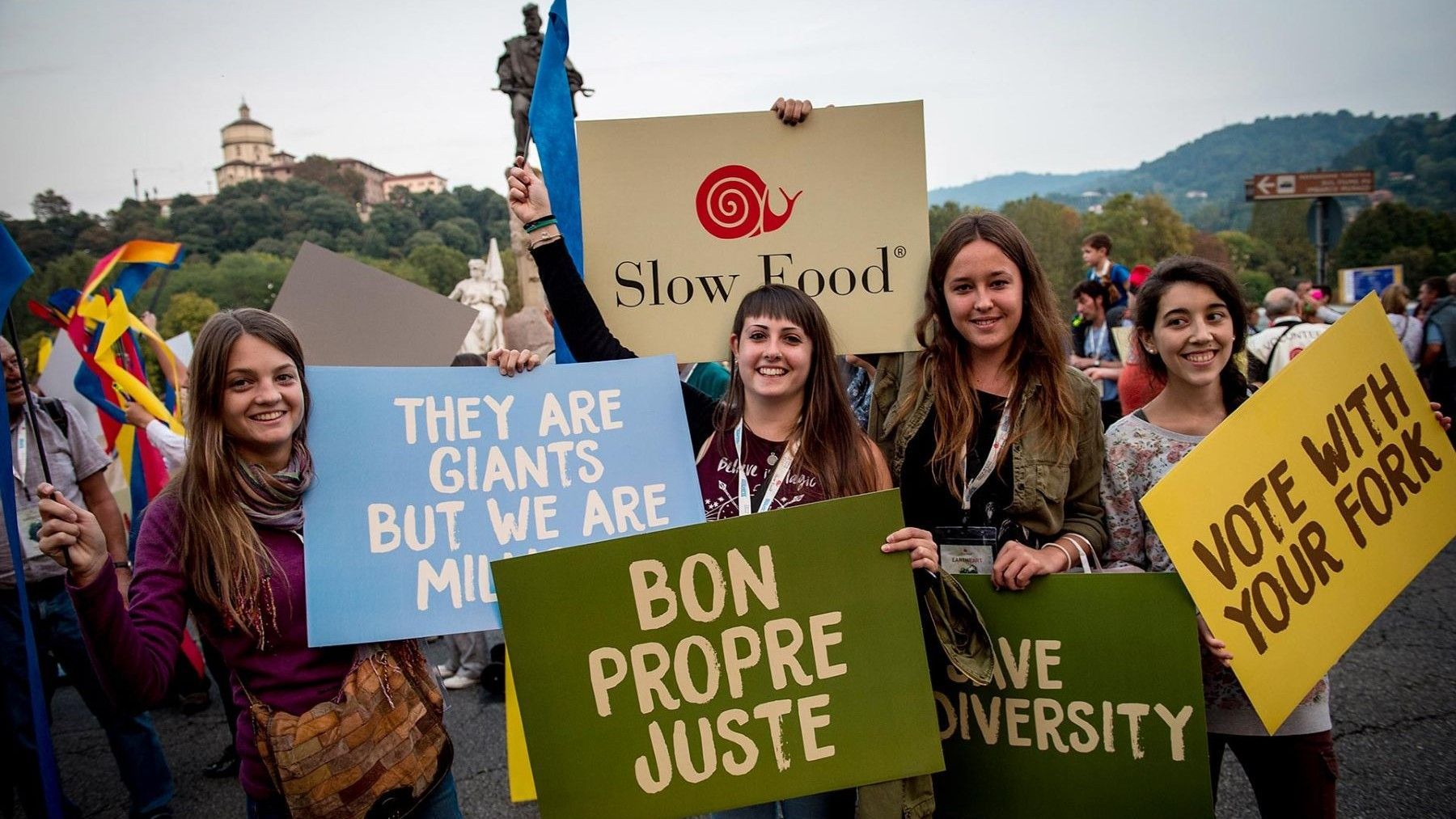
Slow Food marks four decades of activism at a fair in Turin and says it will continue to fight so that everyone has access to good, clean, and fair food.
Carlo Petrini founded in 1986 a movement that would come to change the way people eat and view the world for thousands of individuals around the globe. Opposing fast food, slow food promotes much more than “taking time to eat.” The goal is nourishment that is good, fair, and clean.
Industrial food production is, according to the president of Slow Food, one of the root causes behind the planet’s gravest ills: pollution, greenhouse gas emissions, forced migrations, and much more. For this reason, they will persist with their activism and their struggle until every person on the planet has access to the food they deserve and ecological farming becomes the majority practice.
It all began as a form of resistance when fast food arrived in Italy and some of the essence of gastronomy was lost amid the immediacy of industrial products. In just over three years, Carlo Petrini succeeded in making his movement international. In the year of his passing, the 40th anniversary is remembered, but it is not solely about him, because there is much to fight for.
40 years of Slow Food: eating and living slowly works
Four decades after opposing the arrival of fast food in Italy, the Slow Food movement is celebrating its 40 years in the country with a firm conviction: its campaign for a “good, clean and fair” diet not only remains alive but has become more urgent in a world defined by climate crisis, hunger, and inequalities.
“Slow Food will exist until every person on the planet has the right to access good, clean and fair food,” says Paolo Di Croce, the chief executive of Slow Food International, during the Turin celebration of Terra Madre Salone del Gusto 2026.
The Slow Food organization marks its anniversary at the grand biennial gathering that this weekend turns the center of the Piedmontese capital into the world epicenter for thousands of small producers, farmers, cooks, activists, and consumers. It is a special yet bittersweet milestone, as this edition is the first since the death last May of the movement’s founder, Carlo Petrini, at the age of 76.
The warnings do not stop
Four decades of activism have not eradicated the root problems; on the contrary, current social, climate and political crises make the movement’s message “more important and more political than ever,” warns its chief executive. The pandemic, he contends, exacerbated gaps in social and environmental justice and underscored the need to place the right to food at the center of political debate.
“Today more than ever it is essential to put at the center of politics the right to access food, to a good, clean and fair meal that can feed everyone in a world where hunger continues to be a grave problem,” according to Di Croce.
In that sense, the head of the organization contends that industrial food production is “one of the main causes of the planet’s environmental catastrophe,” in addition to acting as a trigger for forced migrations and conflicts.
“From the beginning we fought for a different model because the risk of losing cultural identities tied to gastronomy was already enormous. But today the accumulation of climate, political crises and the lack of leadership have reached critical levels,” he warns.
A local protest transformed into a global network
What began in 1986 as a cultural resistance enclave under the name Arcigola to defend local gastronomy against fast food, jumped onto the international stage in less than three years.
Today, Slow Food constitutes a global network present in 170 countries that has broadened its goals to the preservation of biodiversity, sustainable agriculture, and workers’ rights in the countryside.
According to Di Croce, this global vision was decisive: “The greatest virtue of our founder was to understand that the only way to win the challenge for a different kind of food was to be global. You cannot think solely of individual interests without lifting your gaze to see what is happening in the rest of the world.”
Furthermore, in the current political context, the organization contrasts its global model with the rise of nationalism: “It would be shortsighted to close ourselves off and think that, since at our headquarters access to good, clean and fair food is guaranteed, there is nothing left to resolve elsewhere,” he notes.
A movement that must be bigger than its founder
The anniversary inevitably carries a tribute to Petrini, but Slow Food wants to prevent the celebration from turning into a retrospective on the past alone.
“For twenty years people asked me all over the world what would happen when Carlo was no longer here. I always replied that his great achievement was creating a movement bigger than any person, including him,” remembers Di Croce.
Petrini himself, he adds, would have preferred the anniversary to look forward rather than dwell on his figure. “He would have told us: ‘Don’t waste time celebrating me, go and do things’. And that is exactly what we are doing.”
Forty years after that protest against fast food, Slow Food thus enters its fifth decade with a mission that, according to its leadership, remains far from finished. “I don’t think we will solve it in the next 40 years,” Di Croce acknowledges. “But sooner or later we will solve it.”