
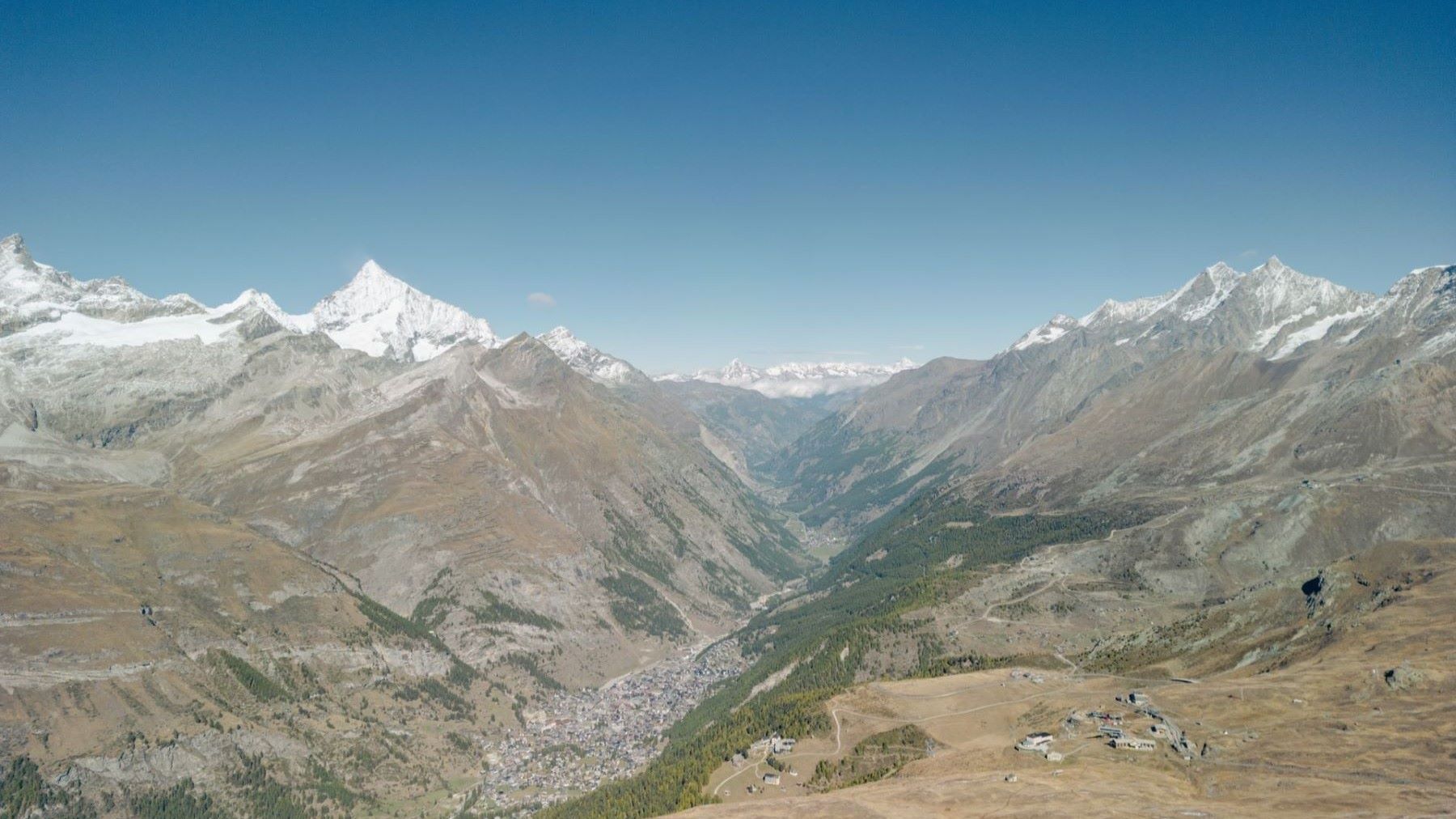
The melting of Swiss glaciers is recording one of its worst seasons after a winter with little snowfall and successive heatwaves, with very grave consequences for their water reserves.
More water arising from the melt today means less ice stored for the future. The melting of Swiss glaciers illustrates that paradox after a season in which 5.5% of the total glacier volume was lost. The GLAMOS balance places the hydrological year 2025/26 among the worst on record.
According to the Swiss Commission for Cryosphere Observation and GLAMOS, the snow shortage and persistent heat have combined to create a season especially dangerous for the glaciers. Scientific monitoring has allowed examining how winter conditions influenced ice exposure during the summer and to connect both periods to understand the annual outcome.
A continuación, recorreremos las mediciones realizadas, los factores que explican el balance y las transformaciones observadas para intentar comprender mejor qué ha pasado con el deshielo de los glaciares suizos.
The Melting of Swiss Glaciers
The glaciers in Switzerland have lost 5.5% of their ice volume in the last year, in one of the largest losses ever recorded, following a winter with very little snow and successive heat waves in spring and summer, according to the scientific bodies tracking glacier status over the long term.
This extreme situation pushed the zero-degree line above 4,000 meters on a record number of days (76), according to the data released today by the Swiss Commission for Cryosphere Observation of the Swiss Academy of Sciences (SCNAT) and the GLAMOS measurement network.
Only this year the average ice thickness on certain glaciers fell by 2.5 to 4 meters and reached about 10 meters in some tongues, with an accumulated loss of almost 20% of the Swiss glacier volume since 2021.
Measurements carried out in September on 23 glaciers in the Swiss Alps show that the hydrological year 2025/26 recorded a mass balance of -2.9 meters of water equivalent, the second-worst result in the historical series, only behind the exceptional 2022, although some glaciers did experience record losses.
The scientists have pointed to a “combination of particularly unfavorable factors,” starting with a winter 2025/26 that was among the ten least snowy since measurements began, while from May to September every month was marked by drought and at least one heatwave.
The snow that protects the ice during the summer disappeared partially as early as June, while in September snow remained scarce even at 3,500 meters of elevation, according to the data presented.
The data and observations from this summer also show that retreat is not limited to ice volume, but that there has also been the disappearance of small glaciers and the disintegration of some tongues.
Among them are Bella Tola, in the canton of Valais, and Griessfiren/Plattalvafirn, in Glarus, whose complete disappearance has been documented by photographs.
Nevertheless, there is not yet a definitive figure for the number of glaciers that have disappeared in 2026. Between 1973 and 2016 more than 1,000 Swiss glaciers disappeared and around a hundred more did so between 2016 and 2023.
According to SCNAT and GLAMOS, the melting now has a paradoxical effect on water resources, since the glaciers lost about 2,200 million cubic meters of water between July and September (more than four times the annual potable water consumption of all households in the country), which has temporarily cushioned periods of water scarcity.