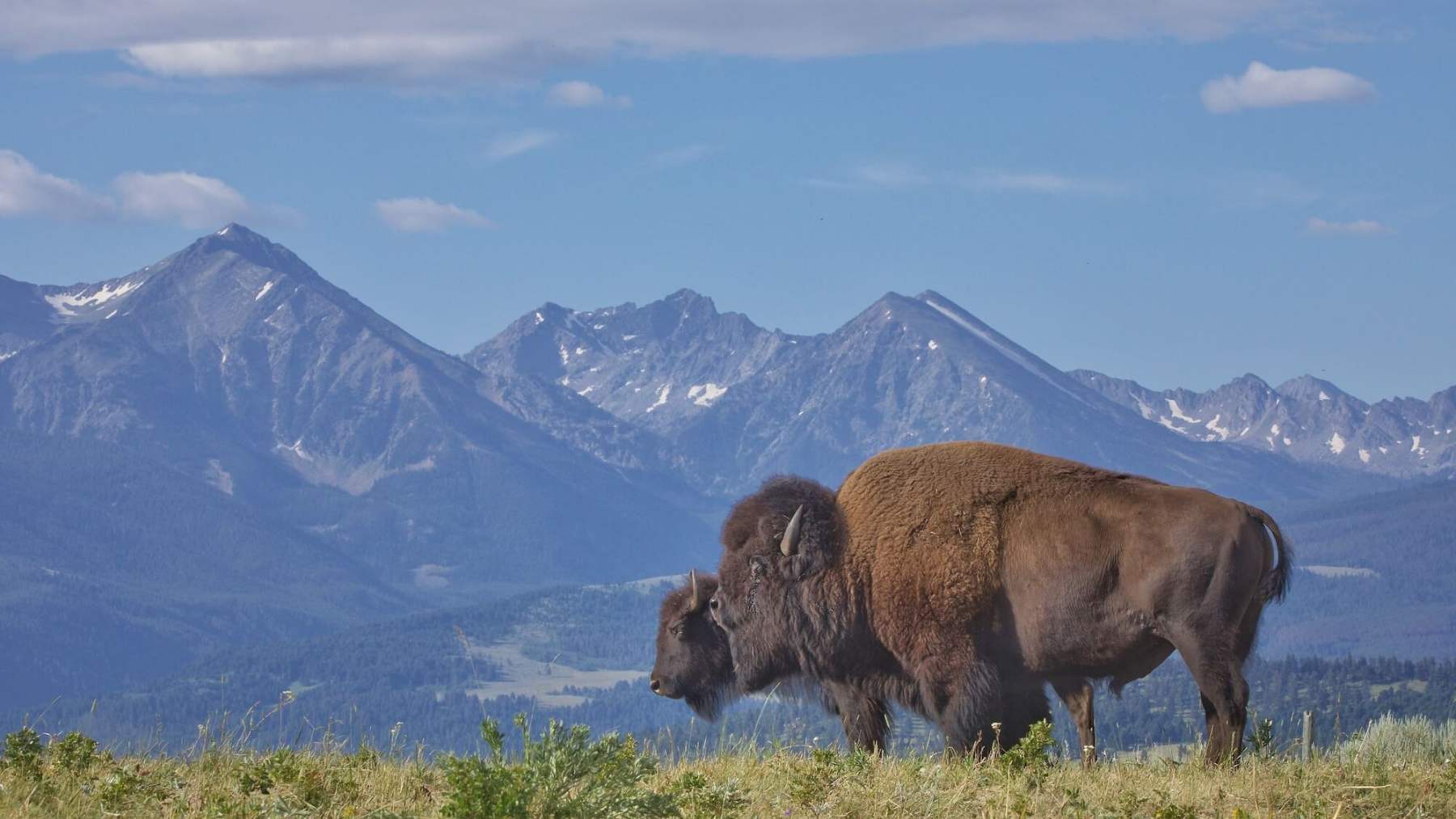
In 1989, Ted Turner, founder of CNN, bought the Flying D ranch in Montana and launched a transition from cattle to bison. Thirty-seven years on, the Turner Institute of Ecoagriculture estimates the herd at around 4,500 animals.
The transformation has also returned more than 2,000 hectares of former cropland to use as pastures, according to the institute itself. Flying D shows how a ranch operation can blend production and conservation, although maintaining that balance demands more than swapping one species for another.
A landscape that remains connected
The ranch spans 113,613 acres, about 46,000 hectares, between the Gallatin and Madison rivers in southwestern Montana. Its lands combine prairies, forests and waterways within the larger Yellowstone ecosystem.
Since 1989, it has operated under a conservation agreement that protects its open spaces. The Turner Institute presents it as a “living laboratory,” where ranching activity coexists with habitats and corridors that allow wildlife to move freely.
The fences had to come back
One of Turner’s early decisions was to remove much of the internal fencing. He hoped that the bison would roam freely through the space and distribute grazing more naturally, as described in the National Bison Association’s handbook.
But the animals had their preferences. In the first five years, staff observed that they returned to recently grazed areas while crossing other patches with tall grasses, leaving some plants without enough time to recover.
The same manual, published in 2017, later described the ranch as divided into eight large grazing zones. The experience provides a practical lesson on ecological restoration (even a native species requires management aligned with available space).
What the plants show
The clearest scientific evidence on plant diversity comes from Konza Prairie in Kansas. A study published in PNAS in 2022 analyzed 29 years and found 103% more native plant species in small plots with bison than in areas without grazing, and 86% more at the watershed scale.
Cattle also increased that richness, though by less than half as much as bison. Here we count how many different species grow, something distinct from measuring how much grass exists or how much carbon the soil stores.
The percentages pertain to Kansas and do not describe an improvement measured at Flying D. Moreover, the bison grazed year-round while cows did so only during the growing season, so the authors caution that they cannot fully separate the animal effect from the effect of its management.
The importance of riparian zones
Another study, published in Frontiers in Ecology and Evolution in 2022, examined lands in central-northern Montana, also outside Flying D. It found that the cover of perennial grasses (those that live for several years), shrubs and trees along streams increased more rapidly in pastures with bison, a change associated with greater bird diversity.
Riparian research continues to offer nuances. A 2023 study found benefits in some aspects of vegetation with bison, but no significant differences in the total number of plant species compared with cattle.
To interpret these results, it helps to consider how many animals graze and how they are distributed. The 2022 study warns that a high density of bison or spaces that are too small can also harm biodiversity.
It is also a business
Turner Enterprises defines Flying D as a venture dedicated to producing bison and conserving wildlife. The company reports roughly 45,000 bison spread across 13 ranches, a scale far larger than this single property.
The Ted’s Montana Grill chain states that most of the bison it serves come from Turner’s ranches. That situates the project within a commercial activity linked to meat, with animals raised and managed by people.
This context matters when assessing its reach. Habitat conservation shares space with production decisions, and environmental outcomes must be evaluated alongside how grazing is organized.
What to keep in mind
The case brings together two advances documented by its managers, a large herd of bison and the restoration of former croplands as pastures. To attribute the same benefits as other projects would require specific measurements of vegetation, riparian zones and soil on Flying D.
The number of animals helps gauge scale, but on its own it does not measure an ecosystem’s health. Official information about the ranch’s status and management is published in the Flying D profile from the Turner Institute of Ecoagriculture.
Image: Turner Institute of Ecoagriculture