
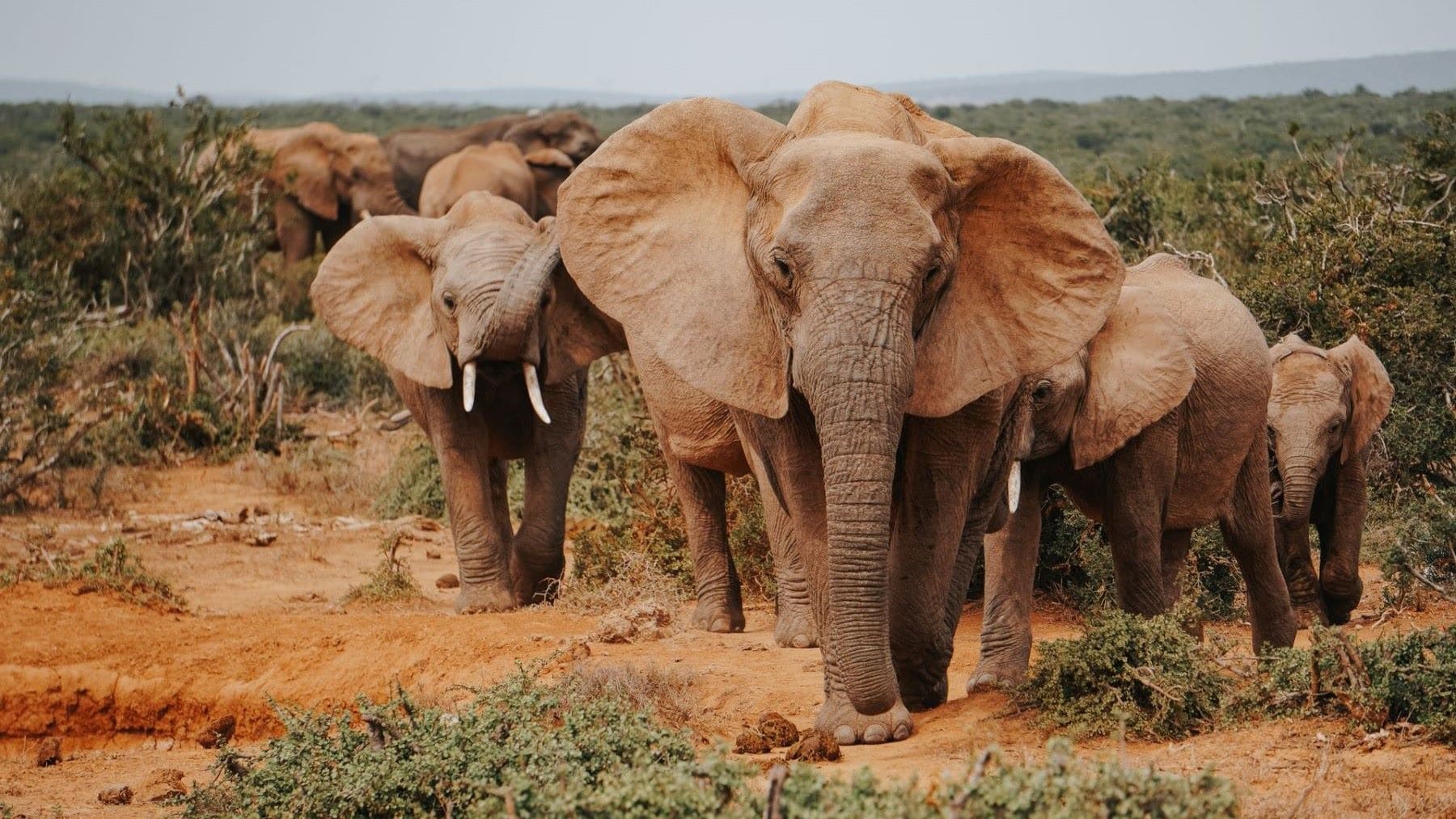
Kenia’s elephants turn to medicinal plants when they are sick or injured, according to a recent study by the Bernhard Nocht Institute. To confirm this, several scientists examined the knowledge of local indigenous guides and rangers. They found that these animals seek out specific plant resources and travel long distances solely to find medicinal leaves or bark.
Of the 39 resources identified in the elephants’ special diet, 87 percent coincide with traditional remedies used by nearby human communities. In addition, researchers documented mothers giving plants to their calves and ruled out the idea that clay ingestion is medicinal. This finding underscores the urgent need to protect biodiversity before it disappears.
The elephants of Kenya
Wild elephants living in the Mount Elgon region of Kenya appear to seek specific plants with medicinal properties when they are ill. This is documented in a study published today in Scientific Reports, which compared the testimonies of community experts with the healing properties of the plants consumed.
An international team led by the Bernhard Nocht Institute for Tropical Medicine (BNITM, Hamburg) interviewed eight Sabaot indigenous experts with more than twenty years of experience living alongside elephants. Of the 39 natural resources these experts identified as part of the elephants’ ‘medicinal’ diet, 87% are also used for healing purposes among local communities.
“For the first time we have a systematic picture of the possible use of medicinal plants by African elephants, based on the local knowledge of people who have lived with them for years,” explains Fabien Schultz, first author of the work and head of the BNITM Ethnopharmacology and Zoopharmacognosy group.
Indigenous knowledge is fundamental to science
Rather than directly observing wild Loxodonta africana elephants —a dangerous species—, the team relied on the accumulated knowledge of people who live with them: two guides, four community wildlife rangers, a retired agricultural official, and a former park ranger. Through semi-structured interviews, the experts described which plants elephants consume when they appear sick and how those plants are used in local traditional medicine.
The researchers prepared herbarium samples of all the mentioned plants and cross-checked them with international databases. They applied a methodology that distinguishes occasional consumption of a plant from cases in which a seemingly ill animal seeks a very specific resource, in small quantities and in an unusual way.
Of the 39 resources described, 25 were explicitly identified as ‘medicine for elephants,’ and eight species — including Aloe arborescens, Bersama abyssinica and Ficus natalensis — met the stricter criteria. Several informants described how elephants travel long distances to a particular tree, not feeding along the way, solely to consume its bark or its leaves.
Clay consumption in the 55 caves of Mount Elgon was also evaluated —a behavior that earned the elephants the title of ‘mining elephants’—, although it was concluded that this is mainly driven by a need for minerals rather than medicinal purposes.
Do animals also have their own medicinal culture?
Among the most striking findings are cases of mother elephants administering plants to their calves, a caregiving behavior toward another individual that the researchers describe as ‘maternal alomedication’. The research team cautions that, for now, neither the exact preparation process nor any medicinal benefit have been confirmed.
The researchers suggest that part of this behavior could be socially transmitted from mothers to offspring, in a manner similar to what has already been documented in chimpanzees. This raises the question: if elephants learn by watching each other, could humans have learned which plants to use by mimicking the elephants?
“Most of the time, people living near animals have known their secrets for generations. Our work as scientists is to start asking the right questions,” notes primatologist Elodie Freymann, coauthor of the study and an expert on self-medication in great apes.
It all started with a sick chimpanzee
The idea that animals can self-medicate —zoopharmacognosy— is not new. In 1987, primatologist Michael Huffman observed a chimpanzee named Chausiku behaving strangely in Tanzania: she chewed a plant locally known as the ‘bitter leaf,’ which was not part of her usual diet. Chausiku had been lethargic and without appetite for days. A day after eating, she recovered. Later Huffman discovered that the plant possessed antiparasitic properties.
That anecdote sparked an entire research lineage. Today the list of animals with documented self-care continues to grow: ants, bees that self-medicate against infections, mosquitoes, chimpanzees, orangutans, and, more recently, elephants.
In 2020, ethnobotanist Alex Greene published a study focused on the Karen communities of northern Thailand — in which Huffman collaborated — estimating that about 8% of mahouts’ ethnoveterinary knowledge might come from directly observing elephants’ self-medication.
Greene, who did not participate in this study, considers that “African elephants are much harder to study,” because “the Asian elephants I worked with are semi-domesticated.”
That is why he regards this first step as “impressive,” although he believes there is room to progress: to place these plants within the broader context of elephants’ overall diet, deepen the understanding of their care practices, and explore the social dimension of these behaviors.
Scientific verification
One of the most intriguing open questions, according to Michael Huffman — professor at Nagasaki University Institute of Tropical Medicine — who did not participate in the study, is whether mother elephants administer plants selectively — in response to specific symptoms in their calves — or if they simply share their usual diet with their young.
The challenge now is to move from anecdotal observation to scientific testing — something that, according to Greene, “so far only Huffman” has achieved in chimpanzees, and which is much harder to replicate in elephants.
To demonstrate medication in chimpanzees, Huffman analyzed the feces of sick individuals. During the rainy season, when intestinal parasite infections rise, he observed that chimpanzees relied on two distinct plant-based strategies to address digestive discomfort. In both cases, fecal analysis showed a clear drop in parasite load after consuming the resources.
Huffman’s recommendation is to apply the same stepwise approach to elephants. Fabien Schultz already has it on his roadmap: “We want to follow specific elephants, film feeding and mother–calf interactions, identify the plants they have eaten, and test their pharmacological effects in the lab.” For now, the team has distributed videocameras to Elgon National Park rangers to document these behaviors.
The animal pharmacy could disappear
African elephants are threatened by habitat loss and conflict with humans. Understanding that these animals also rely on their medicinal plants compounds each deforestation episode; not only is their food being lost, but also their ‘pharmacy.’
“Elephants and local people share medicines and depend on the same ecosystems. It’s a One Health story,” sums up Fabien Schultz. “Understanding these connections could help protect elephant habitats and identify plants worth investigating for human medicine.”
According to the researcher, up to half of modern medicines derive from some form of plant or natural material. Two out of five species are threatened with extinction, despite only a fraction of Earth’s plant diversity having been studied. “Nature holds solutions that synthetic chemistry alone cannot replace,” Schultz notes.
The field pioneer, Michael Huffman, reminds us that each species keeps a unique, time-tested knowledge about survival. Therefore, those “living libraries” we are only beginning to read must also be preserved: “We need nature; nature does not need us,” he states.