
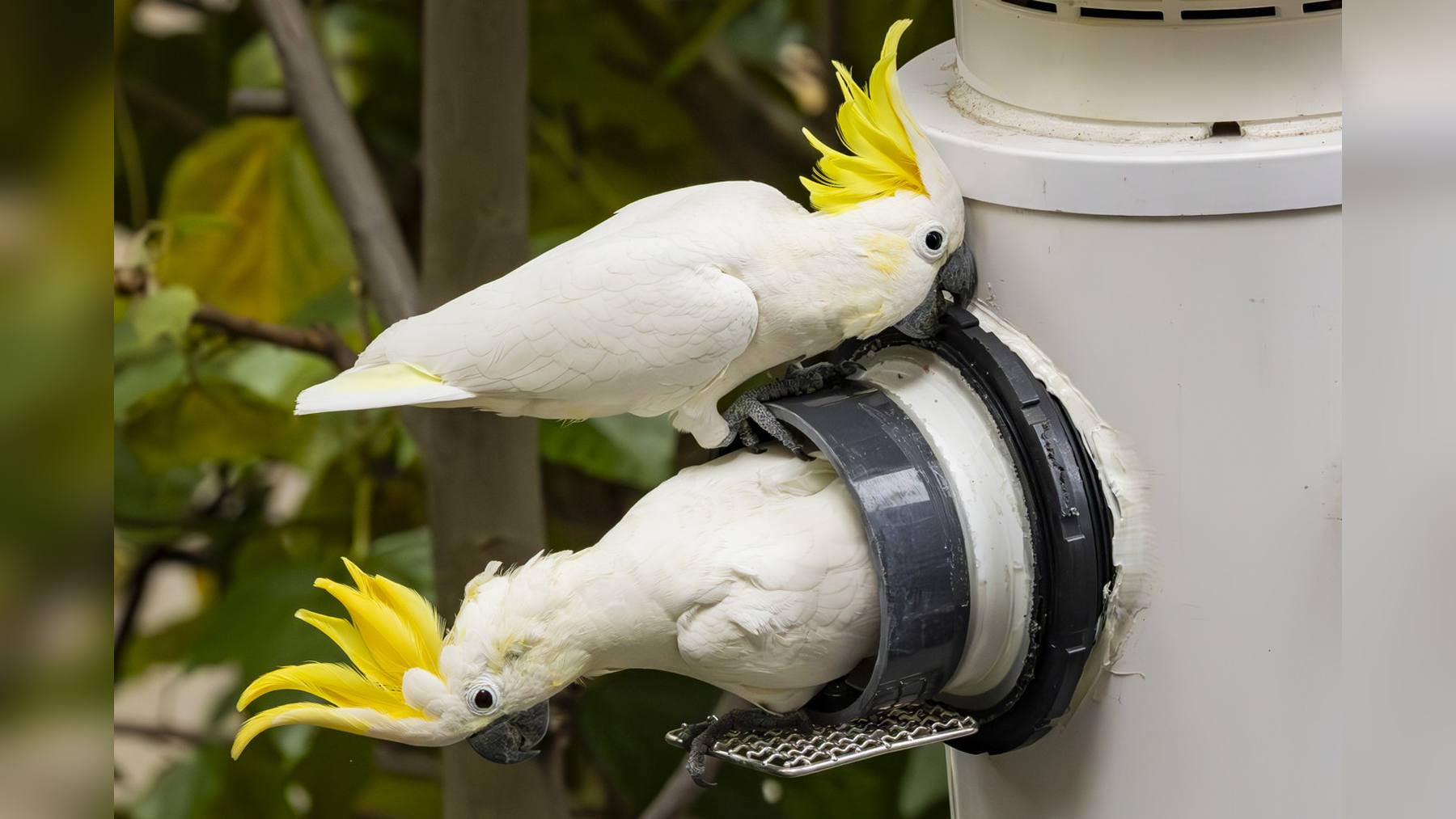
Biologists at the University of Hong Kong (HKU) had installed up to June 14 artificial nests equipped with cameras for the yellow-crested cockatoos (Cacatua sulphurea) on Hong Kong Island. Four were placed in schools and ten in parks, according to an HKU statement published on June 21, 2026. The university has not released a new tally since then.
The project rests on a genetic study conducted by the same team, which sequenced the genome of 41 cockatoos living in the city. The local population numbers around 200 birds, about 10% of the remaining global population, and it maintains a level of genetic diversity comparable to that of other wild parrots.
The species originates from the eastern Indonesian islands and East Timor, where trapping for the pet trade and loss of habitat have reduced numbers to under 2,000 individuals. The study notes that the Hong Kong birds descend from caged individuals that escaped or were released since the 1960s.
A Nest Box with a Camera
Much like the gang-gang cockatoo, which forages and seeks shelter on a vast Australian farm of 35,000 trees and newly planted shrubs, these birds nest in hollows in old trees. In Hong Kong, typhoons and pruning have eliminated more than 60% of the hollows they used, a loss that “has created a housing crisis for these birds,” according to Astrid Andersson, HKU postdoctoral researcher and lead author of the study.
To address the shortage, Andersson and arborist Harry Kahon Wong, her colleague in the Hong Kong Cockatoo Watch group, designed a nest that can hang almost anywhere, derived from Australian prototypes adapted to the city’s humidity.
Each box carries an interior camera that lets the team and students monitor the brood without disturbing the birds, and the students record the size of the clutch, the incubation period, and how many chicks survive, data that are scarce for this species according to HKU’s Faculty of Science.
Tuning the design took months, because the birds would yank out wood shavings and damage any attachment to the box, including the metal lid of the wiring.
Nests in Schools and Parks
The participating schools are The ISF Academy in Pok Fu Lam; St. Louis School in Sai Ying Pun; and Quarry Bay School, which sponsors a nest placed in Victoria Park. The other ten nests hang in parks across the island.
By June, a pair was already using the St. Louis School box, as shown in a photo from professor Winster Wong distributed by the university. For Harry Wong, students can help fabricate and install the boxes “while learning about design for urban wildlife.” Similar initiatives operate elsewhere, such as a Texas teenager who built more than 750 nest boxes.
Seven Hours on a Ledge
In May 2026, Kadoorie Farm and Botanic Gardens sought Andersson’s help to extract a fledgling trapped on a rooftop ledge, according to HKU Lead, the university’s magazine. The chick’s parents were calling from a nearby cornice, so Wong went to the ledge and secured a box there with the chick inside.
The parents spent seven hours peering out before they stayed to care for their chick, and the rescue was resolved in under 72 hours. “Sometimes a simple decision can save a life,” Wong remarked.
The Lost Lineage of Lombok
The study analyzed samples from 41 birds collected between 2018 and 2022, some of which had been captured and released under permission from the Agriculture, Fisheries and Conservation Department (AFCD).
According to the authors, the city cockatoos carry genes from all four recognized subspecies. More than half, 24 birds, share an identical maternal lineage with a museum specimen from Lombok, an Indonesian island where the species has already disappeared, and nine are not related, suggesting multiple birds from that region arrived in the city.
Hence Andersson urges viewing these urban populations as a potential “biodiversity ark.” Other parrots have recovered through supervised translocations, such as the kakapo, which rose from 51 to 325 individuals.
Chicks Still Uncounted
The effective population size—the number of birds truly passing on their genes to the next generation—hovers around 28. The authors note that a figure below 50 signals an unstable population, and they observe that 28 of the 41 birds analyzed have at least one relative in the sample, with some showing elevated levels of inbreeding.
The team also cautions that any relocation to Indonesia would require risk assessment, threat mitigation, the planning of biosecurity measures, and a review of deleterious mutations, diseases, and the ages of candidate birds.
HKU has not published how many nests produced chicks; so far only the St. Louis School pair and the family rescued in May have been disclosed. The complete study has been published in Evolutionary Applications.
Photo: University of Hong Kong
