
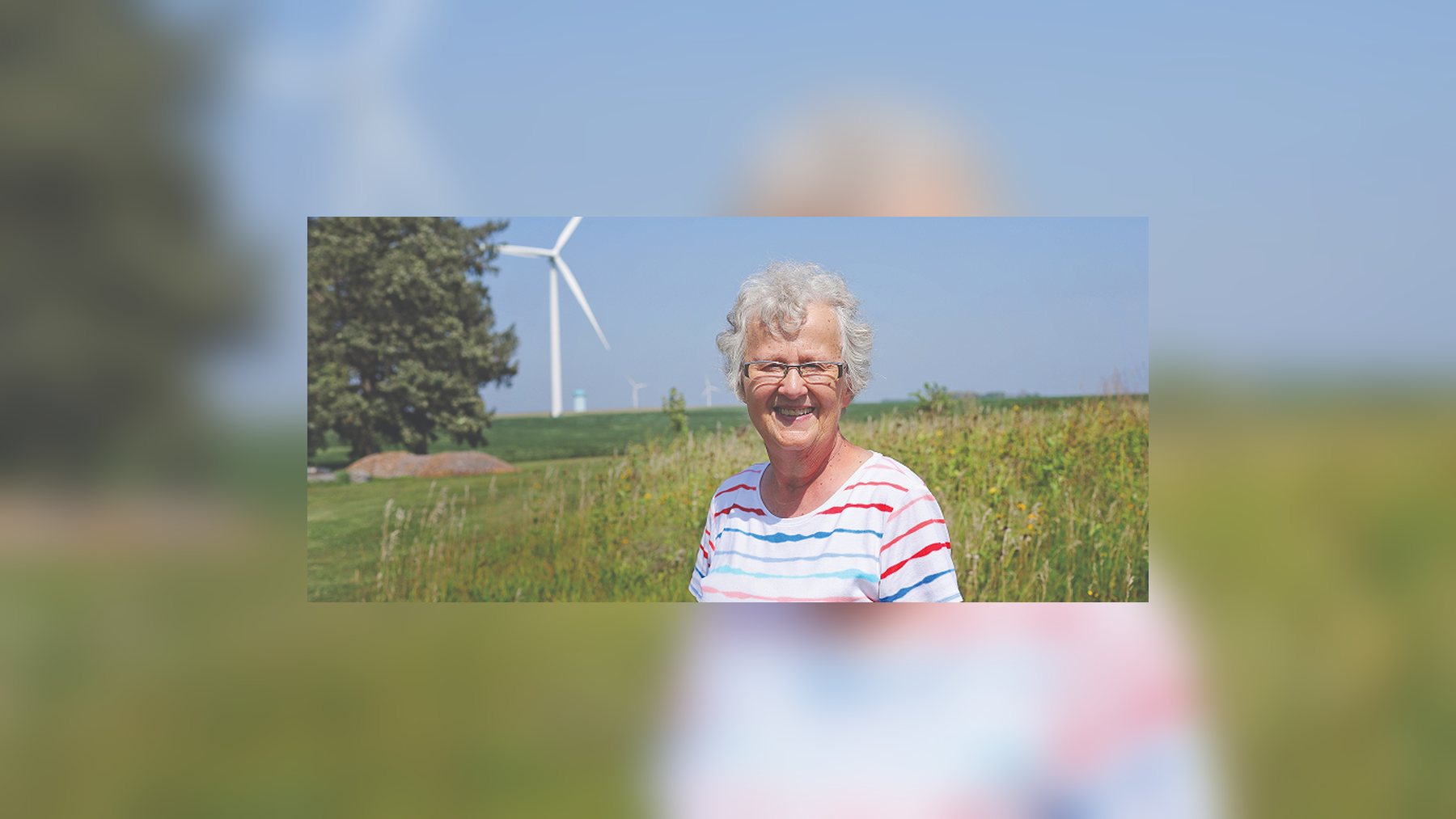
Three wind turbines named Deb, Barb, and Craig have been spinning for more than a decade on Evie’s farm in Grundy County, Iowa. MidAmerican Energy told their story in March 2025 and updated it after her passing in May 2026.
The property spans 160 acres, about 65 hectares. The three turbines are part of the Wellsburg wind park. In return, Evie collected an annual payment for the land’s easement.
Wally’s Idea
Evie and her husband, Wally, met in Wellsburg, where they started a family. According to the company, Wally was passionate about conservation. He planted trees and meadows and read everything he could about clean energy.
When a possible wind park was announced in the area, the couple joined the list of interested landowners. Construction began in 2014, and Wally photographed the project from the outset.
Wally died unexpectedly before the turbines on their farm were finished. Evie kept taking photos. She later assembled a presentation documenting the entire process and showcased it in a grandchild’s class.
Deb, Barb, and Craig
Evie named each wind turbine after one of her children. In her dining room she kept a collection of artworks featuring windmills. Among them was a Dutch windmill tapestry inherited from her grandmother.
MidAmerican notes that the annual payments gave her some financial security after her husband’s death. She explained it with Wally’s idea: having turbines would be “like a kind of annuity.”
“As a farmer, you don’t have a pension plan,” Evie added in that interview. She also said she was “eternally grateful” to Wally for getting them into the project.
What mattered most to Deb, Barb, and Craig was their contribution to Iowa’s clean energy. When someone visited her, she would send them outside to look at the turbines and be amazed.
How a Landowner Is Paid for a Turbine
The company does not publish how much Evie received. The United States Department of Energy’s wind energy development guide explains how these contracts typically work.
According to the document, the promoter pays the owner for each turbine installed on their land. Agreements usually run 20 to 30 years, often with an option to renew.
The guide distinguishes three formulas. It can be a fixed payment, a percentage of what those turbines earn from electricity, or a mix of both. In the second case, the money changes from year to year with the wind.
The department calculates an average payment of $6,700 per megawatt in the United States. Owners typically negotiate with lawyers. The guide also highlights the importance of compensating for crop damage during construction.
Something similar was described by a farmer in Illinois who ended up viewing the rental of his wind turbine as his retirement plan.
What the Wind Means for Iowa
Wind is already Iowa’s primary source of electricity. The Iowa Utilities Board’s electric profile uses definitive 2025 data. Wind produced 58.48% of the state’s electricity, while coal accounted for 25.64%.
That percentage includes installations larger than one megawatt. Wind farms totaled 13,411 megawatts of capacity, more than half of the state’s installed capacity.
MidAmerican has more than 3,500 turbines in Iowa and over 7,800 megawatts of wind capacity. That averages a little over 2 megawatts per turbine.
In 2025, the company paid around $60 million to more than 4,000 owners and neighbors of its parks. Divided evenly, that would be less than $15,000 per person, though each contract differs.
It paid a similar amount in property taxes across 35 counties. That money funds schools, roads, and emergency services, according to the company.
Noise, Birds, and Blades That Are Hard to Recycle
Wind energy also carries costs. The Energy Information Administration notes that turbines do not emit gases during operation and can help reduce fossil fuel generation.
The same agency acknowledges that blades generate noise when spinning and that some people find it bothersome. Birds and bats can die from collisions with the blades.
Manufacturing the components also leaves a footprint, and current blades cannot be recycled. There are trials to reduce these impacts, such as a blade painted black on Smøla Island, Norway.
Another approach is to upgrade older parks with fewer turbines but greater capacity. The industry discussed this at WIND OPS 2026 on repowering.
What Still Isn’t Known
MidAmerican’s profile doesn’t say how much Evie charged or what portion of the farm is occupied by the three turbines. It also doesn’t clarify whether her contract was fixed payment or production-based.
It is also a story told by the company that manages the park. It presents a landowner who was satisfied. It does not include the views of neighbors without turbines or of other owners.
MidAmerican Energy published Evie’s profile in March 2025 and updated it after her death in May 2026.
Photo: MidAmerican Energy
