
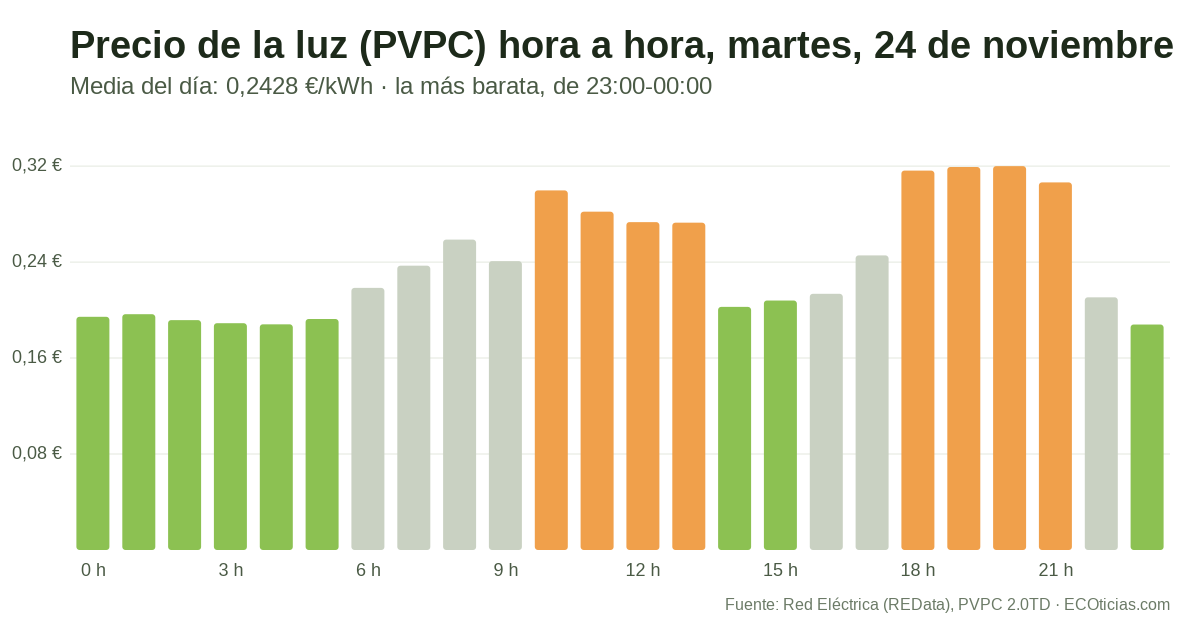
The price of electricity for tomorrow, Tuesday, November 24, will average 0.2428 euros per kilowatt-hour in the regulated tariff (PVPC). This is shown by the hourly table published by Red Eléctrica for that day. The cheapest hour will occur at the end of the day, from 23:00 to 00:00, at 0.1900 euros.
The average is 1.8% below that of Monday the 23rd, which was 0.2472 euros. By contrast, compared with Tuesday, November 17, the kilowatt-hour is 38.7% more expensive. That day the average stood at 0.1751 euros.
What price is this exactly
These are PVPC 2.0TD prices on the peninsula, the regulated tariff for households that have it. They include energy, tolls and charges, but not taxes or the power term. The daily table is published the day before.
That is why they do not match what is finally paid on the bill. They are useful for comparing hours and for deciding when it is convenient to turn on the appliances that consume the most energy.
The cheapest hours on Tuesday
The early morning remains the best time to consume. From 00:00 to 06:00, all hours are below 0.20 euros. The minimum in that window occurs from 04:00 to 05:00, at 0.1902 euros.
The three cheapest hours of the day are from 23:00 to 00:00 (0.1900 euros), from 04:00 to 05:00 (0.1902) and from 03:00 to 04:00 (0.1911). All three are more than five cents below the average.
In the afternoon there is a small respite. From 14:00 to 15:00 the price drops to 0.2048 euros, and from 15:00 to 16:00 it remains at 0.2102.
The afternoon, the most expensive window
The expensive stretch arrives with the return home. From 18:00 to 21:00 are the three most expensive hours of the day, at 0.3196, 0.3227 and 0.3235 euros. The 21:00 to 22:00 hour also stays high, at 0.3097 euros.
Mid-morning there is another smaller peak. Between 10:00 and 11:00 the kilowatt-hour reaches 0.3030 euros, and from 11:00 to 12:00 it remains at 0.2851. By midday it gradually falls to 0.2758 euros at 13:00.
How it changes by hour
The difference between the most expensive and the cheapest hour is a little over 13 cents per kilowatt-hour. In other words, consuming from 20:00 to 21:00 costs about 70% more than doing so from 23:00 to 00:00.
Practically, every kilowatt-hour that moves from the late-afternoon expensive window to the last hour of the day costs between 12 and 13 cents less. This is the calculation you can apply to running the washing machine, the dishwasher, or charging an electric car.
Many of these devices allow you to program the start. Simply prepare them and have them start after 23:00. By 22:00 the price drops sharply to 0.2129 euros, almost 10 cents less than an hour earlier.
Renewables, just context
Red Eléctrica also reports how much electricity comes from renewable sources each day. From November 16 to 22, its share ranged between 55.7% on the 20th and 68.9% on the 19th. Sunday the 22nd stood at 65.7%.
These are data from past days, not a forecast for Tuesday, and they do not explain tomorrow’s price. Last month we already explained how solar power gained weight in October’s electricity mix.
If you don’t have the regulated tariff
Those with a contract on the free market pay what their contract states, not these hourly prices. In that case, the PVPC table serves only as a reference.
To compare what you pay with other offers there is the CNMC’s energy offers comparator, the body that supervises the markets. It helps you view other offers before deciding whether to switch contracts.
Where to look at the price every day
The chart covers the 24 hours of Tuesday, highlighting the cheapest and most expensive times. The hour-by-hour detail, for today and for tomorrow, is on our page of the price of electricity by the hour, which updates automatically.
The grid that carries that electricity is also changing, as we explain with the electricity planning through 2030. Official price data can be consulted on the Red Eléctrica website.
Image: Red Eléctrica