
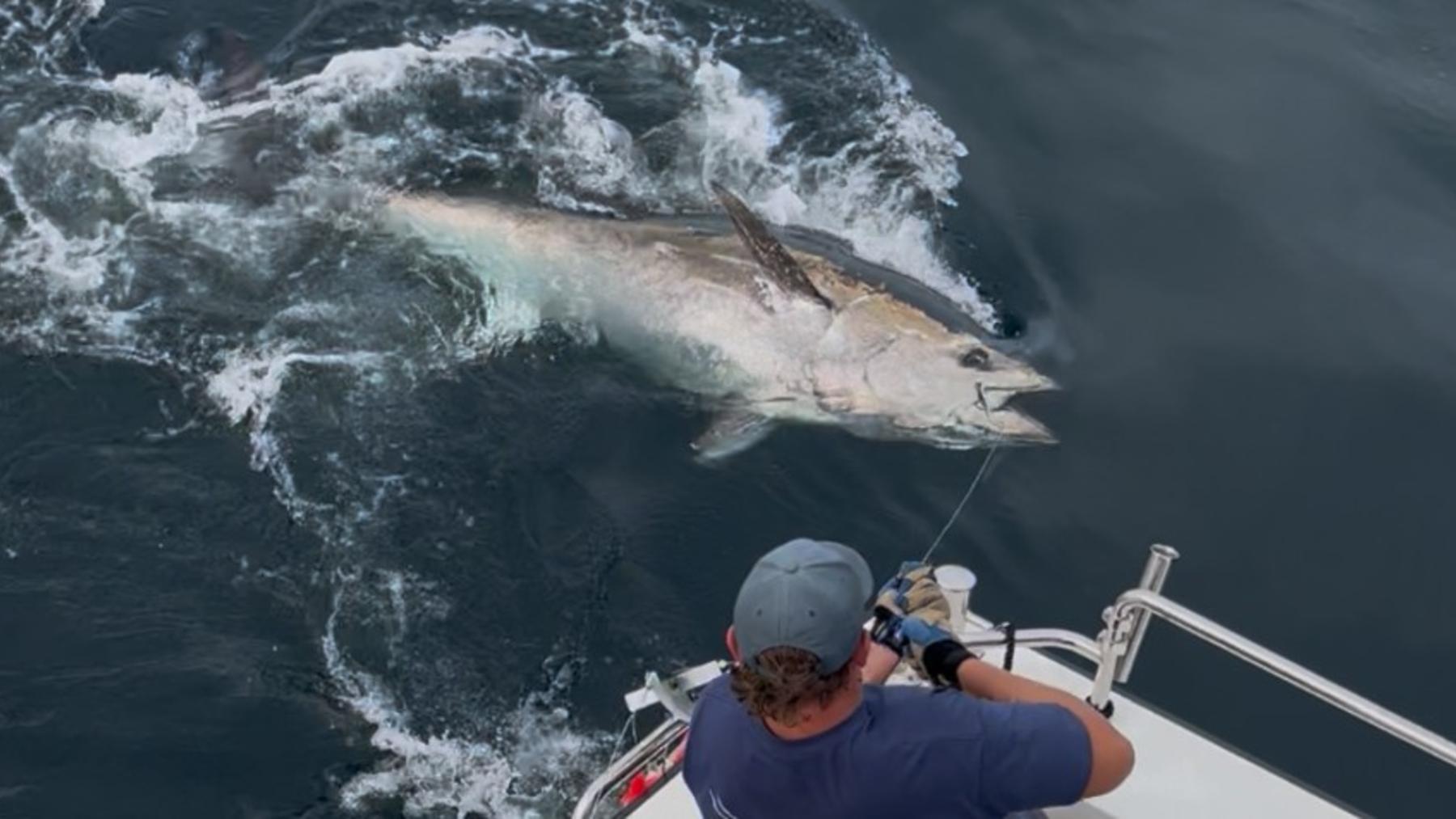
The return of the Atlantic bluefin tuna is reshaping the British fishing landscape. In 2026, the United Kingdom authorizes up to 30 commercial vessels to catch it, double the 15 permitted in 2025, as scientists study the movements of these apex predators.
The recovery opens opportunities for ports and recreational fishing businesses, but it also requires careful oversight of how the resource is used. Knowing how many animals are seen from a boat helps, although deciding how much can be fished requires data on their populations, their movements, and their breeding.
The figures for Atlantic bluefin tuna in the United Kingdom
| Data | Figure |
|---|---|
| Annual British quota (2026-2028) | 230.56 tonnes |
| Commercial fishing in 2026 | 120 tonnes, about 52 % of the quota (own calculation) |
| Authorized vessels | Up to 30, with 4 tonnes per vessel |
| Commercial season | From July 13 to December 31, 172 days (own calculation) |
| Maximum length | 12 metres |
| Tuna tracked for at least 300 days | 25, of which 22 returned to the Channel (88 %) |
| Tunas tagged off Whitby (August 2026) | 5 |
Up to 30 vessels and four tonnes per vessel
The UK’s annual quota for 2026, 2027 and 2028 stands at 230.56 tonnes. Of that amount, 120 tonnes are allocated to commercial fishing in 2026, distributed among 30 vessels with four tonnes per vessel. Those 120 tonnes represent a little over half of the annual quota, around 52 %.
What does this mean in practice? The authorised fishermen have more room to operate, but they remain subject to specific conditions, such as using rod and reel, recording catches, and docking at designated ports.
The commercial season began on July 13 and is planned to run until December 31. Participating vessels must be no longer than 12 metres, and their trips to catch Atlantic bluefin tuna must last less than 24 hours. In total there are 172 days in the season.
Disappeared from the North Sea in the 1960s
Atlantic bluefin tuna had already been part of Britain’s fauna before its recent resurgence. It disappeared from the North Sea during the 1960s, in a context of overfishing and the depletion of herring stocks that fed it.
“Bluefin tuna is a native British species,” recalls Lucy Hawkes, a researcher at the University of Exeter. The comeback did not begin this summer, as a study published in 2021 already documented an increase in its presence in British and Irish waters since 2014.
Recovery, climate and food, with no single cause
Research points to a combination of population recovery and environmental conditions. The 2021 work found relationships between sightings, abundance estimates and a climatic oscillation in the Atlantic, but those associations do not allow attributing the return to a single cause.
Diet also matters, a great deal. Exeter noted in 2025 that there was still a need to better understand the local diet of these animals and launched an initiative to analyse remains of their prey using DNA.
That work aims to understand which fish sustain their presence and how to protect them. The idea is straightforward, because preserving a top predator also requires safeguarding the food it depends on.
22 of 25 tuna returned to the English Channel
Electronic tagging allows tracking tuna well beyond the place where they are captured. A study published in January 2025 in Scientific Reports analysed tagged animals between 2018 and 2021 and found notable fidelity to the English Channel.
Of the 25 specimens tracked for at least 300 days, 22 returned to the Channel, 88 % of that sample. The figure describes the animals studied and it is appropriate to keep that scale when interpreting the results.
The monitoring also documented connections with the Bay of Biscay and the Mediterranean, where breeding zones are located. These journeys show why a country’s decisions must fit within the international management of a species that crosses borders continually.
Five tuna tagged off Whitby
In northeast England, another question remains. On August 17, 2026, Exeter announced that its team had tagged five tunas off Whitby to investigate their origins and movements.
The tags record light, temperature and depth, data that allow estimating where the fish travel. They are designed to detach after two years and transmit information by satellite, though physically recovering the device provides more detail.
Fishermen collaborate by locating and capturing the specimens for the scientific team. This cooperation yields knowledge of the sea and enables studying animals whose origin remained unclear when the project was announced.
Catch-and-release with permit and mandatory training
Recreational fishing in English waters operates on a catch-and-release basis and requires a specific permit. In 2026 it includes mandatory training accredited by Angling Trust, with part online and part in-person on welfare, handling and safety.
Tuna caught under that permit must remain in the water and be released. In addition, all trips must be reported to the competent authority, even when returning to port without having caught any fish.
The challenge is to keep the new economic opportunities in place for years without compromising the recovery. The official guidance for this activity, updated September 3, 2026, has been published by the UK Marine Management Organisation on GOV.UK.
Image: University of Exeter