
Reducing emissions by 18% before the end of 2030 would keep the warming peak at 1.7-1.8°C. This is calculated by the United Nations Environment Programme (UNEP) in its Emissions Gap Report 2026, published on October 21. The cut is measured relative to 2025 and would need to reach 45% by 2035 and 69% by 2040.
And what have countries promised? Much less, because their new plans, if fully implemented, would yield reductions between 5% and 8%. «Overcoming does not mean capitulating», stated UN Secretary-General António Guterres, with the 1.5°C limit already condemned to be surpassed.
Going past 1.5°C, inevitable
After decades of insufficient action, it is no longer possible to limit warming to 1.5°C with an overshoot of less than 0.1°C. That does not mean giving up. It is still possible to decide how much and for how long the threshold will be exceeded.
UNEP calls for its proposed scenario of the smallest possible overshoot. It would have a 66% chance of curbing the peak by the mid-century. And about a 50% chance of returning to 1.5°C or below by 2100.
In practice, we are talking about cutting emissions by an average of 5.7% per year between 2025 and 2035. In addition, around 320 gigatonnes of CO₂ would need to be removed from the atmosphere over this century. According to UNEP’s official note, it is far from clear that this can be achieved.
Heading toward 2.8°C
With current policies, warming could reach 2.8°C this century. If all commitments were fulfilled, it would stay at 2.6°C. Not even the most optimistic scenario, including net-zero targets, would drop below 2.1°C.
Every five years of emissions at the current pace add about 200 billion tonnes of CO₂ to the atmosphere. The peak then rises by around 0.1°C. And that, on a planetary scale, is no small matter.
Inger Andersen, head of UNEP, ties this to “the deadly floods, heat waves and wildfires that have devastated many countries this year.” Anyone who has endured the latest heat waves in Spain knows what she is talking about. Still, she ends with two words: “It is possible.”
133 Megatonnes More in the United States
In 2025, global emissions totaled 58.4 billion tonnes of CO₂ equivalent, roughly the same as the previous year. The declines in soils and forests offset the rise from fossil fuels. That is why UNEP warns that it is too early to speak of a peak.
The United States was the country that increased them the most, by 133 megatonnes, driven by electricity demand and coal. Turkey (24.4), Iran (18.9) and Indonesia (17.4) are far behind. Its withdrawal from the Paris Agreement partly explains why forecasts worsened compared with the previous year.
There is also an accounting trick. The gap between what is done and what is promised for 2030 seems smaller than in the 2025 report, but “this does not reflect a stronger political action.” With Washington leaving the agreement, its target left the global tally and entered its current projections.
From 17.9 tonnes to 3.1
The global average is 6.4 tonnes of CO₂ equivalent per person per year. But Russia reaches 17.9 and the United States 17.6, ahead of China (11.4) and the European Union (7). Indonesia sits at 4.7 and India at 3.1.
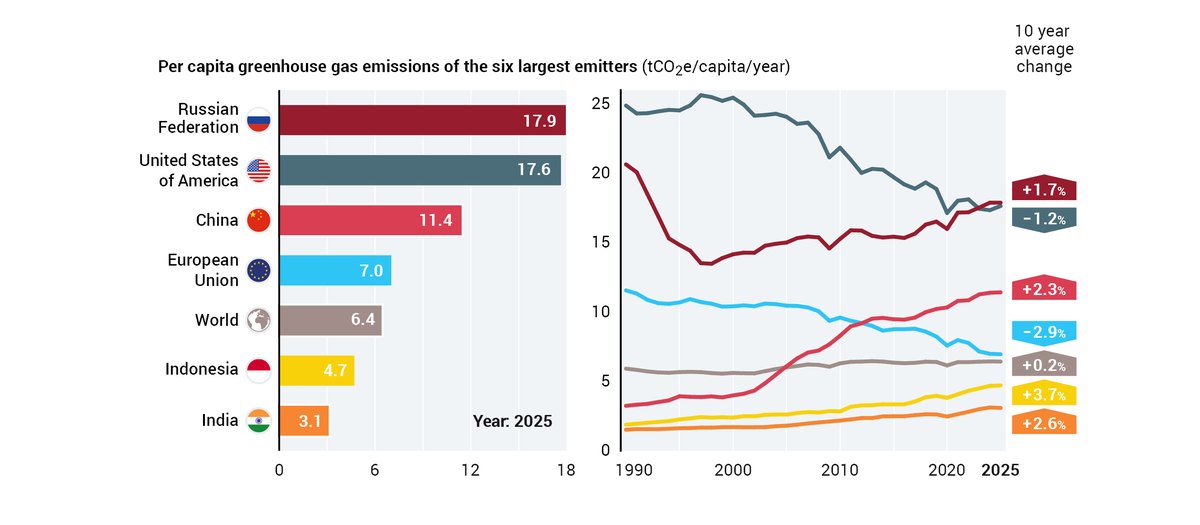
During the last decade, 124 countries increased their emissions and only 63 reduced them. The G20 accounts for 76% of the total, and Argentina, Saudi Arabia, and the United States still have no new targets for 2035. Let’s see who convinces whom at the next summit.
Less Coal Before 2035
To stay on that path, coal’s share in the energy supply would have to fall by at least 55% by 2035. Oil would drop by 15% and gas by 5%. These are serious tasks, and they would be felt in urban smog and in electricity bills.
There are also reasons not to sink. More than 220 assessments confirm that climate policies work, with an average cut of 9% in the electricity sector. The problem is that these successes remain concentrated in a few sectors and countries.
The next stop is Antalya (Turkey), because COP31 kicks off the second global stocktake of the Paris Agreement. The report calls for bringing targets to 2035 and 2040, such as tripling renewables, and it is worth recalling that the United States has already left COP30.
The 18% Has a Range
That 18% figure should be read with caution, because the report itself provides a range of 15% to 36%. It also comes from only eight scenarios, and no one guarantees the outcome.
The 2025 data are preliminary, with an error margin of 5.5 billion tonnes up or down. It is not clear either whether humanity will be able to remove as much CO₂ as the scenario requires.
The Emissions Gap Report 2026 has been published on UNEP’s website.
Photo: UNDP Morocco
