
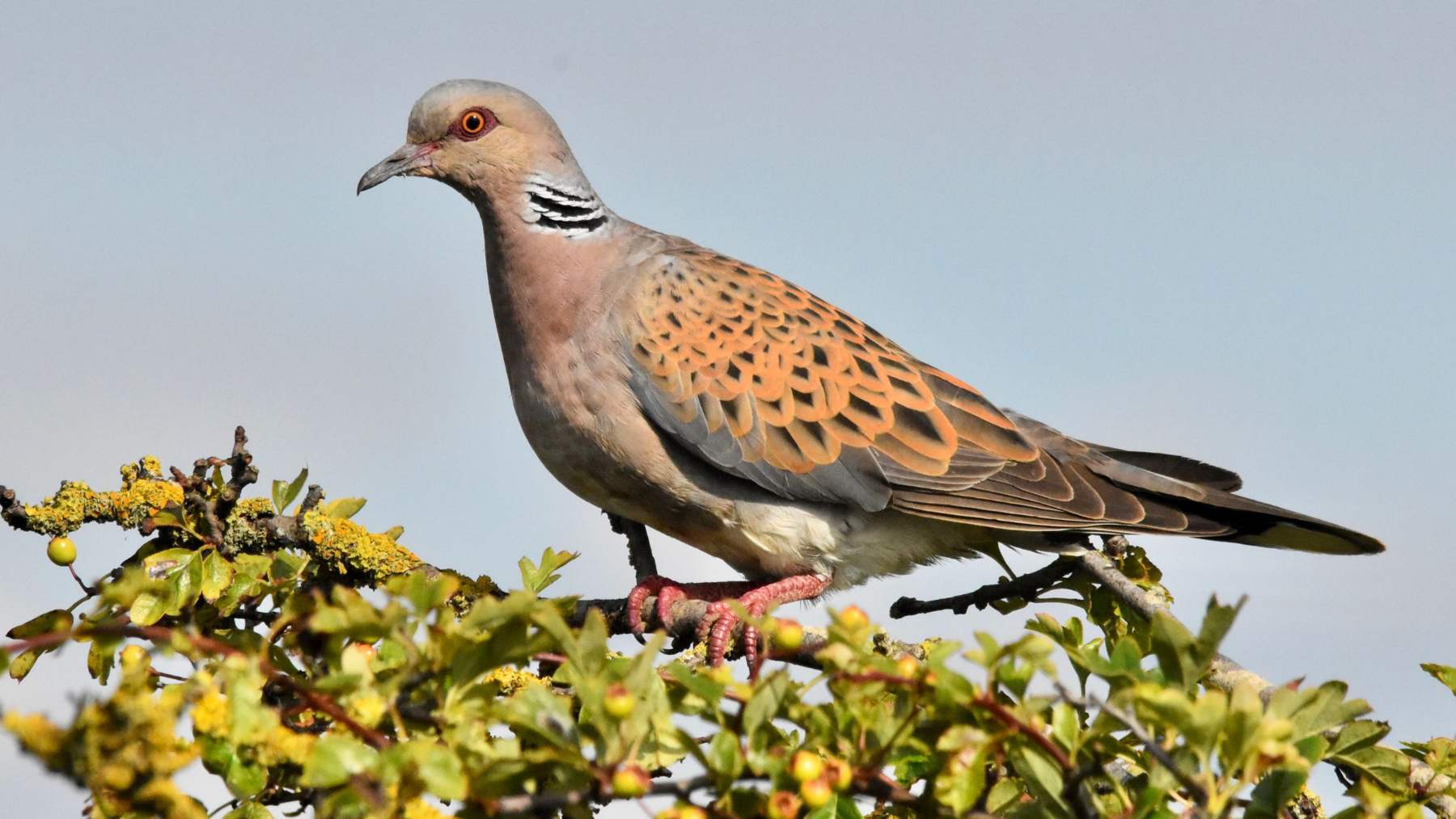
Thirty European turtledoves have been released near Selborne, in Hampshire, inside the South Downs National Park, in an effort to boost their population in the United Kingdom. The release took place in late spring 2026 and is part of an initiative that plans another hundred birds for spring 2027.
The project blends the release of birds with the restoration of ponds, hedges and plants that provide them with food. An egg-lert has already been observed, but it remains to be seen how many will survive, migrate and breed again in the area.
A Decades-Long Decline
The European turtledove (Streptopelia turtur) has lost 99% of its British breeding population between 1967 and 2024, according to the British Trust for Ornithology (BTO). It is a decline that has accumulated over decades, which explains why releasing thirty birds has attracted so much attention.
The species is listed on Britain’s Red List of birds of conservation concern. Globally, it is classified as Vulnerable, a distinction necessary to understand the news and not confuse the risk of disappearing from the UK with imminent extinction worldwide.
Restoring Its Pantry
What does a turtledove need to stay and raise its chicks? The RSPB, Britain’s bird-conservation organization, points to three basic resources that should be found near one another, ideally within 300 metres: readily accessible seeds, dense vegetation for nesting, and water.
In the South Downs, wildflowers such as fumitories and vetches have been planted, whose seeds serve as food. Seven ponds close to nesting sites have also been restored so that the birds can drink and bathe, according to information released about the project.
Those plants that we often call “weeds” can be a pantry for wildlife. The RSPB explains that turtledoves seek seeds on the ground and need low vegetation with clearings that allow access to them. Food shortages in agricultural landscapes make their recovery difficult.
A Nesting Event That Is Encouraging
One of the released females returned to the enclosure to lay eggs, as the park ranger Paul Bushell explained. The official described that behavior as “incredibly encouraging” and highlighted the thrill of seeing and hearing these birds in the landscape again.
The observation is promising, though by itself it does not prove that a self-sustaining population has been established. Laying a clutch is a first step, and it will need to be verified whether chicks hatch, learn to fly and subsequently join the breeding population.
A Journey Across Spain
The next challenge takes these birds far beyond Hampshire. Park officials expect them to undertake a migration of about 4,800 kilometres to their wintering grounds in sub-Saharan Africa, crossing France, Spain and Morocco.
Their return to the South Downs is anticipated for spring 2027, but it remains an expectation. That journey helps explain why protecting a migratory species requires looking beyond the release site. The conditions they encounter along the journey are part of the same story.
Releases Spark Debate
The release of birds bred in captivity does not have the backing of all conservation groups. Operation Turtle Dove, a coalition in which the RSPB participates, states that it currently does not support these releases as a conservation measure and focuses its work on restoring the conditions the species needs.
The Turtle Dove Trust, for its part, advocates combining controlled releases with habitat improvements. In its response to those criticisms, it acknowledges that there is still no definitive evidence of the long-term success of breeding and reintroducing this species. Monitoring will be decisive in assessing the results.
The Test for the Upcoming Springs
Wardens are gathering observations sent by the community and placing them on a map to track the birds’ movements. That collaboration will allow for a better understanding of where the birds appear and what happens when the next breeding season arrives.
The plan to release another hundred specimens broadens the project’s scope, though its results will need to be measured over the coming years. The question will be whether the turtledoves find food, survive and continue to breed continuously in this agricultural landscape.
The announcement of this action was released on September 7, 2026. The official statement has been published on the South Downs National Park’s website.
Image: Gary Roberts / South Downs National Park Authority