
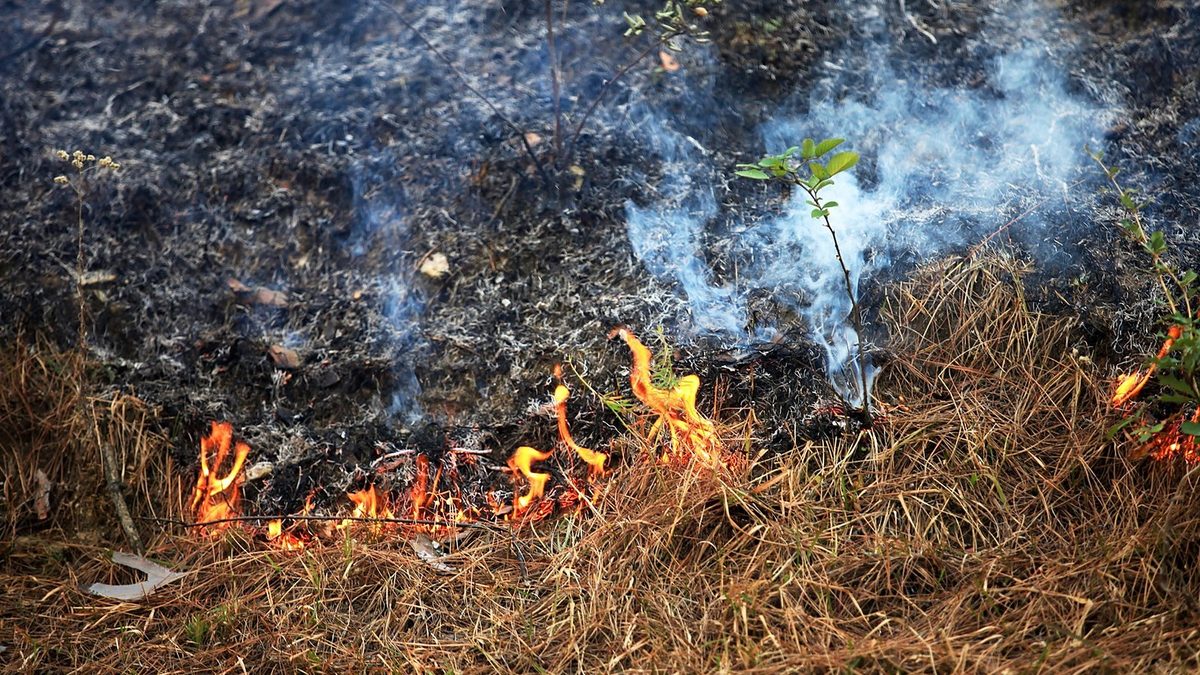
In November, olive trees or vines are pruned, and on many farms the same pile of branches is formed, waiting for a match. Well, the Waste Law states that this, as a rule, should not be done. Since April 2022 it has been generally forbidden to burn vegetative residues from the field and the countryside, and it can only be done with authorization from the autonomous community.
Everything stems from Article 27.3 of Law 7/2022, on waste and polluted soils for a circular economy. Law 30/2022 gave the wording that applies today, in force since January 2, 2023, and with it came a relief for small agricultural holdings. In Aragón, for example, burns outside the danger season can be notified or requested from October 16, so the issue is very timely.
What exactly does the law say
The first sentence of the article leaves little room for interpretation. “Generally, the burning of vegetative waste generated in the agricultural or silvicultural environment is not allowed,” states the Official State Bulletin.
We are talking about the branches that come out when pruning or what is cleared from the forest. The law asks to manage those residues according to the waste hierarchy. The priority is to recycle them through the biological treatment of organic matter.
Exceptions and permits
There is, however, one group for whom the general rule is different. “Small and micro agricultural holdings are exempt from this regulation,” says the same article. That exemption is supported by a 2016 European directive on atmospheric pollutants, which worsen air quality.
And what qualifies as a small holding? The article does not specify, neither by hectares nor by turnover figures. Anyone in doubt should consult with their regional ministry before lighting anything on fire.
Be careful, because that exemption does not give a blanket freedom. According to the Government of Aragón’s FAQs, small holdings are exempt from the prohibition except for stubble, but always provided they have authorization from the competent body. Moreover, the article is applied without prejudice to the Forest Law.
For the rest, the law only allows two reasons to authorize a burn. One is pests that cannot be treated in another way, and the other is to prevent fires.
Penalties for burning without authorization
The law cites this conduct in its Article 108.2.d. It sits among the very serious infringements for abandonment, dumping or uncontrolled management of waste. This provision applies when there is grave danger to health, serious damage to the environment, or if it occurs in protected spaces.
For very serious infringements, Article 109 sets fines from 100,001 to 3,500,000 euros. These amounts correspond to cases meeting those conditions, not to any unauthorized burn.
How it works in each community
In Galicia, according to a note from April by the Department of Rural Environment, agricultural burns must be reported two days in advance. It can be done via its website or by calling 012 on working days.
The Xunta asks for confirmation that the materials are agricultural residues from farms. Forest residues heaped up require authorization, and no permit is valid on days with wind and high temperatures.
In Aragón, the danger period runs from April 1 to October 15. Outside of it, in the forest or within 400 meters, piles of separated residues must be notified, and you must wait seven working days. If the vegetation is continuous, such as a stubble field, authorization is required.
Even so, burns are only allowed on days when the region’s risk index is green. From November 1 to January 15, the operating hours are from 8:00 to 15:00.
What to do with the branches
One option is to shred them and leave them on the ground as fertilizer. This is proposed by the Government of Aragón, which also reminds that the residues can be taken to an authorized waste manager.
When shredded, the residues are incorporated into the soil as an organic amendment. In this way they do not remain piled on the property. A burned forest takes years to recover, as shown by the repopulation of the Piloña forest, which burned in 2023.
What depends on each place
The national law sets the general rule, but it does not specify the day you can burn in each town or which papers are needed. That is detailed by each autonomous community with its own fire regulations, as Galicia and Aragón do.
So before lighting the first branch, it is worth calling the ministry and asking whether notification suffices or whether a permit is required. The full text has been published in the Official State Bulletin.
Image: Xunta de Galicia
