
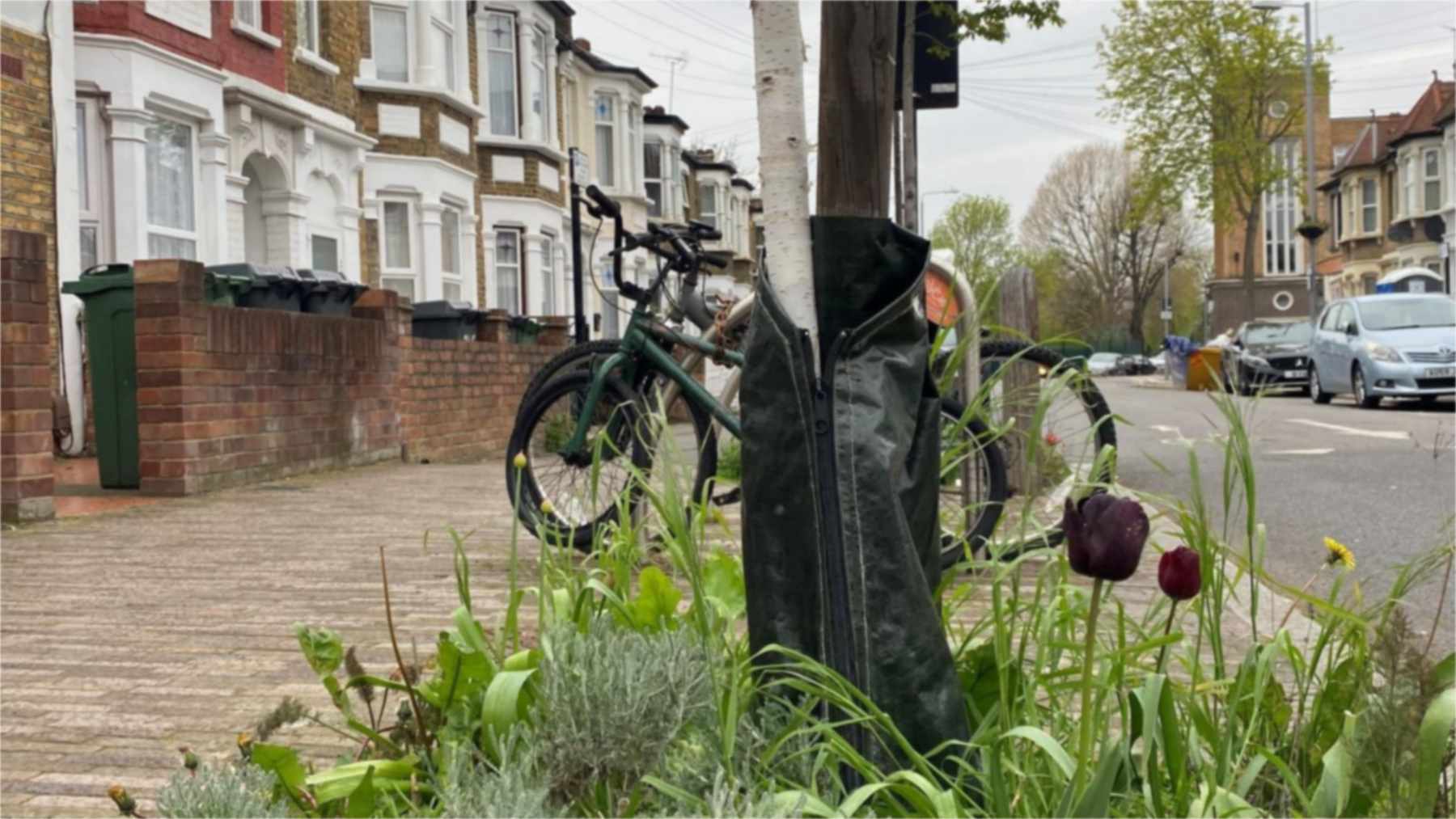
Katharine Hoskyns, an 89-year-old retired professor, has tended a small garden on the sidewalk of Hamilton Gardens, a cul-de-sac off Abbey Road in London’s St John’s Wood neighbourhood for more than 25 years. In July, Westminster City Council sent her a notice to remove a bench and more than 20 pots from the spot.
The council explained to the BBC that it acted after a string of local complaints and that episodes of drug use and litter had occurred around the bench. Hoskyns, who walks with a walker, says she has never witnessed any of that and simply passes between the pots without issue.
Tomatoes and Geraniums to Offset the Cars
The garden began when parking bays were introduced along the street. Hoskyns, who has lived in the area since the 1960s, started placing pots with her sister-in-law, Catherine Hoskyns, a 91-year-old retired university professor.
“We both love gardening a lot, and when Westminster City Council put parking bays on the street, we wanted something to balance the cars and make it a bit prettier,” Katharine told the local newspaper Westminster Extra.
Today there are perennial flowers, geraniums, tomato plants, aromatic herbs, and a vine “that’s doing fairly well,” as she describes it, in addition to the bench. The stretch of sidewalk, a stone’s throw from the studio where the Beatles recorded, leads only to the back door of her home, and Abbey Road’s orchestra has nicknamed the street “The Pots” (the pots), according to the same paper.
A Corner for Neighbours, Children and Workers
“People gather there to say hello to neighbours. Parents with children sit for a while and older residents use it. Paradoxically, it’s one of the city council workers’ favourite spots to take a break and have lunch,” Hoskyns told Westminster Extra.
The BBC spoke to her about what the garden means to her. “This space is important to me because I love gardening and it gives me a lot to do. I need a way to keep myself occupied in retirement,” she said. “People come up and chat with me while I’m working, so it also gives me a little social life.”
Her neighbour Holly Bell-Stevens thinks the corner would lose its character without the pots, in a city where hundreds of neighbours have just adopted Barbican plants. “We have this quiet oasis within Westminster, and removing the pots would turn it into another concrete corner,” she told the BBC.
“My children learned to ride bikes at this corner. We walk our dogs here. It creates community and touches everyone,” she added.
The Council Letter Gave two Weeks
The letter Hoskyns received at the end of July, cited by Westminster Extra, spoke of complaints from a “local member of the community” and claimed that, despite having discussed the matter with her family for a long time and offering help, not enough had been done to remove the pots or the bench. The deadline to remove everything was two weeks.
The council also cited safety concerns. “We’ve recently had a pot fall… many of these objects can fall, especially in bad weather, and could injure users of the footway or damage nearby parked vehicles. Moreover, it has not been confirmed that the bench is structurally sound,” the text stated.
The demand was issued under the Highways Act, the UK law governing public ways. On its website, the council warns that unauthorized pots may be subject to enforcement actions if they obstruct the passage or attract complaints, the BBC reports.
“After a series of residents’ complaints and informal attempts to resolve this dispute over several years, the council was reluctantly compelled to start formal proceedings,” a council spokesperson told the BBC. “Residents should be able to live without antisocial behaviour affecting their lives. Moving this bench will help reduce the recent nuisance in the area.”
The council added that it hoped to work with Hoskyns to move the bench and pots to a more suitable location and that it trusted the situation could be resolved amicably.
The Family Denies Anti-Social Behaviour Problems
“At first, when I received the letter, I was upset and very angry, but then my whole family got involved, wrote to the council and began this petition,” Hoskyns told the BBC. The petition—driven by her son—surpassed 190 signatures according to Westminster Extra; the BBC notes more than 1,000 signatures in August, with neither outlet clarifying whether it concerns the same campaign.
Catherine Hoskyns points to a single neighbour. “We believe one neighbour complained and claimed antisocial behaviour and that the place was an obstacle,” she told the local paper. “I’m 91 and I use a four-wheeled walker; the pots don’t obstruct anything, and the council has installed cameras showing there’s no antisocial behaviour at that bench.”
Katharine went further and recalled the council’s own policy to green the streets. “It’s a waste of time for council officials. They have an environmental policy to encourage soft urban edges, planting, and street greening,” she said. “This garden does that—it has been there for at least 25 years and really doesn’t bother anyone except that neighbour.”
Removal Put on Hold in August
After Westminster Extra queried the case, the council put the enforcement on hold and said it would re-examine whether the plants were causing any problems, according to the newspaper’s August 14 report.
In early September, the BBC reported that the deadline had passed and the garden remained in place, while Hoskyns waited for news from the council. Neighbours told the network they would welcome the chance to work with the council on the garden’s future.
The Council Guide Recommends Geraniums and Compact Plants
Westminster itself offers advice to residents who cultivate plants in tree pits, the soil spaces around the street trees. Its Tree-Pit Gardening Guide, updated on 17 June 2025, says this practice can enhance street aesthetics, benefit biodiversity, and deter littering, vandalism, and other antisocial behaviours.
In the plant-selection section, the Council recommends compact-growth species so that height and width do not obstruct the sidewalk, and sturdy, drought-tolerant varieties. Among the seasonal plants mentioned are calendulas and geraniums, though it cautions that they are more vulnerable to theft and vandalism.
The guide refers to tree pits rather than sidewalk pots like Hoskyns, but it demonstrates that the council values street greenery when it does not impede passage.
What Is Still Unknown
None of the published information confirms that the council has withdrawn the demand or that a final agreement has been reached with the family. It remains unclear where the bench and pots should be relocated to.
The reports of drug use and litter come from the council, and Catherine Hoskyns’ claim of camera footage to counter them has not been independently corroborated by public records.
The principal information comes from the BBC’s September 3, 2026 report and Westminster Extra’s August 14, 2026 article.
Image: Westminster City Council