
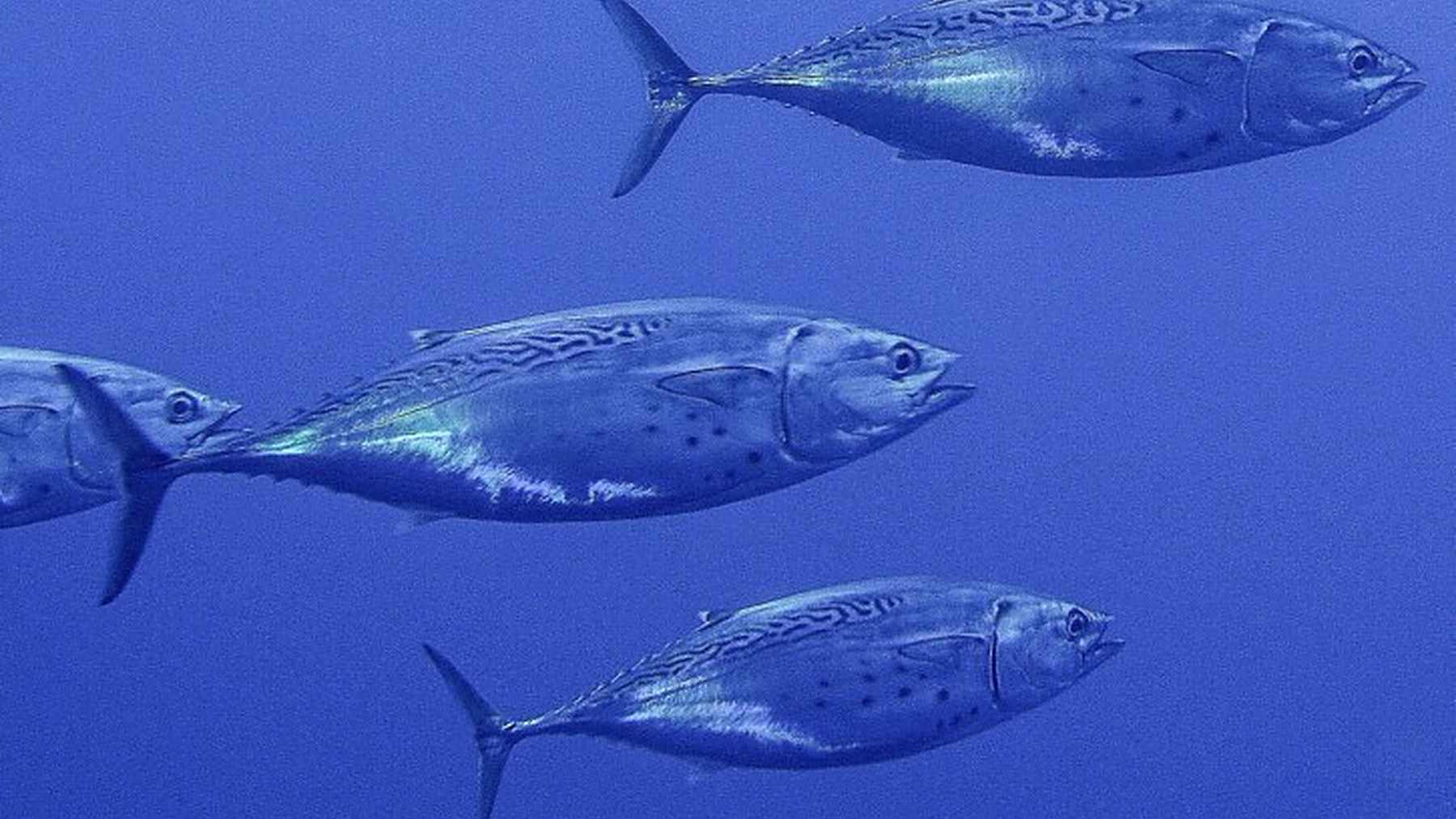
What has long been fished in the Mediterranean for centuries under the name “bacoreta” is not a single fish. An international study with participation from the Spanish Institute of Oceanography (IEO-CSIC) concludes that there are two species of bacoreta that are almost identical on the outside. One inhabits the North Atlantic and the Mediterranean, while the other dwells in the tropical waters off Africa.
The study, published in the journal Hydrobiologia, analyzed the DNA of more than 600 specimens and nearly 38,000 genetic markers. And who cares about this, aside from biologists? Well, those who manage fisheries, because catches of this small tunid are tallied in areas that could mix two species.
A name from 1817
Until now, all bacoreta were listed in books as Euthynnus alletteratus. The researchers propose reviving the name Euthynnus quadripunctatus for the fish of the North Atlantic and the Mediterranean. It stems from a description from 1817 and was used for a period, until it was absorbed by the other name.
The enduring name would stay for the tropical populations studied in Senegal, Ivory Coast and Gabon. In practice, the bacoreta caught in Spanish waters would carry a different scientific surname. A small change on paper, but with significant implications.
More than 600 fish analyzed
The study was led by the University of Girona (UdG) and the IEO-CSIC, with personnel from their oceanographic centers in Cádiz and Málaga. Teams from Portugal, the United States, Vietnam, Brazil, Tunisia, Senegal, Ivory Coast, and Gabon also participated.
To reach this conclusion, the team crossed three types of tests. Mitochondrial DNA from over 600 specimens, a genome-wide analysis with around 38,000 markers, and 466 dorsal spines. The spines are used to estimate the age of the fish, a process somewhat like counting tree rings.
All methods used to separate the species arrived at the same conclusion. The two groups form distinct evolutionary lineages, as distant as other species already recognized within the genus Euthynnus. They are what biologists call cryptic species—outwardly alike and internally different.
The northern stock grows faster
The difference between the two bacoretas does not stop at DNA. The northern specimens grow faster and reach larger sizes at the same age. The study’s models estimate a theoretical maximum size of about 99 centimeters for the northern group, versus around 70 centimeters for the tropical group.
In the north, growth also speeds up during warm months, while in the tropical group growth is much steadier. This aligns with their reproductive patterns. In the Mediterranean, reproduction concentrates from late spring to summer, and in the tropical Atlantic it is distributed across much of the year.
In other words, the northern fish bets on reproducing in season and growing quickly. The tropical one grows more slowly but reproduces during more months.
Sicily separates more than Gibraltar
Within each species there are more divisions than expected. In the northern one, results indicate at least three major populations. One in the western Atlantic, another in the eastern Atlantic and western Mediterranean, and a third in the eastern Mediterranean.
The curious part is where the boundary lies. One would think of the Strait of Gibraltar, but the analyses point to the Sicily Channel as the major genetic barrier. This sea has its own rules for tunas, as seen when counting why the Balearic Islands are key for bluefin tuna.
In the tropical species there are also differences among Senegal, Ivory Coast and Gabon. Yet they are much smaller than the gap that separates the two lineages.
Senegal, in the wrong box
And here comes the practical part. Small tunas catches in the Atlantic are recorded in large statistical areas that do not always match the real populations. Some, the authors warn, might be pulling together individuals from two species.
The clearest example is Senegal, included in one of the large North Atlantic areas. But the bacoretas analyzed there belong to the tropical lineage. It’s like counting in the same tally two fish that grow and reproduce differently.
That is why they urge better knowledge of where each species lives before setting new management units. The work stems from ICCAT’s Small Tunas Programme, the body that sets the rules to protect tuna from overfishing. It was funded by that programme and the European Union.
A gap off Mauritania
There remains a big unknown, because there are no samples from Morocco, Western Sahara, or Mauritania. Without them, we don’t know where the boundary between the two lineages lies or whether they interbreed. Samples from the Southwest Atlantic will also be needed.
Nevertheless, the IEO emphasizes that this is one of the first works to combine high-resolution genomics and growth studies to investigate cryptic tuna species. It also notes that there may be “unrecognized biodiversity” even in fish that have been fished for centuries. Discovering something new in the wild, like the tiny orange fish described in the Amazon, is almost to be expected, but in a market fish it is rather more surprising.
The full study can be consulted open access in the journal Hydrobiologia, and the official note has been published by the Spanish Institute of Oceanography.
Photo: Xavi Salvador Costa / Fishipedia
