
The temperature at which it is advisable to set the heating at home is 21 °C when wearing appropriate clothing, according to the Institute for Diversification and Saving of Energy (IDAE), which for the thermostat specifies 20 or 21 °C. The World Health Organization (WHO) sets the floor at 18 °C for the general population and warns that more may be needed in homes with older adults, children, or chronically ill individuals. The 19-degree limit approved in 2022 is not a valid reference, as it was in force only until November 1, 2023 and was never applied to housing.
Ideal indoor temperature at home in winter
IDAE summarizes this on its tips page for households: with appropriate clothing, 21 °C “is enough to maintain the comfort of a dwelling.” In its heating FAQs, the thermostat figure is between 20 and 21 °C, with warm clothes inside the home.
The WHO addresses the issue from a health perspective. Its 2018 housing and health guide proposes 18 °C as a safe interior temperature for the general population in temperate or cold climates, and it does so with a strong recommendation. It acknowledges that the evidence does not allow identifying an exact threshold. To pick that figure, it relies on a conclusion from a previous WHO working group: between 18 and 24 °C there is no demonstrable risk for healthy, sedentary people. Two follow-up studies conducted in Scotland, cited by the guide, linked homes heated below 18 °C with a higher risk of hypertension, and the risk increased below 16 °C.
The Regulation of Thermal Installations in Buildings (RITE) also provides a wellbeing range for designing installations: between 21 and 23 °C in winter and between 23 and 25 °C in summer. This is not a limit for residents, but it settles a common doubt: 23 °C is not a cold nor excessive temperature, as it falls within the wellbeing range for both seasons.
Heating temperature in each room
We did not find any public body with a complete table by rooms. IDAE gives a single figure for the whole dwelling, and WHO provides a general minimum. The clearest room-by-room breakdown from an official source is an example from the Green Homes program, from October 2014, which is published on the website of the National Environment Education Center (CENEAM), part of MITECO.
| Room | IDAE | MITECO (CENEAM, 2014) | WHO (2018) |
|---|---|---|---|
| Living room and dining area | 21 °C with appropriate clothing (20-21 °C on the thermostat) | 19-20 °C | 18 °C, general minimum |
| Kitchen | No specific figure | Around 18 °C | 18 °C, general minimum |
| Bedroom | Turned off at night (15-17 °C if the house is poorly insulated) | 15-17 °C | 18 °C, general minimum; higher for vulnerable individuals |
| Corridors | No specific figure | 15-17 °C | 18 °C, general minimum |
| Bathroom | No official recommendation | No official recommendation | 18 °C, general minimum |
| House empty for a few hours | 15 °C | No specific figure | No specific figure |
The WHO does not distinguish between rooms: its figure is the minimum for the entire dwelling. According to CENEAM, with that room-by-room distribution, the average home drops by 1 or 2 °C without people feeling cold.
The 19-degree limit expired in 2023 and was never applied to homes
In August 2022, Royal Decree-Law 14/2022 approved a shock plan for energy savings in climate control, in its Article 29. In administrative, commercial, and public spaces already regulated by the RITE, heating could not exceed 19 °C and air conditioning could not drop below 27 °C. The winter limit thus dropped from 21 to 19 °C, and the summer limit rose from 26 to 27 °C. The measure applied only during the operation of the heating or cooling installation and did not apply to homes.
These limits were set to expire. The seventeenth final provision of the decree stated they would be in force “until 1 November 2023,” and the BOE (Official State Gazette) does not record any extension of Article 29 (the extension that existed for Article 30 did affect public procurement). The Constitutional Court stated in its ruling 20/2024 that the article has not formally been repealed, but “for the most part it has lost its validity.”
What remains in force is the RITE itself (Royal Decree 1027/2007). In buildings and premises used for administrative, commercial, and public purposes (offices, shops, shopping centers, cinemas, bars, restaurants, stations, or airports), the heated air cannot exceed 21 °C and the cooled air cannot fall below 26 °C. The 21 °C limit applies when heat is produced with conventional energy. Homes remain outside this regime, and inspections fall under the responsibility of the autonomous communities. As of October 29, 2026, the consolidated text of the RITE in the BOE has shown no changes since August 2, 2022.
How much does consumption rise per degree of increase?
IDAE uses a simple rule: for every degree you raise the thermostat, energy consumption rises by around 7%, along with higher spending and CO2 emissions. The government used the same estimate in the preamble of the 2022 decree. This is an approximation, not a measurement for each house (the 2014 Green Homes program stated “around 10%”), and the actual cost depends on the system, insulation, and tariff.
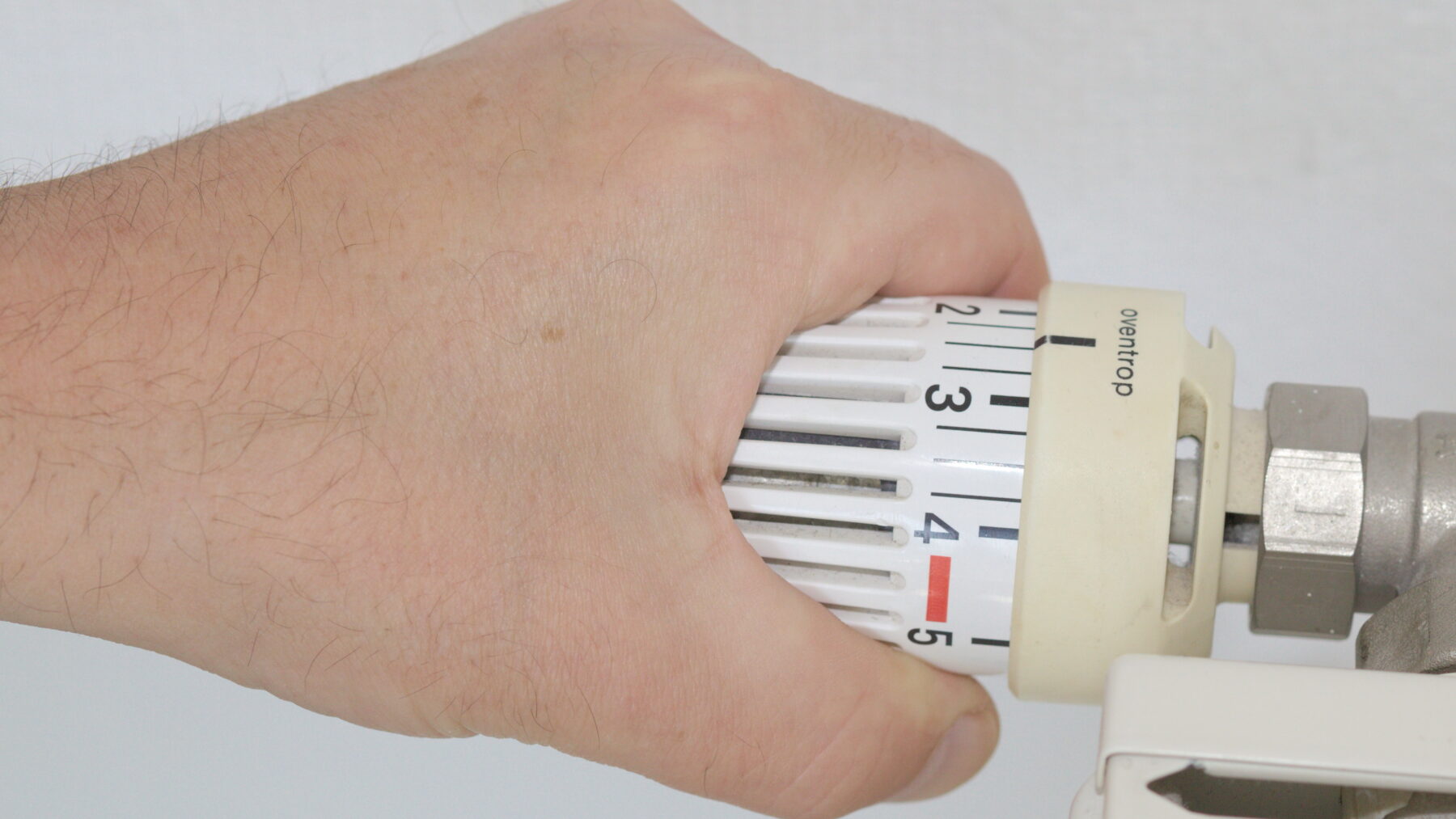
In this way, setting the heating to 25 °C implies four degrees more than the 21 °C recommended by IDAE, with each degree roughly 7% more consumption. That temperature already falls outside the winter wellbeing range of the RITE (21-23 °C) and outside the 18–24 °C range cited by WHO. None of these sources recommends 30 °C: that would be nine degrees above IDAE’s figure.
Nighttime and when you’re out of the house
IDAE advises turning off the heating at night, since for sleeping, 15-17 °C is “sufficient,” and to switch it on again a few minutes after waking. According to the agency, doing so is “much more efficient” than leaving it on all night. If the house is very poorly insulated, it suggests leaving it at 15-17 °C instead of turning it off. For short absences, the guideline is to lower the thermostat to 15 °C (the “Economy” setting).
This advice coexists with WHO’s minimum because the two figures pursue different objectives. IDAE focuses on energy savings and comfortable sleep, while WHO sets a health floor. In a study of adults with chronic obstructive pulmonary disease (COPD), cited by its guide, the best health condition was associated with more days spent in a bedroom at 18 °C or higher for at least nine hours. If elderly people, children, or chronically ill individuals live in the home—especially those with heart or respiratory conditions—the reference is not to drop below 18 °C, and WHO acknowledges that more may be needed.
The 2008 IDAE and ATECYR guide for central heating in multi-unit buildings already placed nighttime at 18 °C, with 21 °C by day. It also clarifies the “turning off” guidance: it depends on the building’s inertia, i.e., how much heat it stores. With heavy walls, it considers it more appropriate not to stop heating, and in the colder areas it also recommends not turning it off. In general, it proposes continuous schedules, with reduced temperature when no one is home.
How to set the heating to spend less
These are IDAE’s guidelines that do not require any works:
- Thermostat at 20-21 °C and warm clothes inside the house.
- Heating off at night and to 15 °C if you’ll be out for a few hours.
- Thermostatic radiator valves or a programmable thermostat, which save between 8 and 13%.
- Bleed radiators once a year.
- Lower blinds and pull curtains at night to avoid the “cold wall” effect.
- Ventilate for a few minutes, preferably before turning the heating on.
The thermostat explains only part of the expenditure. The other part depends on the system itself, since a gas boiler does not consume the same as a heat pump or an electric radiator, and before changing, it is worth comparing the different heating systems and the consumption of each. If you heat with radiators or electric stoves, it’s also useful to know the consumption of each appliance in watts. In homes with a heat pump, another option is to produce part of that electricity with solar panels.
Other temperatures not to confuse
The boiler temperature is not the same as the living room temperature. The boiler heats the water for radiators, and that figure is regulated within the device itself; what the person in the house feels is the air temperature, set by the thermostat. The appropriate water temperature depends on each installation, so it is wise to follow the installer’s instructions.
At work, another rule applies. Royal Decree 486/1997, addressing workplaces, sets temperatures between 17 and 27 °C in offices and sedentary work areas, and between 14 and 25 °C for light work, with humidity between 30% and 70%. That adds to the RITE limit: in an office with conventional heating, winter temperatures should move between 17 °C (minimum working) and 21 °C (RITE ceiling).
In summer, IDAE’s reference goes in the opposite direction: 26 °C or more, with appropriate clothing, is enough to be comfortable at home, and a fan provides a sensation of 3 to 5 °C cooler. We cover this in detail in the guide on what temperature to set the air conditioner.
