
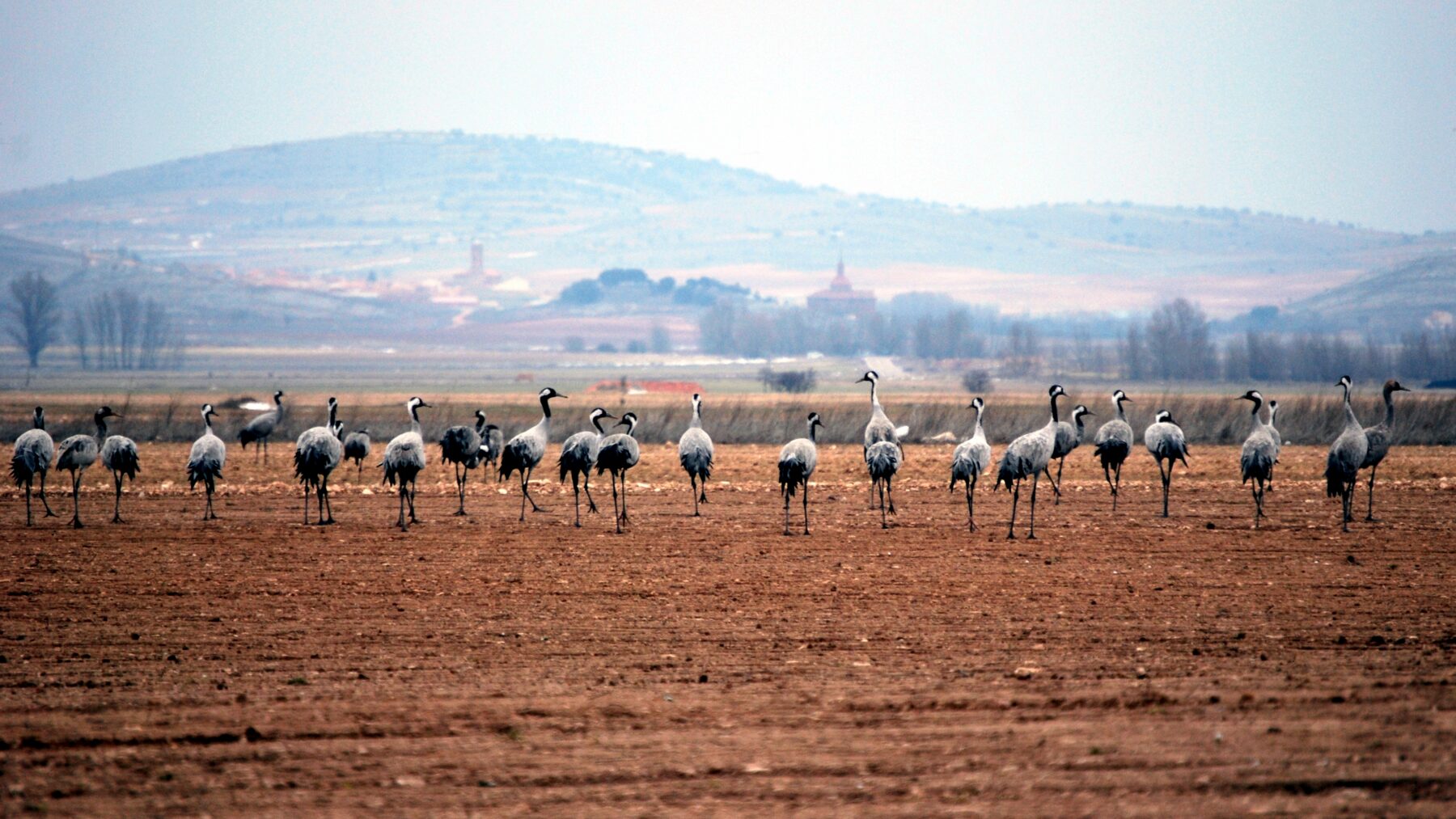
To see cranes in Spain you have to go between October and March, and the best places are the Gallocanta Lagoon (between Zaragoza and Teruel), the dehesas of Extremadura, and the Las Tablas de Daimiel National Park in Ciudad Real. According to SEO/BirdLife’s data sheet on the common crane, they enter the peninsula via the Navarre Pyrenees, pause first at Gallocanta, and stop there again from February to the end of March, on their way north. The ideal timing depends on the site, since at Gallocanta the peak arrivals occur in the second half of November and by the end of February, while in Extremadura, where they winter, the maximum occurs in December and January.
Calendario de las grullas en España por zonas
Spain is the main winter destination for European cranes in the Western Palearctic (Europe, North Africa and part of the Middle East). The peak does not fall on the same dates everywhere. In Extremadura, where they winter, it is December and January. Gallocanta is primarily a stopover site, and there the crane numbers rise and fall twice per season. Seeing cranes is one of the autumn naturalist appointments, alongside the deer rut, and this is its calendar by zones:
| Zone | When they arrive | When there are more | When they leave |
|---|---|---|---|
| Laguna de Gallocanta (Zaragoza and Teruel) | Mid-October (the first count is from the 14th to the 19th) | From November 18–23 and February 20–29 | By mid-March fewer than 1,000 |
| Extremadura | Early October, especially the second half | December and January | The last ones, in early April |
| Community of Madrid (transit zone) | Around October 22 | November 1–10 and February 21 to the end of the month | Until mid-March |
| Las Tablas de Daimiel and Cabañeros (Ciudad Real) | Mid-October (Daimiel) | Winter (Cabañeros peaks in December) | No published date |
Gallocanta: cuándo llegan las grullas y cuándo hay más
The lagoon serves as a roosting site for cranes from October to March, according to the public-use record of the nature reserve, and the Government of Aragon counts them almost weekly. Its last three censuses depict the same pattern: few birds in the first October count (between 297 and 1,502), the autumn peak between November 18 and 23, a drop in January (between 4,650 and 15,331), and a second peak between February 20 and 29.
| Season | First census | Autumn maximum | Return maximum |
|---|---|---|---|
| 2023-2024 | 314 (19 October) | 39,560 (23 November) | 28,317 (29 February) |
| 2024-2025 | 1,502 (17 October) | 34,112 (21 November) | 40,514 (20 February) |
| 2025-2026 | 297 (14 October) | 19,222 (18 November) | 28,227 (27 February) |
The autumn of 2025 is not a reference: avian influenza killed many cranes in northern Europe and in the lagoon during arrival, and the autumn maximum remained well below the two previous years. For the 2026-2027 season, the Red Natural de Aragón reported on October 13, 2026 that the first birds had arrived “timidly” and gradually, without giving a number (ECOticias counted the return of free routes to Gallocanta on October 17, 2026). By March, when the first swallows—migrants from Africa—arrive in Spain, Gallocanta had fewer than 1,000 cranes (840 on March 14, 2024 and 358 on March 12, 2025).
Observatorios, rutas guiadas gratuitas y hides
If you go on your own you do not need a reservation. The observatories of Los Aguanares, Los Ojos and Gallocanta and the towers of La Reguera and El Cañizar are freely accessible, and the circular path PR-Z 33 measures 30.6 kilometers and circles the lagoon. The Interpretation Center, on the Bello-Tornos road, is free; the Red Natural de Aragón publishes the days of opening, and it is advisable to confirm the hours at 978 73 40 31.
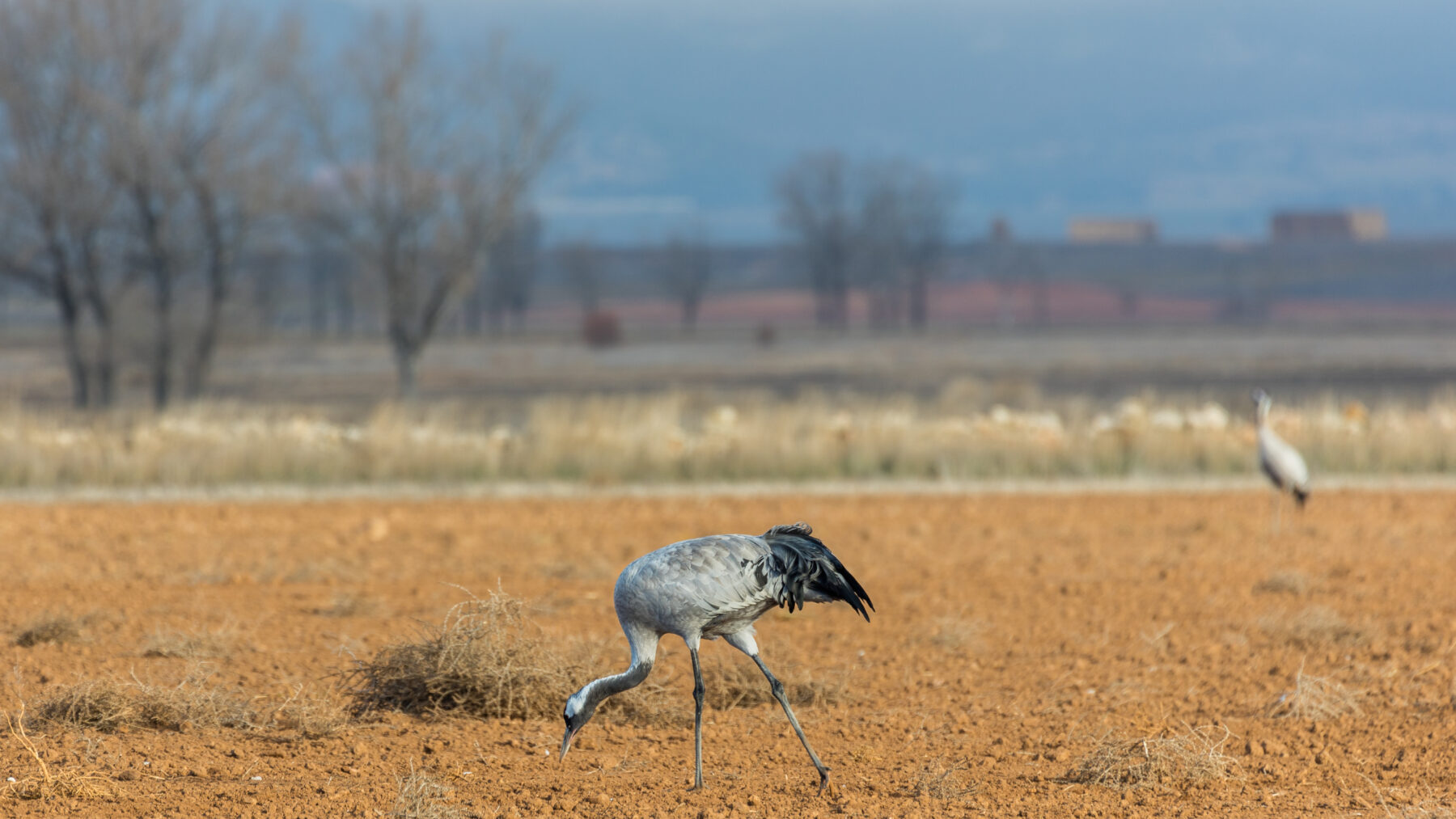
- Free guided tours. “In the Cranes’ Footsteps” runs on weekends and holidays from October 24, 2026 to early December 2026, with a morning and an afternoon shift of about three hours. Reservations must be made on the Red Natural de Aragón website (up to 10 adults and 9 children per booking) and participants must come by their own car; pets are not allowed and it is recommended for those aged 6 and up.
- Hides. Small hides for two people, with prior reservation and payment, where you enter one hour before dawn and exit one hour after sunset. They must be requested from the Teruel Provincial Service ([email protected] or 978 64 11 45), according to the reserve’s public-use plan, and the most requested hides for cranes are those at Bello.
The tracks that enter the reserve have a clearly marked prohibition of passage for vehicles and people, and slipping along them to get closer disturbs the birds. What you can do is watch from the observatories and from the free-access route, with binoculars or a telescope, and most visitors do so at sunset.
Dónde ver grullas en Extremadura
Extremadura is the main wintering zone. In the December 2025 census it counted 84,777 cranes, almost half of Spain’s total, and 58,127 were in Badajoz. The Junta de Extremadura estimates that the habitats they use cover 44% of the region and divides wintering into eleven sectors, with Zona Centro, Azuaga and Navalmoral the largest, and SEO/BirdLife locating the greatest concentration in the Vegas Altas comarca. According to the phenology published by the Junta, they arrive mainly in the second half of October, the peak is between December and January, and the last birds depart in early April.
A good starting point is the Moheda Alta periurban park, in Navalvillar de Pela (Badajoz), with an interpretation center at kilometer 4.8 of EX-116 (the road from Villanueva de la Serena to Guadalupe), three observatories to follow flights between feeding grounds and roosts and guided routes on request. Its website does not provide hours, rules or prices, so you have to inquire at the Municipal Town Hall of Navalvillar de Pela. There, on December 2, 2023, the fifteenth edition of the Crane Festival was held, with more than 500 attendees, according to the Junta de Extremadura. As of October 29, 2026, the festival website does not show a program for the 2026 edition.
Grullas cerca de Madrid, en Daimiel y en otras zonas de paso
The Community of Madrid is mainly a transit zone (243 cranes in the December 2025 census). A 41-season study, spanning 1979 to 2023 and published on the AEMET blog, places arrival around October 22 and spring departure around February 28 (medians for the 1991–2021 period), with the autumn peak in the first ten days of November.
In Ciudad Real, the December 2025 census counted 11,600 cranes in Las Tablas de Daimiel and 8,500 in Cabañeros. Daimiel has hosted cranes since mid-October, and in winter the entrance to the roost can be observed from the Prado Ancho tower with a telescope, at the end of a 1,500-meter linear path (about two hours), according to Parques Nacionales. The Cabañeros audio guide dedicates December to flocks that cross very low over the raña (their vast plain) at dawn. Neither park’s site provides schedules; it is advisable to check with each park. If you want to chain visits, here you have Doñana and the other national parks.
SEO/BirdLife also lists as stopover zones La Moraña (Ávila) and Villafáfila (Zamora), La Sotonera (Huesca), the brine flats of Alcañiz (Teruel), El Hito (Cuenca) and Buendía. If you are interested in other wetland birds, another classic option is to visit the flamingos of Doñana and the Ebro Delta.
A qué hora ver las grullas y de qué se alimentan
According to the Junta de Extremadura, cranes follow very marked routines: they spend the day at feeding grounds and, at the end of the day, fly to common roosts where thousands gather, sometimes after stopping at nearby pre-roosting sites. This is why the best times are dawn, when they depart, and dusk, when they return. In the dehesas they feed mainly on holm oak acorns (at the start of winter, almost exclusively that, according to SEO/BirdLife); in rainfed cereals, wheat, barley and oats, and in irrigated stubble, rice and corn, according to the Junta.
Gripe aviar: qué hacer si encuentras una grulla muerta
On December 15, 2025, Diario de Teruel reported 992 cranes found dead around the Gallocanta lagoon since mid-October, and the Asociación de Amigos de Gallocanta estimates 20% more. ECOticias followed those weeks the first suspicions about mortality, the SEO/BirdLife alert, and the progression of outbreaks in wild birds.
The 2025-2026 season report from the Ministry of Health counts 188 outbreak sites in animals in Spain, 165 of them in wild birds, the last in May 2026, with no cases in humans, and anticipates new outbreaks in wild birds in 2026-2027 with the autumn migration. As of October 29, 2026, the Red Natural de Aragón alerts page lists none for avian influenza; before you go, check that page and also the Extremadura Junta alerts.
The recommendations from the Ministry for Ecological Transition, aimed at the winter of 2025-2026 (document dated December 9, 2025) and which place cranes among the birds most capable of amplifying the virus, can be summarized as follows:
- Do not touch any wild bird, especially if it is wounded or dead, and keep your dog away from carcasses.
- Call 112 and provide the exact location (preferably with coordinates), the date and time, the number of birds, the species, and the symptoms you observe.
- Avoid approaching roosts or large gatherings of birds.
- Avoid at wetlands anything that might scare them, such as drones or boat routes.
Cuántas grullas hay en España
The national census of December 2025 counted 185,249 wintering cranes, compared with more than 232,700 in January 2025. It is coordinated by José Antonio Román from Grus Extremadura with volunteers and technicians from the administrations, and Román attributes the decline to avian influenza, with more than 40,000 cranes dead detected in Europe (95% of them between Germany and France), according to Lanza Digital.
| Community | January 2025 | December 2025 |
|---|---|---|
| Extremadura | 118,177 | 84,777 |
| Castilla-La Mancha | 48,192 | 41,396 |
| Aragón | 40,918 | 36,199 |
| Andalucía | 14,168 | 10,265 |
| Castilla y León | 9,129 | 9,061 |
| Navarra | no data | 3,193 |
| Madrid | no data | 243 |
| Total de España | more than 232,700 | 185,249 |
Source: national census coordinated by Grus Extremadura, with January 2025 and December 2025 data published by Lanza Digital.
These are minimum figures. A study by Kees Woutersen published in 2025 in Munibe Ciencias Naturales recalls that in 2015 the cranes counted crossing the Pyrenees in spring (303,357) exceeded by 95,203 the January census, and places the Iberian Peninsula at around half of the cranes wintering in Europe.
