Where sugarcane once grew, a young tropical forest is now advancing. Annie Schoenberger, Rainforest Rescue and hundreds of collaborators have reclaimed 18 hectares at NightWings, near Wonga Beach, in Queensland (Australia), planting more than 119,000 trees, according to the tally published by the organization in May 2026.
The transformation has brought food and shelter for wildlife, but also a recognition that looks to the future. According to Rainforest Rescue, on May 14, 2026 the authorities of Queensland declared the restored area of high conservation value and its vegetation moved to Category A, a designation that strengthens protection against clearing.
A Forest Under Protection
What changes when a plantation receives this recognition? The land’s recovery is underpinned by legal restrictions on removing its vegetation, a point of particular significance after ten years of work.
It is worth understanding the scope of the measure. Category A regulates vegetation and may permit certain actions that are authorized or exempt, according to the Queensland Government’s guidance, so it does not mean an absolute prohibition on any intervention.
An Idea Born Among Bats
Schoenberger bought the property in 2014 and wanted to provide habitat and food for the spectacled flying fox, a fruit- and nectar-feeding bat. According to her own account, the previous owner had already reforested part of the land, while the other 18 hectares remained occupied by sugar cane. “I have always wanted to leave something that creates a positive impact,” she writes in a testimony published by Humane World for Animals Australia.
Rainforest Rescue joined in 2015, bringing knowledge about which trees fit the transition from rainforest to wetland. The seeds came from the Daintree, and the work began shaping a corridor from the slopes down to the low, moist areas. The choice of species responded to the conditions of each environment.
A Decade of Shared Work
The first community planting day took place in 2016. Subsequently, new gatherings with volunteers, workers and partner entities followed, gradually covering the former fields with indigenous species, year after year.
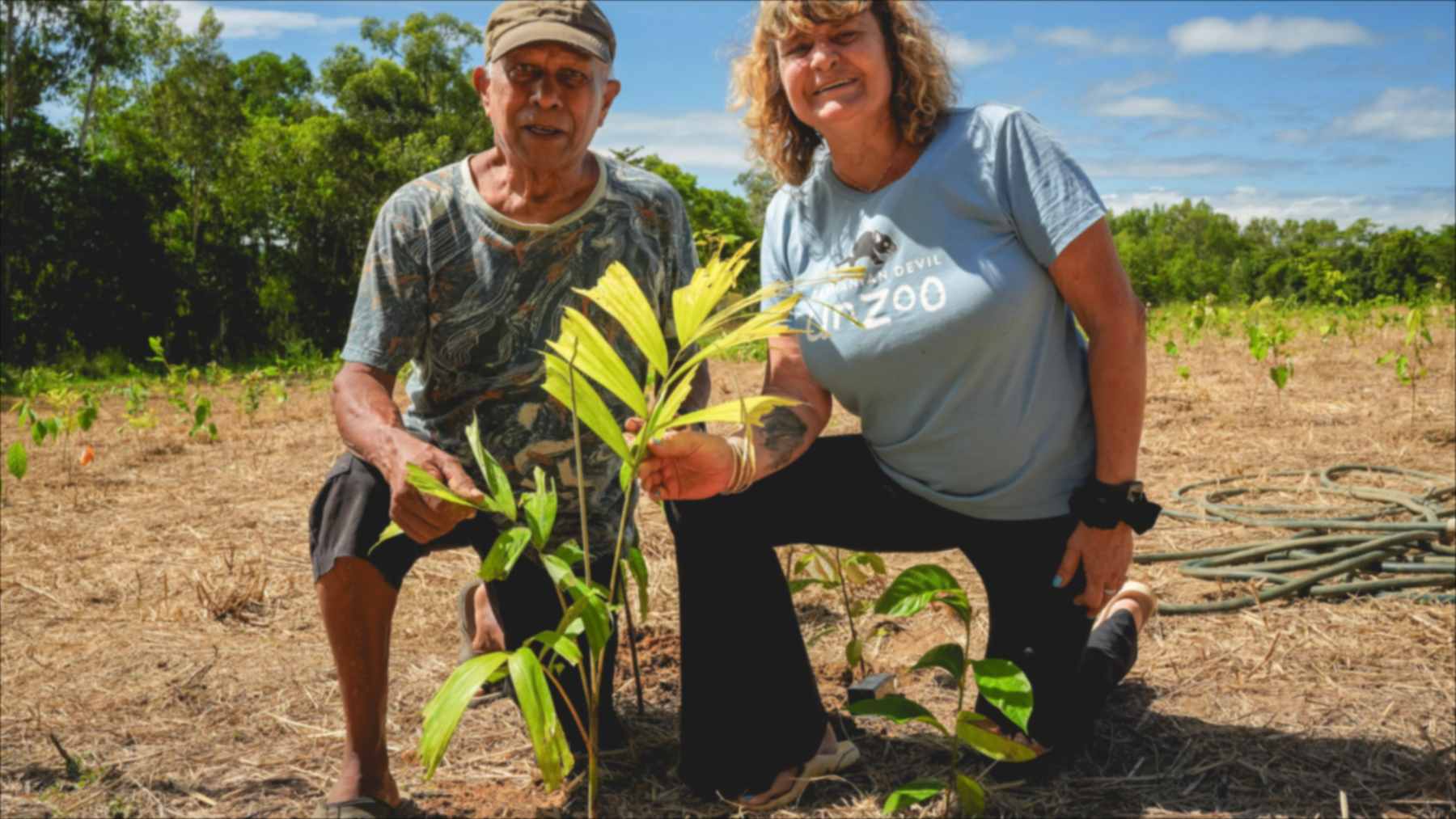
The culmination of this phase arrived on May 17, 2025, when 183 participants planted 3,300 trees. Schoenberger planted a native fig, food for the spectacled flying foxes, while Bennett Walker, an elder and traditional custodian of the eastern Kuku Yalanji people, planted a palm linked to his family’s history.
Each Tree Plays Its Part
Diversity helps explain what is being recovered. In the 2023 planting, 3,300 specimens spanning 90 species were added, including both fast-growing trees and others that require considerably more time to mature.
The early species close the canopy quickly, yield fruit, and contribute leaf litter to the soil. The slower-growing species can remain shaded for years before a light gap opens, allowing the forest to attain different heights and habitats.
That pace explains why the process continues even after the shovels are put away. Finishing the planting does not mean the forest has reached full maturity, because trees grow, seed, and renew themselves at different rates.
Wildlife Finds a Place
In May 2026, Rainforest Rescue reported new observations of spectacled flying foxes and cassowaries shared by Schoenberger. The sanctuary file published by Humane World for Animals Australia also lists inventories with more than 75 fauna species, though this figure cannot prove that all of them arrived thanks to the restoration.
Bats, moreover, participate in the regeneration of the forest. The Queensland Government explains that flying foxes transport pollen and disperse seeds, even far from the tree on which they feed, helping new plants find space to grow.
Water and the Future
The intervention also included the restoration of a wetland. Rainforest Rescue asserts that water-quality tests show a reduction in sediments and turbidity in nearby streams, although its outreach page does not provide figures to quantify the improvement.
The next objective announced is to apply for recognition as a natural refuge when conditions are met. This status would represent a conservation agreement with the Queensland government to protect the property’s natural and cultural values, while allowing compatible uses.
For now, NightWings blends a growing forest with protection for its already-recognized vegetation. The record of the restoration and information about its protection have been published on the project’s official Rainforest Rescue page.
Image: Martin Stringer / Humane World for Animals Australia