
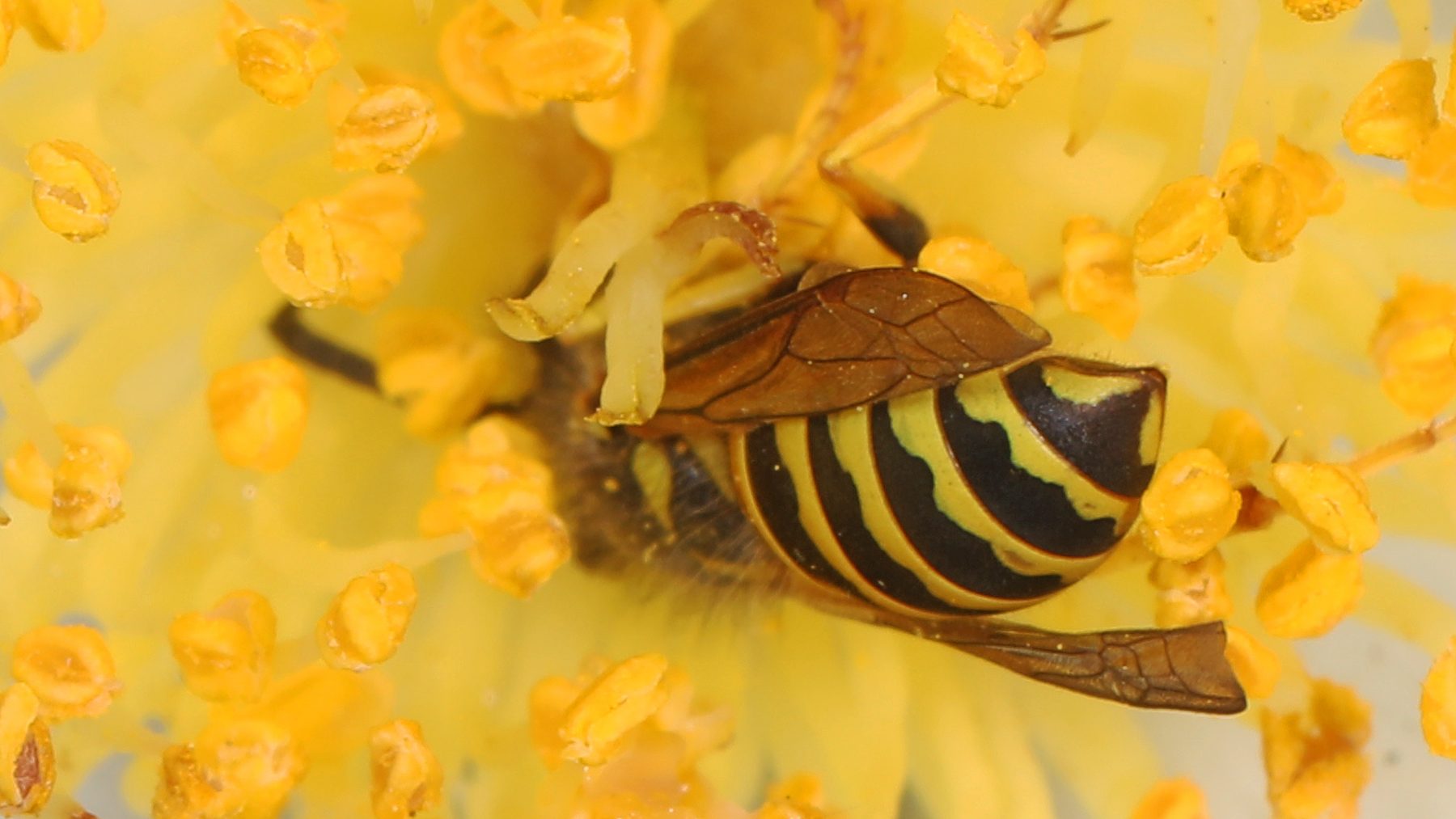
Adam Hintzke, who runs with his wife Chandell the pest-control company Bug Man and Queen Bee in Milwaukee, Wisconsin, treated this year a quarter-acre lot, about 1,000 square meters, with five underground yellowjacket nests.
«Before this year, it would have been very unlikely to find two yellowjacket colonies on the same property in the Milwaukee area,» he told The Washington Post. Since spring, his company has received 30% more calls about yellowjackets.
«Now you see them go after your sodas, your beers, your wines and all that sweet stuff,» Hintzke explained. «That’s why now they’re so bold and everyone notices.»
Empty patios from Madison to Green Bay
About 145 kilometers to the west, near Madison, the outdoor patios at Buck & amp; Honey’s restaurant have stayed empty even on sunny days. «People don’t want to be out there with them,» said its manager, Steph Martin, to the same newspaper. «In the end there were tables that sat outside and then moved inside. Overall, it hasn’t been a good patio summer for us.»
In Green Bay, Corey Vann, general manager of Hagemeister Park, told FOX 11 on September 9: «I’ve been here 15 years and I’ve never seen so many wasps swarming over the tables.» In the United States, people commonly refer to these wasps as “bees.”
On the outskirts of Chicago, Marty Sapiega, a Fox Valley Pest Control technician, told NBC Chicago that «yellowjacket activity has been fairly intense this year. We’ve received many calls about nests in siding, nests in ground-level patios and gardens, and in trees.»
An early spring gave queens an edge
According to experts consulted by The Washington Post, the Midwest had a quick spring, with above-normal temperatures in March and April. That gave the wasps more time to build nests and lay more eggs.
Records support this at least for March. The Midwest Regional Climate Center calculated an average of 5.9°C for the region that month, 3.2°C above the 1991-2020 normal, and it ranked as the eighth warmest March on record.
Chelsea Cook, an assistant professor of Biological Sciences at Marquette University, told WTMJ that an early, mild spring probably gave an edge to the queens and that, without a late cold snap, the colonies had more time to grow.
Colonies that arise from a single queen
Yellowjackets, of the genus Vespula, form annual colonies. Only fertilized queens survive the winter, spending the cold months hidden away and founding a new nest in spring.
«The colony reaches its maximum size in late summer or early fall, which is where we are now,» said P. J. Liesch, an extension entomologist at the University of Wisconsin–Madison, to WUWM on September 17. «That’s why we see so much activity right now.»
The University of Minnesota Extension estimates that a nest can reach about 5,000 wasps at its peak. The Illinois Department of Public Health notes that «more people suffer stings from yellowjackets than from any other type of wasp or bee.»
At the end of summer their diet changes as well. Michael Draney, a biology professor at the University of Wisconsin–Green Bay, summed it up for FOX 11: «Now they’re interested in carbohydrates, and you’ll find them in sodas, birthday cake, and beer. That’s why they’ll concentrate on our picnics.»
When the nest is inside the wall
Some species nest underground, in abandoned rodent burrows, according to the University of Minnesota. Others, such as the German yellowjacket, seek gaps within homes: eaves, cavities beneath the floor, and the interior of walls, according to the Illinois Department of Health.
«Nests inside the house can be especially dangerous, because they sometimes bore through drywall and start entering the living space,» warned Sapiega, who pointed to clues like a buzzing behind the wall or the banging of wasps as they dig.
The most common mistake is sealing the entrance. «It is very important not to seal a live nest. If you do, you’ll force them to seek exits elsewhere, and that could mean inside your home,» the technician said.
Minnesota also warns against using aerosols in the same context. A fact sheet from the Iowa State Extension Service adds that wasps appearing indoors after the first frosts almost always come from a nest in the wall, because they seek the warm side of the wall when food outside runs out.
What the experts recommend
The simplest measure is to eat indoors during the peak. «One of the easiest things to do, because food attracts them so easily, is to limit outdoor meals, if possible,» Liesch told Spectrum News on September 9.
Emily Laub, an evolutionary biologist at the University of Illinois who has spent about eight years studying wasp behavior, reminded The Washington Post that they are not out there «with the aim of spoiling your day.» «They are certainly motivated to protect their home, just as you are to protect yours,» she said.
According to the newspaper, the carbon dioxide in our breath signals the presence of another living being and can trigger their defense. «If I approach a nest too closely to see what’s inside, I actually hold my breath or breathe away from the nest. So move slowly and breathe away from them,» Laub advised.
A Minnesota Extension note dated August 25 urges picking fruit before it softens and removing fallen or rotted fruit, and warns that traps «often capture only a few at a time.»
«If that same nest were tucked away in a far corner of the garden, or about 9 meters up a tree with no one passing by, it’s fine to leave it,» Liesch said, noting that these wasps prey on other insects and also pollinate.
What the figures still do not show
No source provides a count of wasps for this year. Calls to pest-control companies measure complaints, and Sapiega himself said he cannot assure there are more wasps, though «they are certainly causing a lot of trouble for homeowners right now.»
The Washington Post attributes the uptick in part to climate-change-related trends. Liesch is more cautious. «To a point, it’s a bit hard to know. For some questions about what a population does, you have to look at long-term data series,» he told WUWM, though he noted that an early spring would give colonies more time to grow.
Beekeeper Meghan Milbrath, of Michigan State University’s extension service, downplayed it in The Detroit News on October 4: «People talk about wasps and yellowjackets as a nuisance and a plague. It’s something we hear every year from late August through October, until frosts arrive.»
Frost will end the season
According to FOX 11, the number of wasps is already dropping somewhat each day, but the big decline comes with the first hard frost. «Typically sometime in October, but it will depend quite a bit on the weather,» Liesch said, adding that if there isn’t a frost until November, the season could stretch a little longer.
Until then, it’s wise to cover food and drinks, check inside cans before drinking, and not confuse wasp-mimicking insects that are harmless with actual wasps.
The original report on the wasp uptick was published in The Washington Post on September 13, 2026.
The new queens have already mated and will spend the winter hidden. In spring, each will attempt to found its own nest.
Image: Judy Gallagher / Wikimedia Commons (CC BY 2.0)