
“When he asked me to design his house, he said: ‘Can you use as much hemp as possible?’” said designer Joost Bakker on April 23, 2026, during a webinar hosted by the iHemp NSW association. He spoke about Zac Efron and “Futurecave,” the residence the actor is building on a 128-hectare rainforest estate in New South Wales, Australia.
The house, located near Byron Bay in Tweed Shire, envisions around 2,200 lime-free hemp blocks bound with oyster shells, in addition to carpentry, mattresses, curtains, and textiles made from the same material, according to Australian and specialist press. Bakker’s aim is to repurpose waste such as oyster shells and replace conventional concrete and quarry lime with renewable materials.
Six bedrooms in modular units with green roofs
The design spaces the six bedrooms across independent modules, connected by exterior walkways, each with its own bathroom and with green roofs that bring vegetation back to the landscape. Planning documents, cited by Daily Mail Australia, describe architect Frank Burridge’s project as a house “that sequesters carbon and creates habitat.”
Efron bought the land in 2020. In remarks to the Australian Financial Review, cited by the agency BANG Showbiz, he explained that his number-one goal is “to always take time for myself, rest, recharge, and be in nature as much as possible, as close to the earth as I can get.”
The actor met Bakker in 2021 while filming the Netflix series “Down to Earth.” The designer is known for his “Future Food System” installations—zero-waste experimental homes designed to house their occupants and produce their own food, such as the one he built in Federation Square, Melbourne, between 2021 and 2022.
Hemp blocks bound with oyster shells
The so-called “hempcrete,” or hemp concrete, blends the woody portion of the hemp stem with water and a binder, which typically is lime. In Efron’s house, the blocks for interior walls use an oyster-shell binder developed with the Shuck Don’t Chuck shell-recycling program as a potential substitute for quarry lime, and as of May they were still undergoing testing, according to HempBuild Magazine.
“Over the past year we have experimented with hemp blocks, replacing concrete with two materials that heal the environment: hemp, perhaps the planet’s best plant for repairing and restoring soil health, and, of course, oysters,” Bakker wrote on Instagram in November 2025, according to U.S. television station KATU.
At the seminar he summed it up with a simple image. “I love the idea that hemp has restored the soil and that oysters have restored the reef. From that perspective, I think it’s an incredibly sustainable way to build,” he said.
A house designed to combat mold in the heart of the jungle
The choice also has health reasons. According to Bakker in the seminar, the actor suffered a mold poisoning that left him gravely ill, and the estate receives about 3.5 meters of rain per year. “If you’re worried about mold, there’s nothing better than hempcrete or these hemp blocks. It’s impossible. Mold can’t grow on them,” Bakker stated.
“I actually think a house is like a human being. If I wear waterproof clothing that doesn’t breathe, I start to sweat. A house isn’t any different,” added the designer, highlighting that hemp blocks can absorb water and also release it.
The rest of the materials follow the same logic, with a natural cork exterior finish sourced from the Italian company Diasen, made from wine-cork waste, and New Zealand wool used as insulation for the roof. “Basically, I don’t use materials that can’t be recycled,” Bakker summarized.
Kitchens built from 100% hemp board
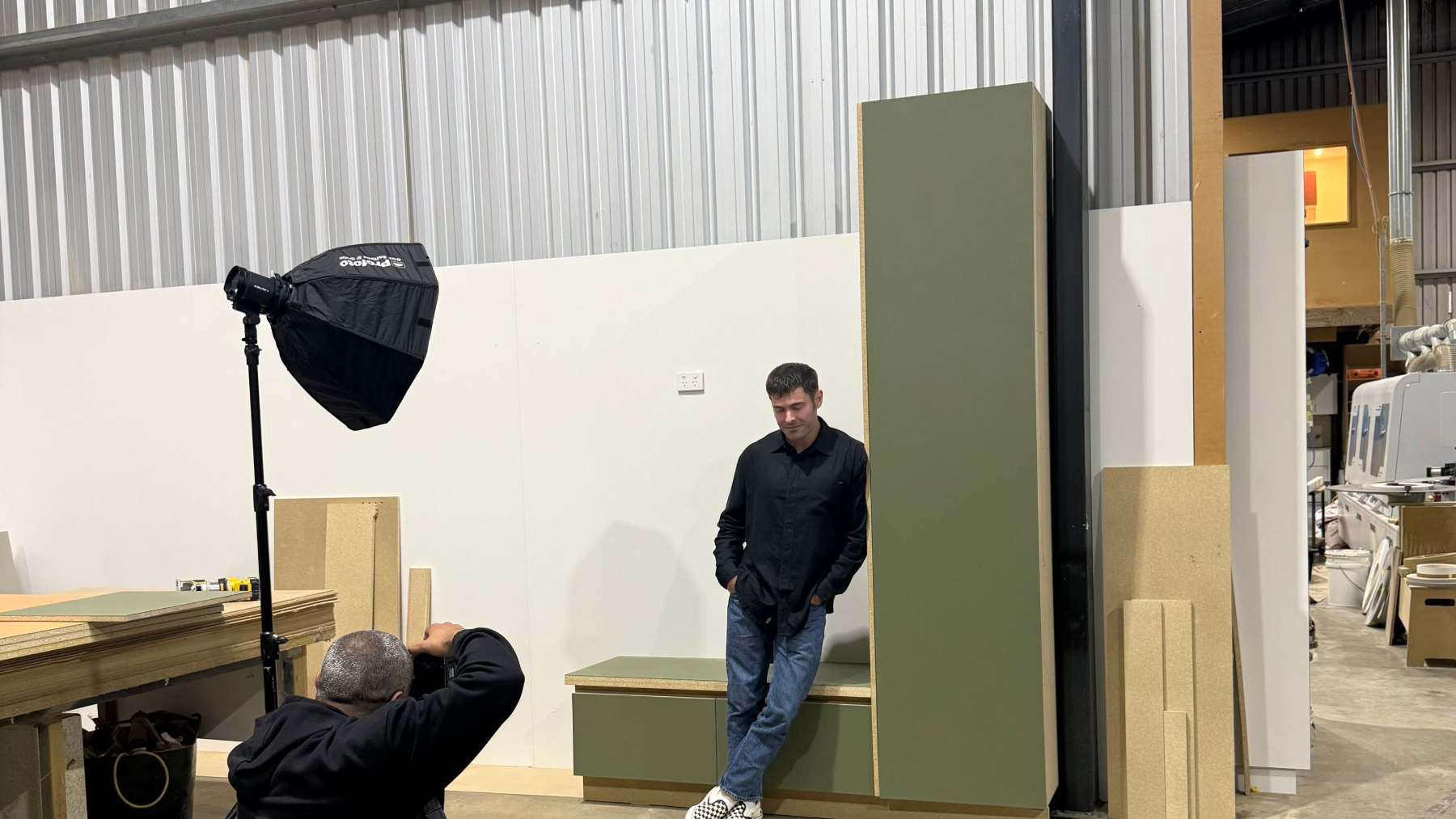
Kitchen and bathroom furniture is manufactured in Hastings on the Mornington Peninsula (Victoria). There, Burmak Cabinets, a family business founded 20 years ago and led by Brad Kyle, works with Australia’s first 100% hemp board, for which it holds exclusive rights, according to the local Mornington Peninsula Magazine.
Efron visited the plant with Bakker, spent hours talking with the workers, and remained into the afternoon to observe the process, the magazine says, adding that the actor committed to using their joinery in the house. Several outlets, citing a May 22 Instagram post by Bakker and Plantbord, estimate 200 hemp-plant boards from that brand for the kitchen and bathrooms.
In Burmak’s hemp board, the thick fibers from hemp grown in Australia form the core while the finer fibers make up the outer face. The same magazine notes that the plant takes only about 100 days to go from seed to harvest.
Hempcrete insulates partitions and steel supports the structure
These blocks are used in walls that do not bear the building’s loads, which in Efron’s house are the interior partitions. The pavilions feature a steel structure, according to planning documents cited by Daily Mail Australia.
What the material does provide is wall insulation. Florence Collet and Sylvie Prétot of the French LGCGM laboratory measured the thermal conductivity of hempcrete walls, finding values between 90 and 160 mW/(m·K) at 23 °C and 50% relative humidity. Thermal conductivity measures how much heat a material passes through, and the lower the value, the better the insulation.
The study, published in 2014 in Construction and Building Materials, found that density weighs far more than moisture. Conductivity rises by about 54% when density increases by two-thirds, and by less than 15–20% when moving from a dry material to 90% relative humidity.
A carbon balance that hinges on the binder
Hemp absorbs CO2 as it grows, and part of that carbon remains stored in plant-based construction materials, which explains much of the interest in using it for long-lasting walls.
A 2017 life-cycle analysis published in the Journal of Cleaner Production by Alessandro Arrigoni and other Italian researchers evaluated a non-load-bearing hempcrete block wall. “The overall emissions balance is very favorable,” the authors write, because thanks to CO2 captured during cultivation and the carbonation of the binder, “hempcrete blocks have a negative carbon footprint.”
The same study notes that the production of raw materials is the main source of impacts and that transport distance and the amount and composition of the binder can greatly alter results. After 240 days, only the outer layers of the blocks showed significant carbonation, and the analysis excluded the end-of-life phase due to a lack of reliable data.
What remains to be verified
Those results correspond to lime-bonded blocks and do not certify the carbon footprint of Efron’s house, whose oyster-shell binder was still under testing in May. No data have yet been published on energy use, indoor humidity, or the building’s performance once inhabited.
Bakker announced in May 2026 on Instagram that construction had begun, and by late 2025 there were plans to finish in September 2026. Regarding the material’s future, the designer remained optimistic: “I truly believe that in ten years we will look back and see a thriving industry.”
The details of the house were presented by Bakker at the iHemp NSW webinar on April 23, 2026, which HempBuild Magazine picked up on May 14, 2026.
Imagen: Burmak Cabinets